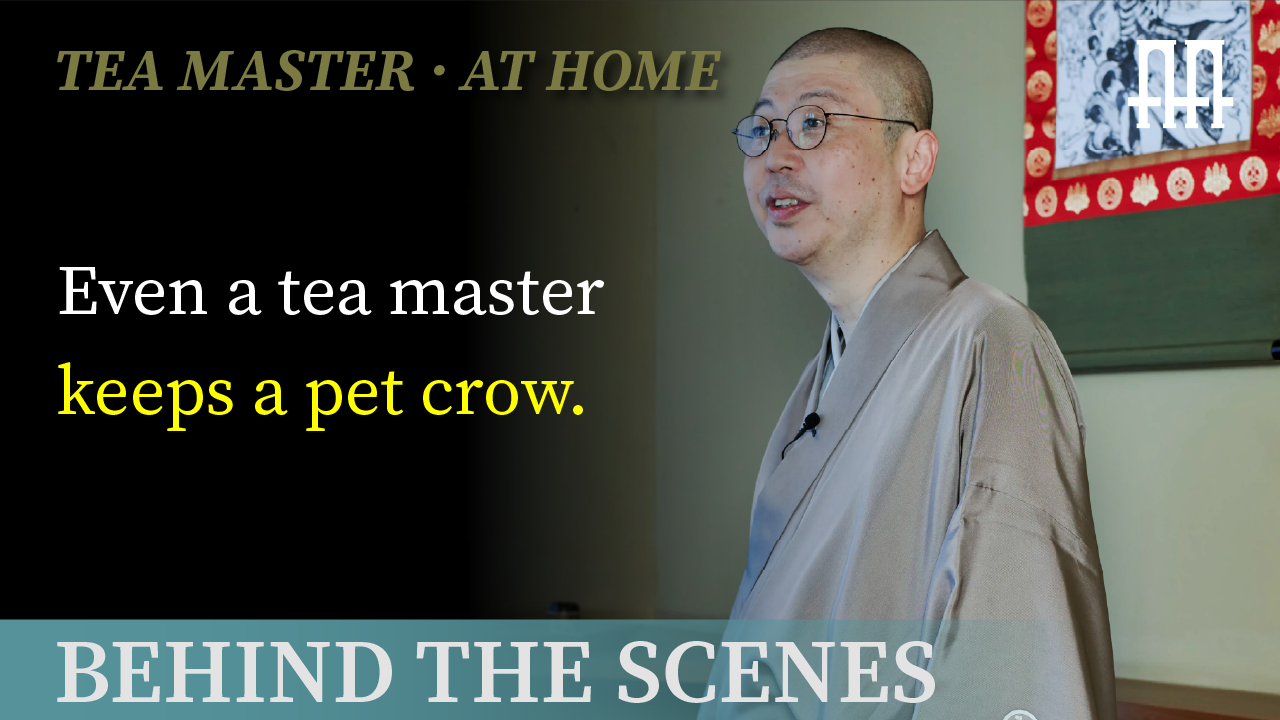
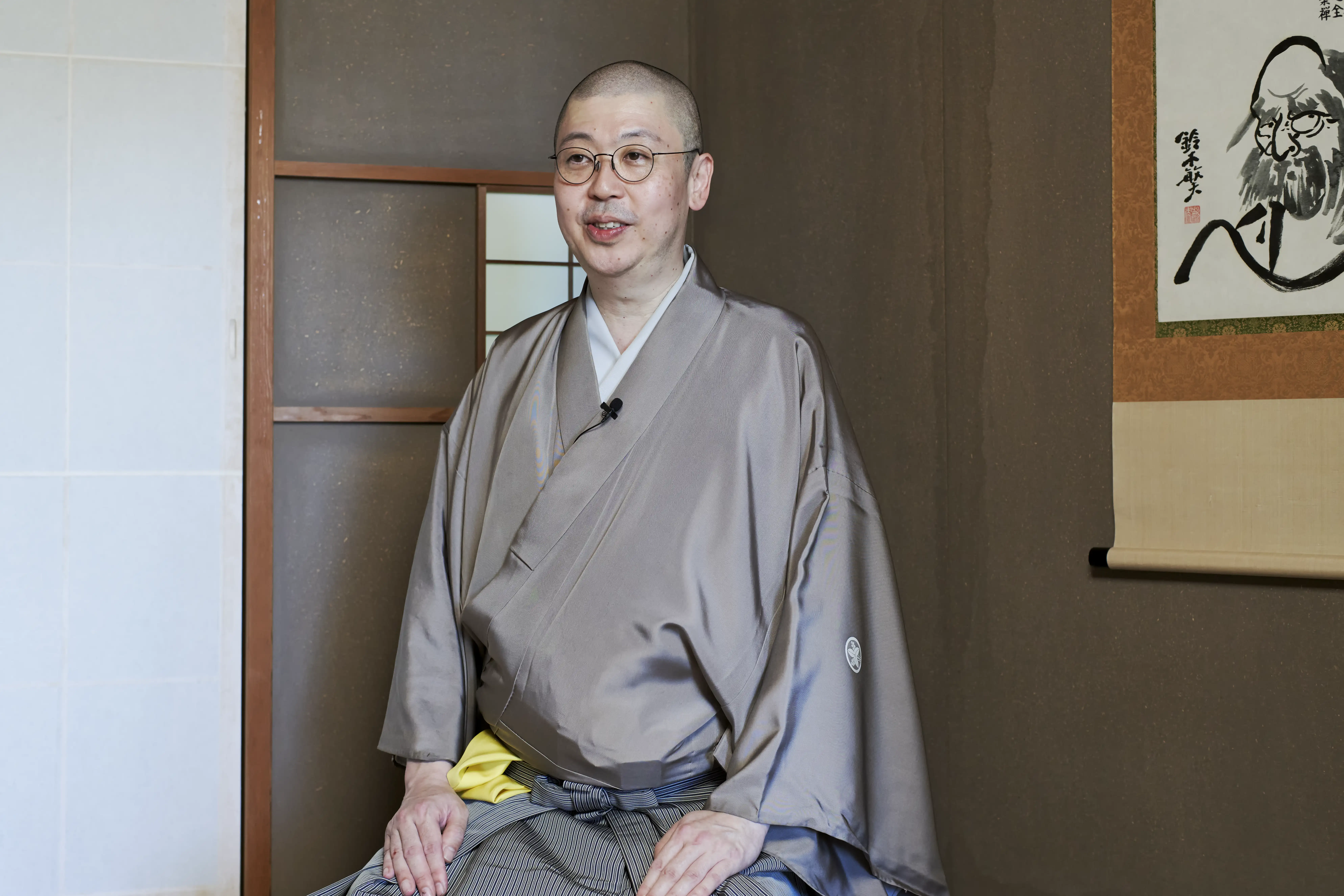
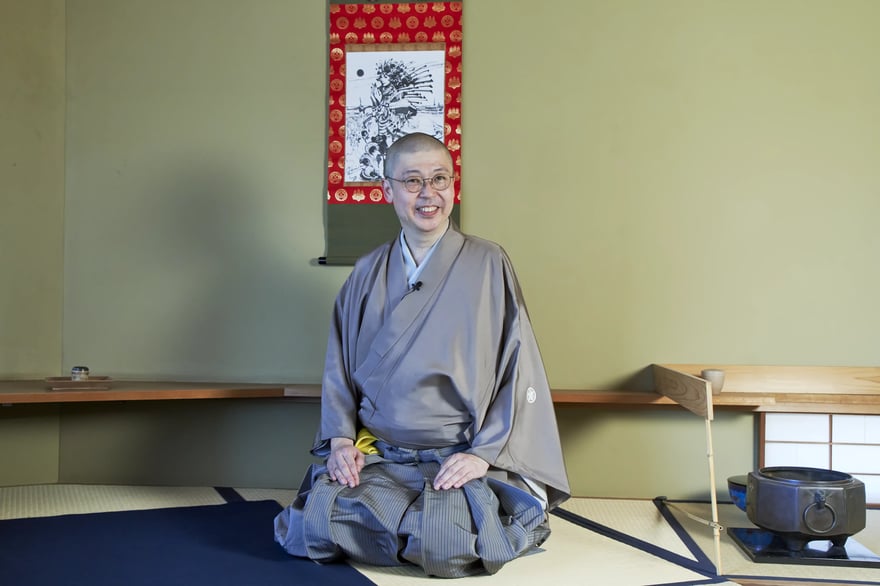
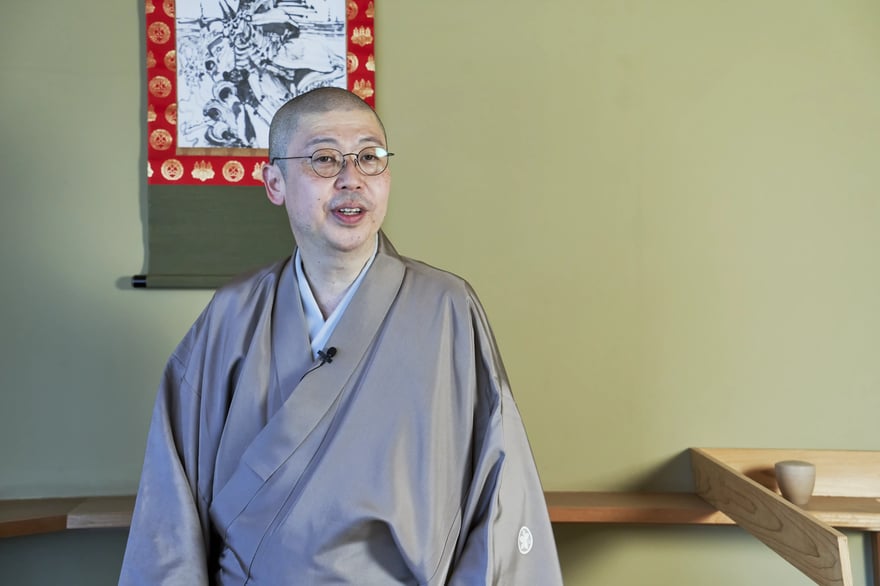
A single hanging scroll hung in the room where this interview took place — a painting of Daruma by Studio Ghibli producer Suzuki Toshio, inscribed by a Daitokuji monk. As the conversation went on, it became clear that the various utensils in the room all mirrored, in their own way, this man's thinking about tea. Whether he spoke of history or of his own path, Sokou Udagawa's tone stayed even throughout, never rushing toward a conclusion. Choosing his words, laughing now and then, tracing his memory slowly — his manner seemed to overlap, somehow, with the sense of unhurried pause he says he values in chaji — a full tea gathering that unfolds over several hours, from a charcoal ceremony through a kaiseki meal to a shared bowl of thick tea.
Sokou Udagawa is the 18th head of the Sowa school of tea, an advisor to the Nezu Museum, and the proprietor of Sokkon and Yobanashi Sahan, two venues where guests can experience chaji firsthand; he is also the author of Nantonaku Wakaru Cha no Yu (roughly, "A Feel for the Way of Tea"). Across three sittings, we spoke with him about the history of tea — from the Heian and Kamakura periods through the age of the warring states and the Meiji Restoration to the present — about a childhood steeped in tea and incense, and about the thinking he brings to chaji itself.
For most people, the tea ceremony is familiar as a discipline of lessons and manners, but few ever encounter what lies beyond it: chaji, the entire day of inviting friends, receiving them, and seeing them off. Asking him to talk about chaji rather than temae — the formal procedures of serving tea — was the single question we kept returning to throughout.
A Life Steeped in Tea from the Start
Udagawa didn't choose tea, he says, so much as find it already there — part of the air around him before he was old enough to remember choosing anything.
Toguri: What first brought you into this world, as a child?
Udagawa: My grandmother's influence was strong — I was very much her grandson. The head of the Shino school of incense and tea used to visit her often, and I started tagging along. From the age of two or three, I was picking up tea naturally; someone would say, "You made a lovely sound there," and I loved it, so I'd imitate them, whisking tea myself. There was always a banquet at the end of an incense gathering or a tea gathering, and if I went around pouring drinks, the grown-ups would make a fuss over me. As a child, that alone made me happy.
It might be closer to say it entered his body naturally, as a place where he was surrounded by adults and doted on, rather than as tea learned as tea. He recalls himself, at the time, as a child who liked period dramas and didn't play outside much. It wasn't that tea itself mattered so much — it was simply part of ordinary life.
But this everyday world broke off at some point. When the previous head of the Shino school's wife passed away, he stepped away from practice, and by the time he reached high school, he'd drifted from it almost entirely. It was entering university and joining the tea ceremony club that brought him back to tea — and it was there that he met his teacher, Hori Soyu, of the Sowa school.
Toguri: You encountered the Sowa school at university. What did you learn there?
Udagawa: Hori Soyu taught me not just temae but the tea utensils themselves. I think that's when my interest in the objects themselves began. Around the same time, a connection through the university tea ceremony club led me to a part-time job at the Nezu Museum, which also deepened my interest in the utensils.
Even after graduating, Udagawa says again and again, he had no intention of making tea his profession. Behind that lay his grandmother's own way of living.
Toguri: Did you intend, from the start, to make tea your profession?
Udagawa: No, if anything, the opposite. My grandmother herself held a teaching certificate in incense but never taught — she'd invite whoever she liked and enjoy it however she pleased, in the manner of what we'd now call a sukisha, an amateur connoisseur who pursues tea and its arts purely for personal enjoyment, without teaching or profession. I leaned the same way — I thought that turning it into work would bring obligations, and I'd lose the ability to enjoy it as a hobby. In fact, I had no intention of making a career of art either, but a connection at the time of my graduation led to a job at the Nezu Museum. Even there, though, I worked in administration rather than in art itself, so I meant to keep some distance.
But that distance would close in a way he never expected.
Toguri: How did you come to be a teacher within the Sowa school?
Udagawa: I had no intention of becoming a teacher, but my own teacher at the time fell ill, with an autumn tea gathering approaching, and the question came up of what to do with the students. A few of us teachers split the responsibility between us. At that point I still thought my teacher would be back once the gathering was over — but the day before it, she passed away. In the end, I simply inherited the role of teaching her students.
Naturally, Udagawa says, he had doubts about teaching others while still a student himself. It was a conversation with Izumida Rōshi, of Shogen-in at Daitokuji, that gave those doubts an answer.
Toguri: How did that uncertainty resolve itself?
Udagawa: While I was doing sanzen — sitting in Zen practice with him — he spoke to me about Hinayana and Mahayana Buddhism. Hinayana holds that if you're still in training yourself, it isn't your place to be helping others. Mahayana, on the other hand, holds that even if the boat sinks and you're drowning too, even if you couldn't reach the shore alone, two people swimming together might make it. Even if I was still unfinished myself, we could simply learn together. Hearing that changed how I understood teaching.
What this exchange captures is a posture: not standing as an authority handing something down from above, but walking alongside his students as a lifelong learner himself. That same posture carries through into how he relates to the Sowa school itself.
Toguri: Is there something you particularly value within the Sowa school?
Udagawa: There's certainly a devotion to the aesthetics of temae and utensils, but compared to wabicha — a style of tea gathering that prizes rustic simplicity and quiet imperfection over display — I think there's something more flexible here, less bound by fixed forms. It was also a school that caught on among court nobles, so I think it developed by combining all sorts of culture — burning incense, drawing on the themes of waka poetry — into a single pleasure.
Toguri: How do you think about your own individuality?
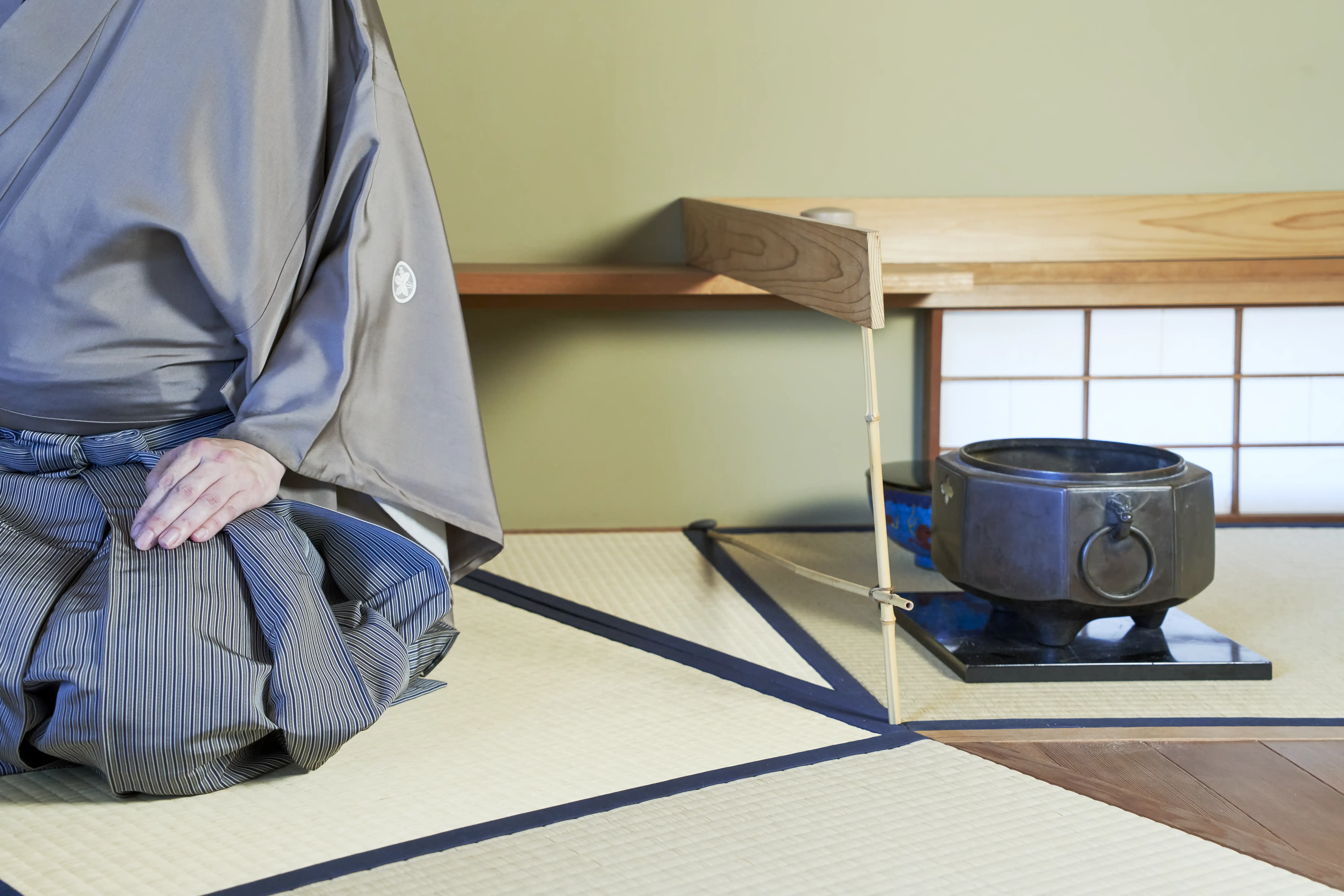
Udagawa: My own activity centers on chaji, and in chaji especially, I think it's better for the teishu — the host who prepares and leads the gathering — to come through, more than the character of any particular school. You learn the forms and the rules, and then bring out your own taste in utensils. For me, that might mean building a chaji around a Noh theme, since I love Noh. Around the Meiji Restoration, it seems there were tea masters serving liver and bacon as part of kaiseki, and I think taking in new materials and techniques, era by era, is really what the way of tea has always done.
This trust in flexibility overlaps with a broader refusal, throughout his life, to settle into any single fixed form. That same posture shows up later, in his taking tokudo — Buddhist ordination — at Shinjuan, Daitokuji. In honor of the name given to him there, Kan'asai, "cold crow," Udagawa keeps an actual crow at home. What's compressed into this is a path walked not as a master born into one house of the Sowa school, but as a single seeker who has kept facing tea, again and again, on his own terms.
"Kan'asai — 'cold crow.' I keep an actual crow at home."
— Sokou Udagawa
What Is Chaji? Tea's Long Road From Ritual to Hospitality
For most people, the tea ceremony is familiar, but the word chaji itself is not. Asked about this distinction, Udagawa began by simply defining what chaji actually is.
Toguri: To start, what exactly is a chaji?
Udagawa: Tea, originally, was something like a house party for friends. These days, people tend to picture a tea gathering as performing temae in front of a large crowd, but originally it meant inviting four or five friends to your home and laying charcoal to heat water. While the water heats, you serve food and sake; once it's boiled, you pass around a single bowl of koicha, tea whisked thick almost like a paste, for everyone to drink from in turn. After that comes usucha, and then the gathering closes. This whole sequence — inviting guests, receiving them, and seeing them off after tea — is chaji.
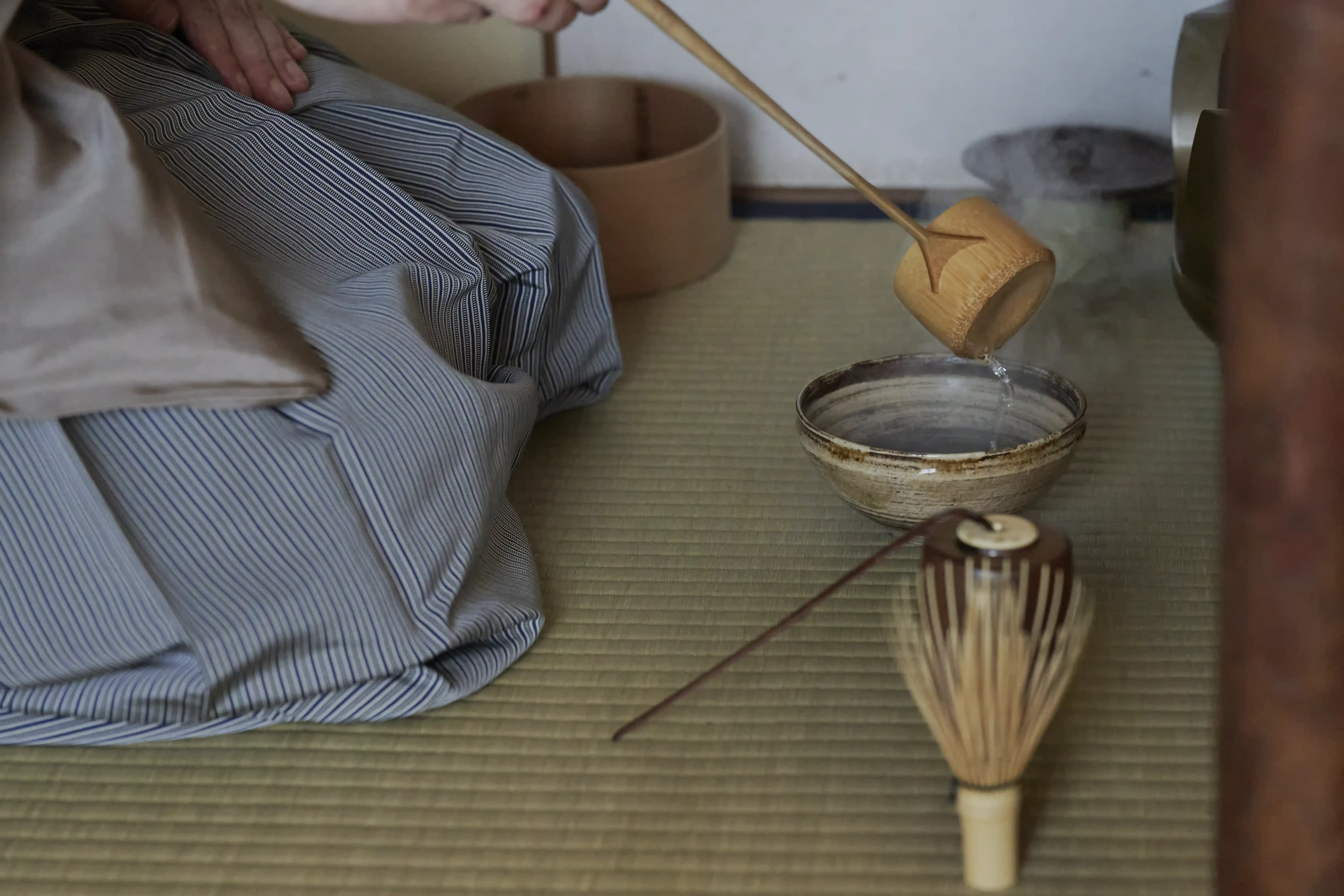
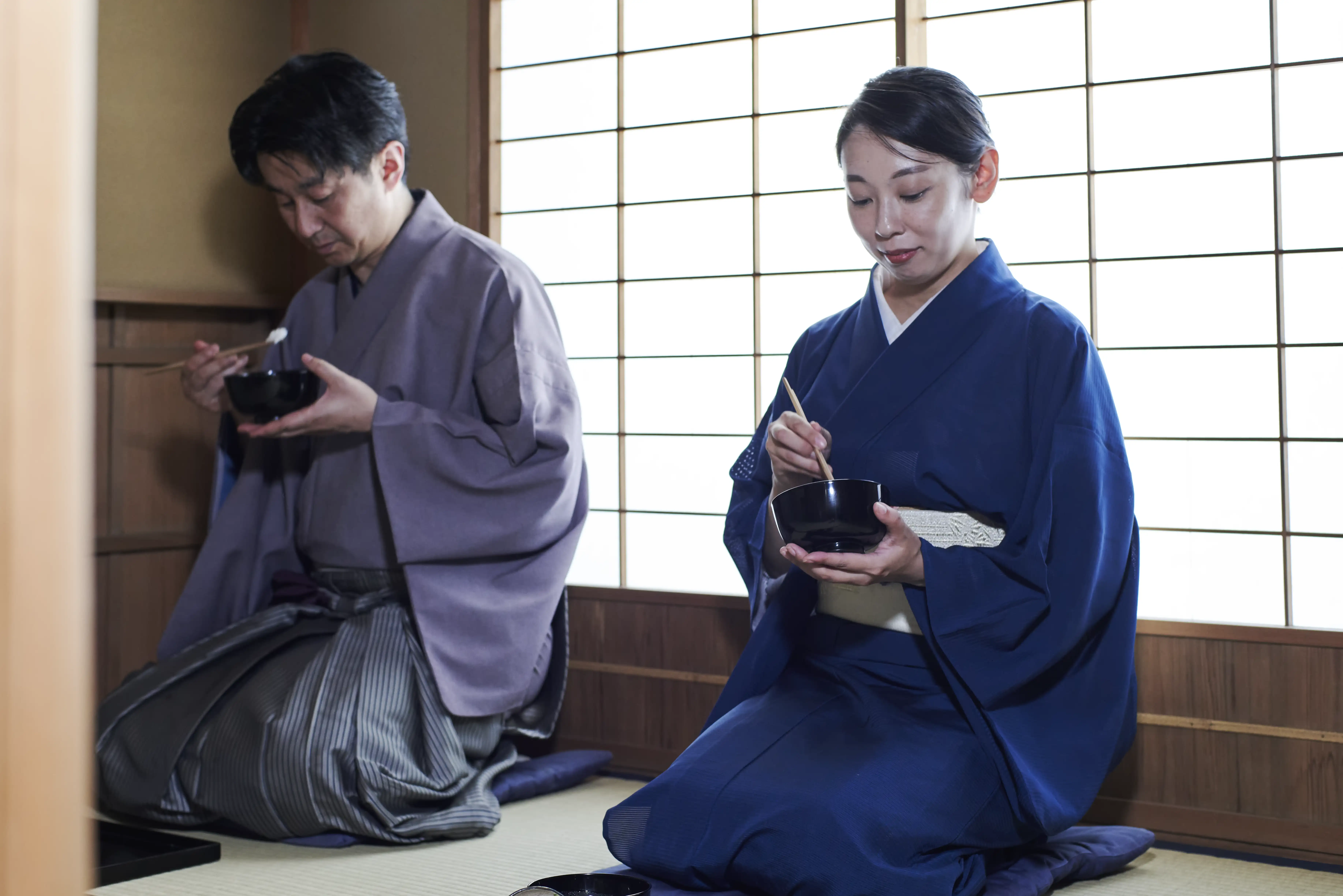
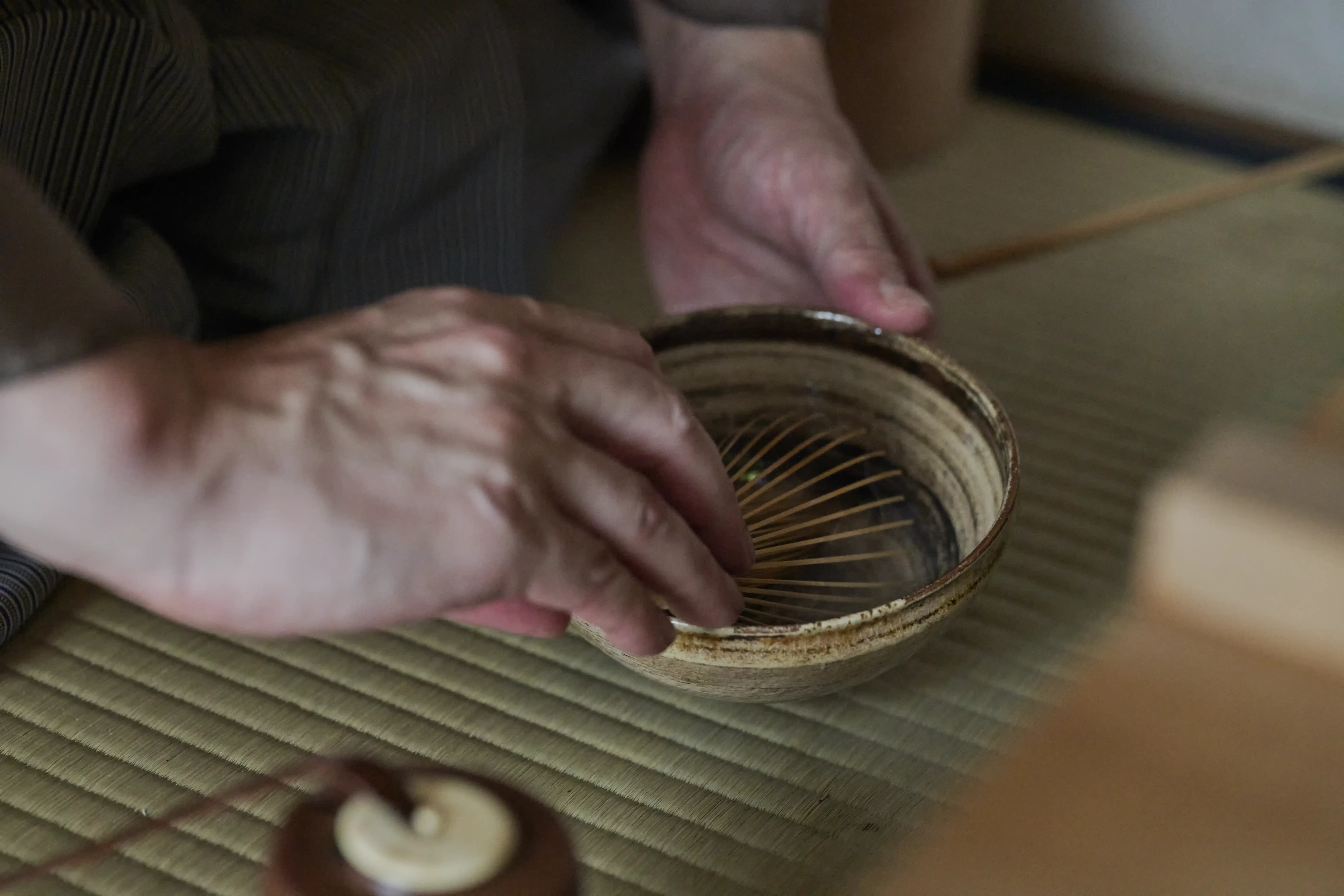
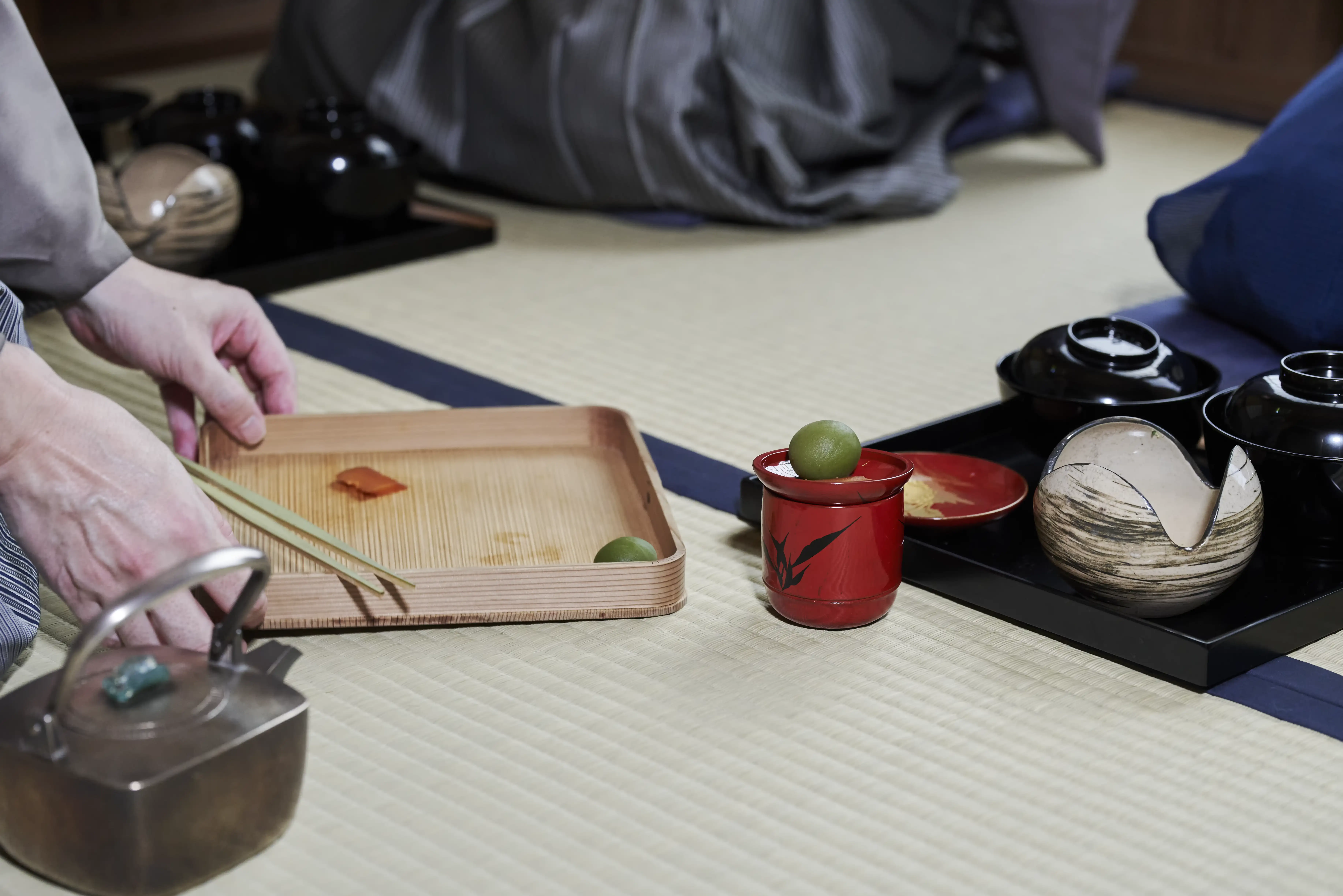
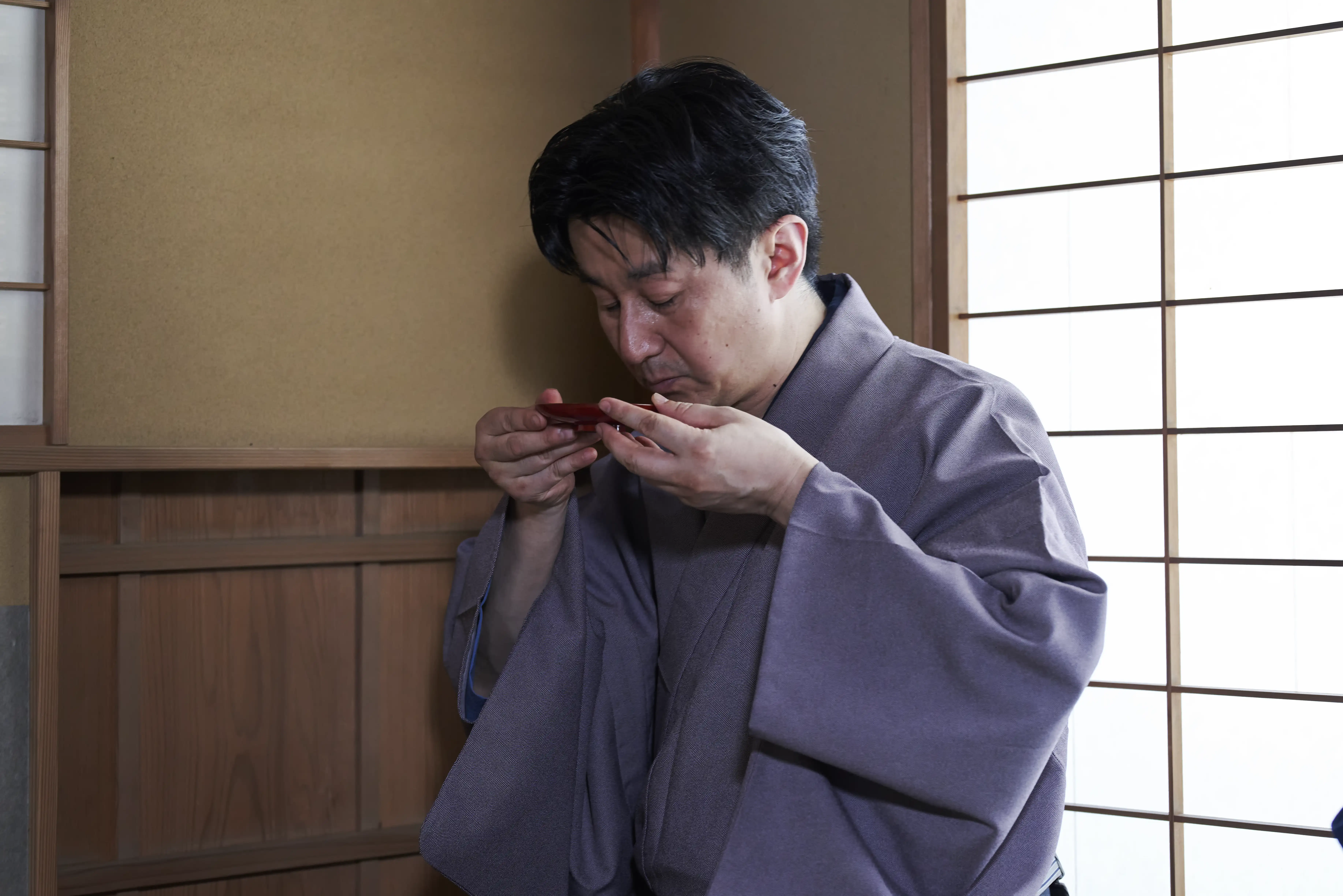
Today, in most schools, chaji is treated as the ultimate goal that practice builds toward. But Udagawa sees the order the other way around: chaji didn't come after practice — it must have come first. Understanding that means tracing where tea itself came from.
Toguri: Going back through the history of tea itself, when and how did it first arrive in Japan?
Udagawa: The tea plant itself originally came from China, and the culture of drinking it was transmitted to Japan along with it. There are theories placing this earlier, but the common account credits the Zen priest Eisai with bringing it back together with Zen. This culture of tea-drinking was eventually presented to the shogun, and there's an anecdote that it spread in popularity because it was said to help with hangovers.
This imported culture would go on to develop, among the flamboyant basara daimyō, into a kind of sophisticated pastime.
Toguri: I understand there was a culture called tōcha — could you tell us what that was?
Udagawa: The Japanese of that era loved imported culture too, and they drank tea while displaying valuable treasures alongside it — Zen, the cutting edge of culture at the time, and paintings and artworks from Song-dynasty China. Tea from Uji, in Kyoto, was called honcha, "true tea," and everything else was hicha, "not tea," and people played a game of guessing which was which. Guess correctly and you'd win a lavish prize — and this became a tremendous fad known as tōcha.
Tōcha eventually cooled, and under the Ashikaga shogunate, tea and art objects came to carry the weight of a symbol of power. It's on this same trajectory, Udagawa explains, that the idea of hospitality — of thinking of the other person — began to grow.
Toguri: What lay behind tea's development as a culture of hospitality?
Udagawa: The Ashikaga shogunate's practice of displaying imported cultural treasures, art, and tea jars gradually became a symbol of power. Oda Nobunaga, too, tried to show that he was the rightful heir to that power by treasuring the utensils the Ashikaga shoguns had owned. In the midst of this, the influence of Zen and a distinctly Japanese sensibility drawn from waka and renga poetry worked their way in, and I think that's where the idea of truly considering the other person, and how to receive them, began to take root.
This distinctly Japanese sensibility crystallized into wabicha, said to have begun with Murata Jukō.
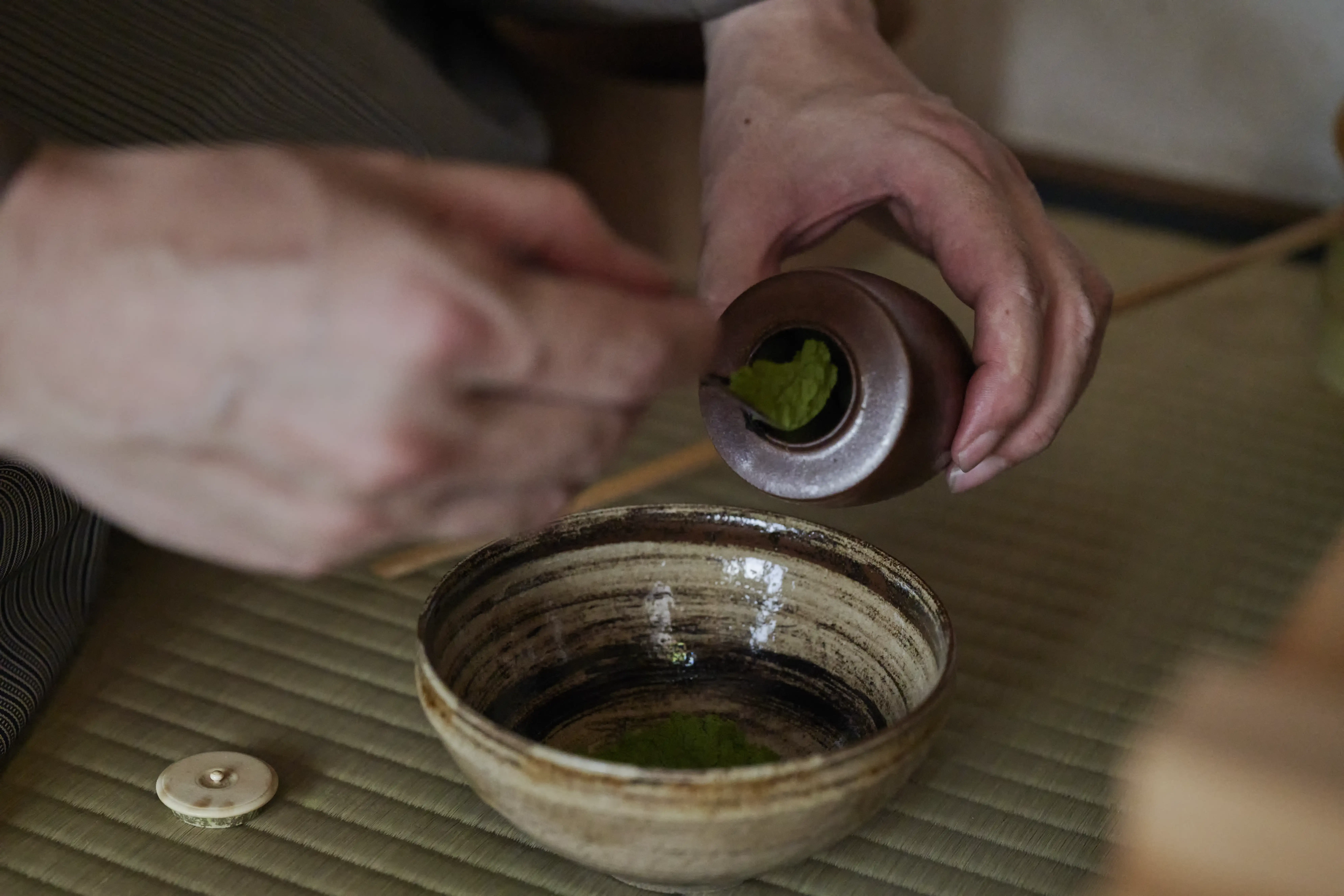
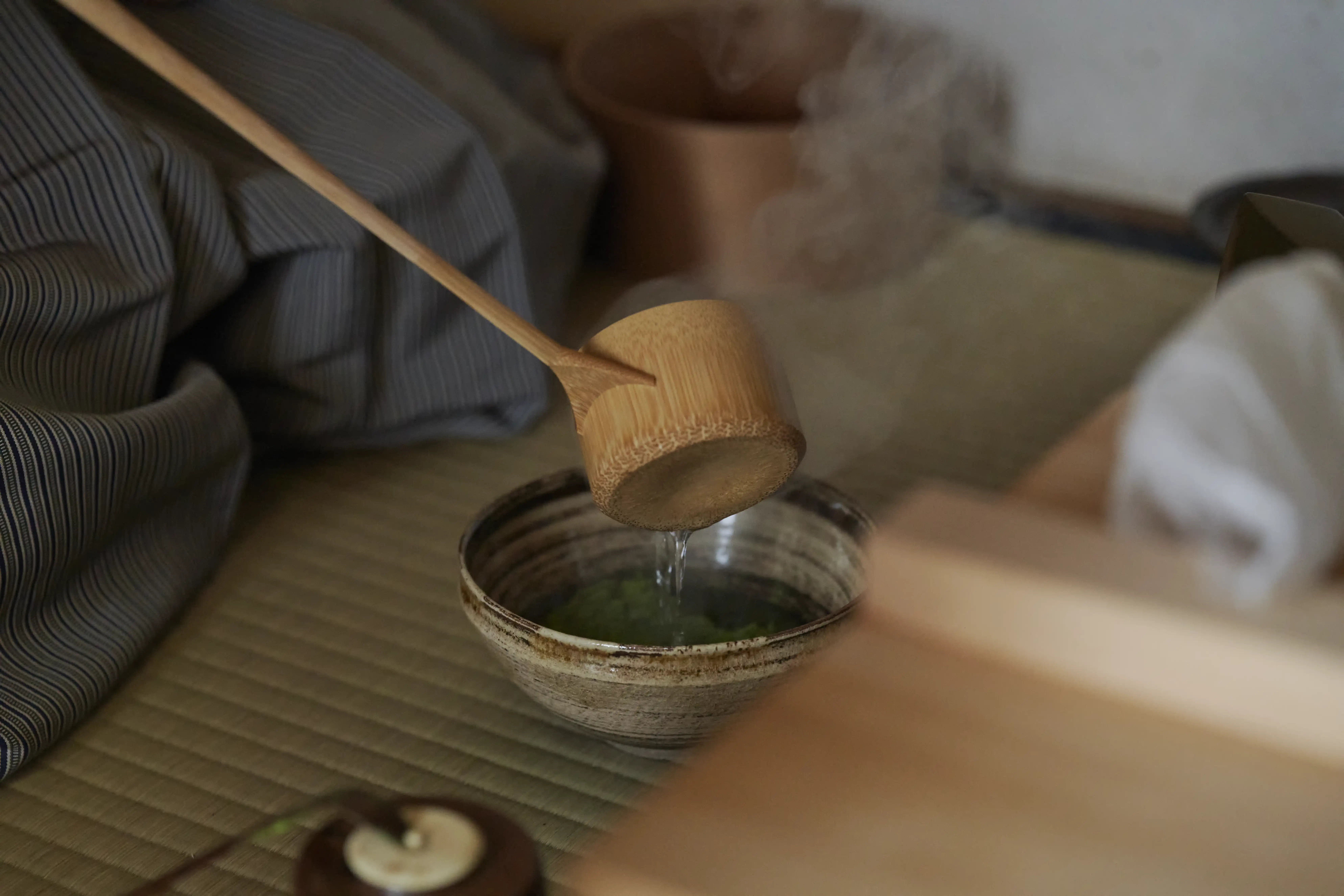
Toguri: What, specifically, is wabicha?
Udagawa: Where the Ashikaga shogun's tea meant displaying art imported from China in a formal study, wabicha is said to have begun with Murata Jukō — a student of Ikkyū — as a distinctly Japanese form of tea. This coincided with a period when Japanese expression was shifting from Chinese poetry toward waka, and a sensibility that wove in a kind of quiet melancholy, rather than showiness, along with the spiritual bent of Zen, was absorbed into it. People often illustrate it with a particular waka: cherry blossoms in full bloom, or hills ablaze with autumn color, are nowhere in sight — only a fisherman's hut on the shore, in the dusk of an autumn evening. Beauty found not in something obviously beautiful, but in a hut standing alone once the leaves have all fallen, as the sun goes down. That is the heart of wabi, and the sensibility of wabicha.
The wabicha that Jukō began was systematized, through Takeno Jōō, in the generation of Sen no Rikyū, and then split, in the generation of Rikyū's grandson Sen no Sōtan's children, into the three Senke schools. In this branching, Udagawa sees the differing circumstances each tea master found themselves in.
Toguri: I understand there were also lineages of tea rooted in the samurai class and the court nobility, beyond the three Senke schools.
Udagawa: Yes. After Rikyū's death, warrior-tea masters such as Furuta Oribe and Kobori Enshū were active, and a lavish banquet style of hospitality tea for entertaining the shogun, known as onari no cha, developed. There was also tea that became fashionable among the court nobility. Rather than devoting themselves entirely to wabicha, court nobles tended to enjoy tea as one pastime among many — composing waka for a whole day, playing go or kemari, holding a banquet in the evening.
Having branched out over the centuries this way, accumulating a rich thickness of culture, tea would be forced, with the Meiji Restoration, into an entirely different shape.
Toguri: How did the culture of tea change after the Meiji Restoration?
Udagawa: Until then, the people known as tea masters served as sadō, kept by daimyō, drawing a stipend while assisting their lord or teaching tea to those with a serious interest. But with the Meiji Restoration, the daimyō disappeared, and even the great financial houses of the time had their eyes turned more toward Western culture than Japanese, so many households fell into hardship. Urasenke and others led the way in spreading tea widely, through school education, to the general public — women in particular. As a result, I think, its character as etiquette instruction and bridal training grew stronger.
Tea, which had been a place for entertaining acquaintances, shifted its center of gravity toward a place for acquiring manners — and much of what we know today as "the tea ceremony" extends from that history. And what faded, in its shadow, was chaji itself, Udagawa says.
Toguri: Among people studying the tea ceremony today, are there few who have actually experienced a chaji?
Udagawa: It's true that every school says the ultimate purpose of studying tea is chaji, but not many people are actually doing it. If anything, the practice of holding a chaji at all has become genuinely rare now. That's exactly why I want to create more opportunities for people to encounter chaji, even briefly.
Toward a Single Bowl: The Architecture of a Chaji
Udagawa described the day of a chaji with startling specificity — almost like the running order for a stage production.
Toguri: How does the day of a chaji actually unfold?
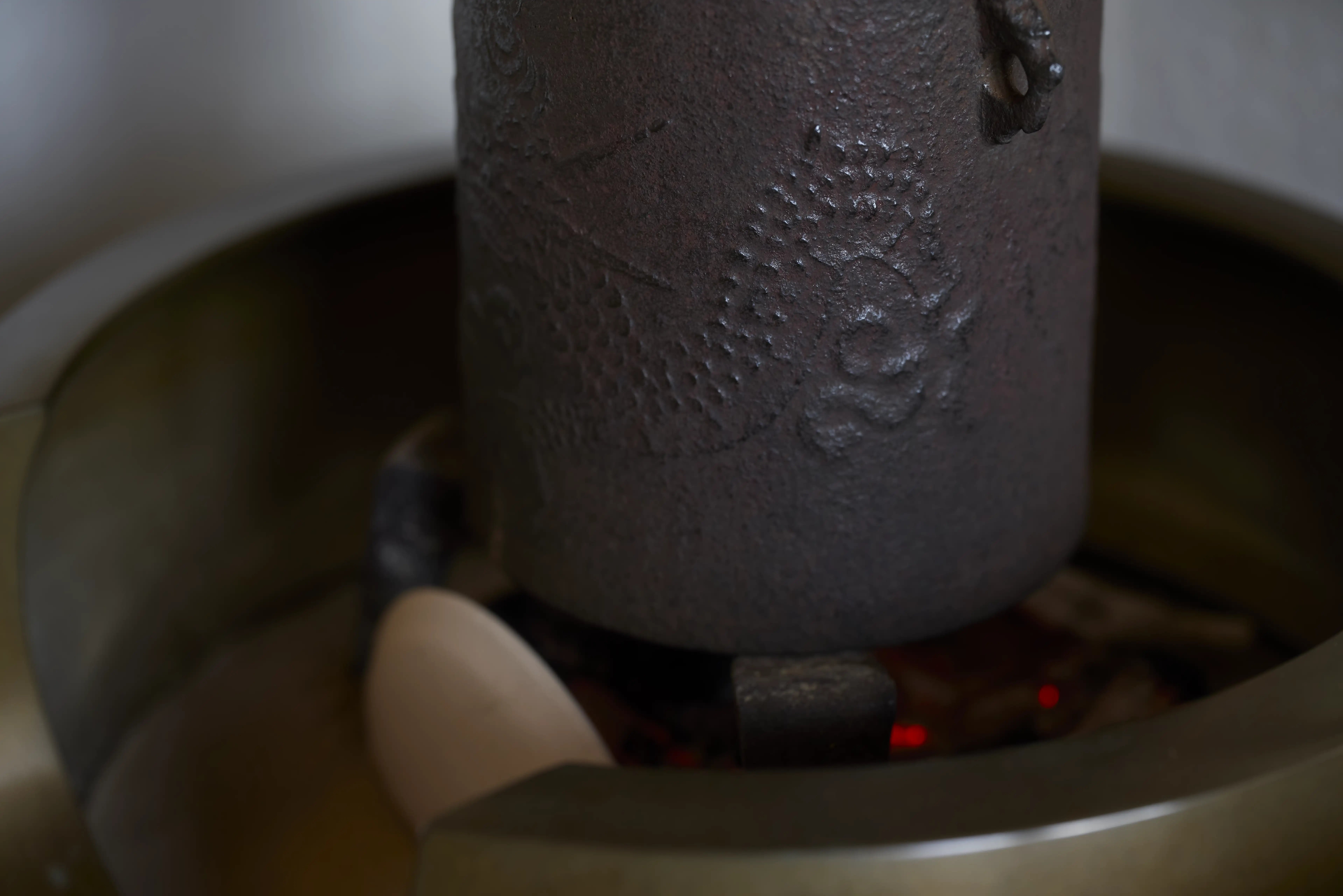
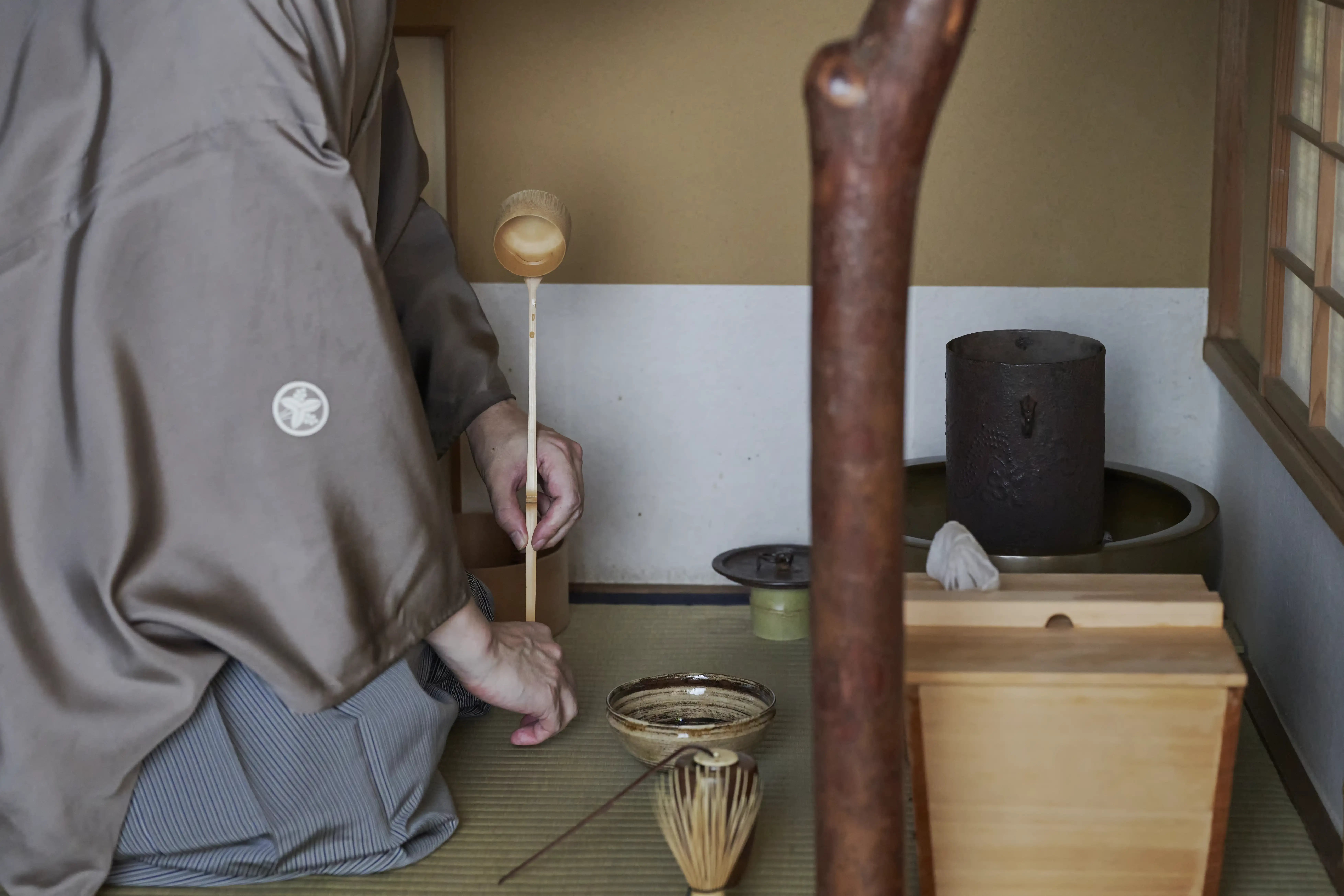
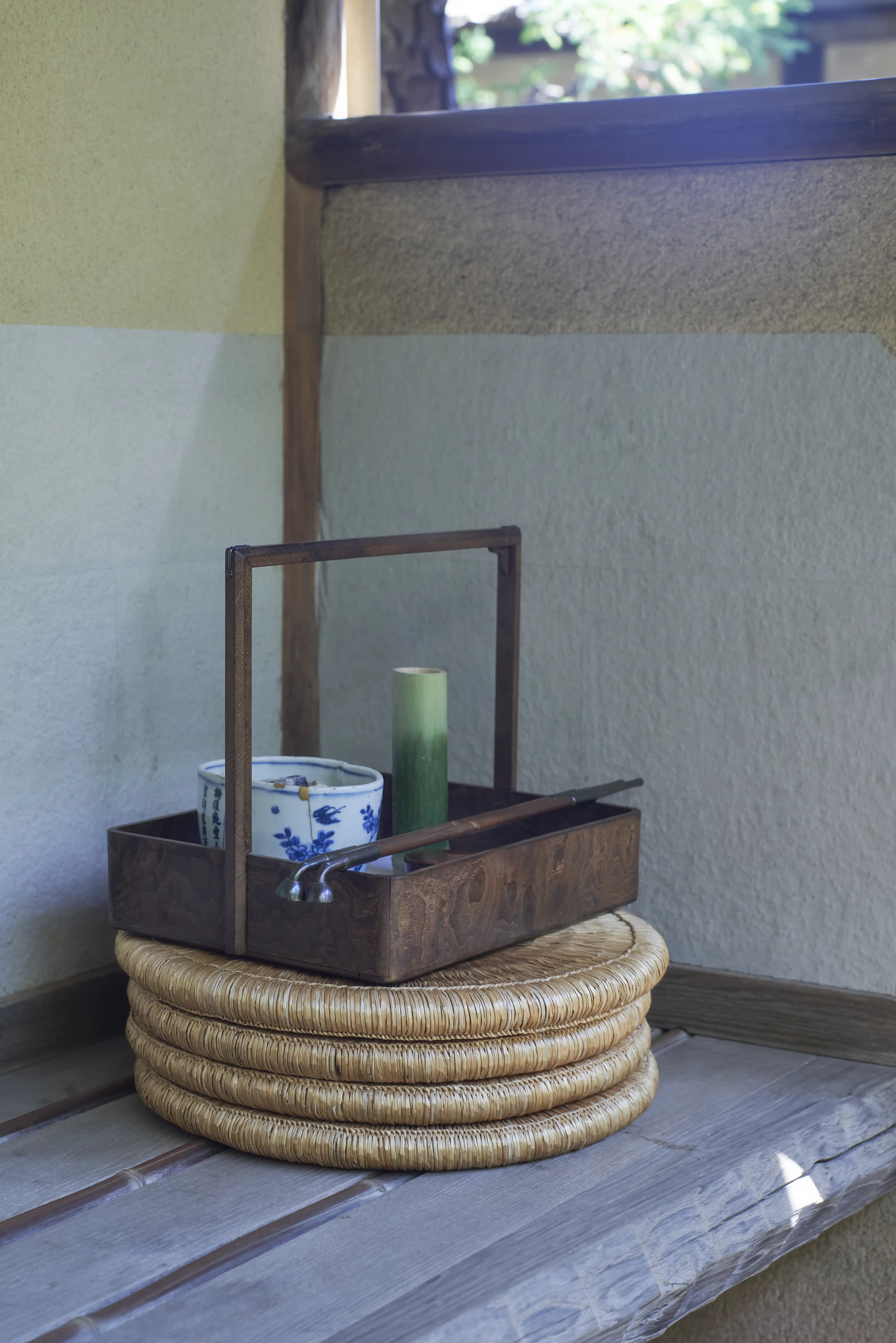
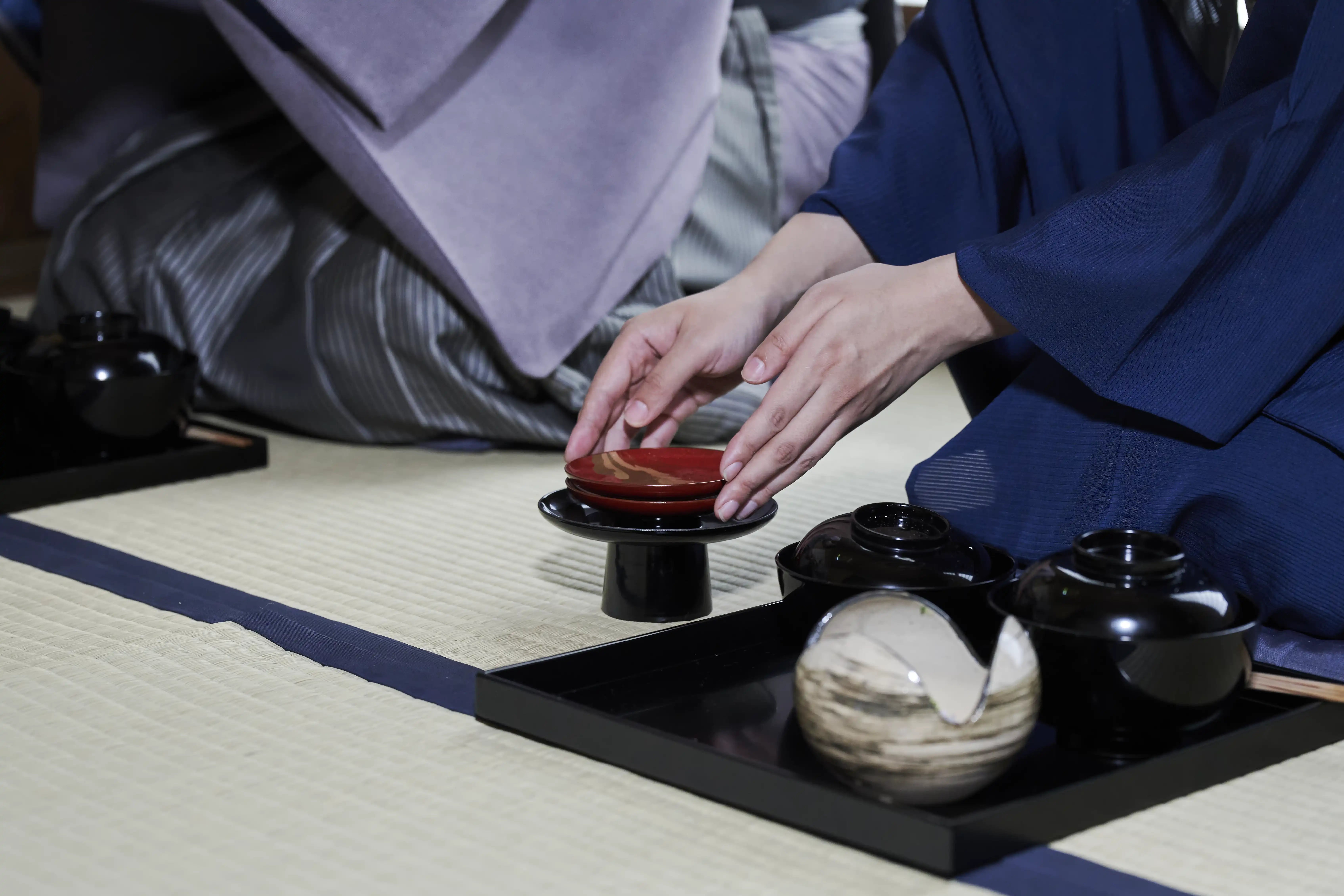
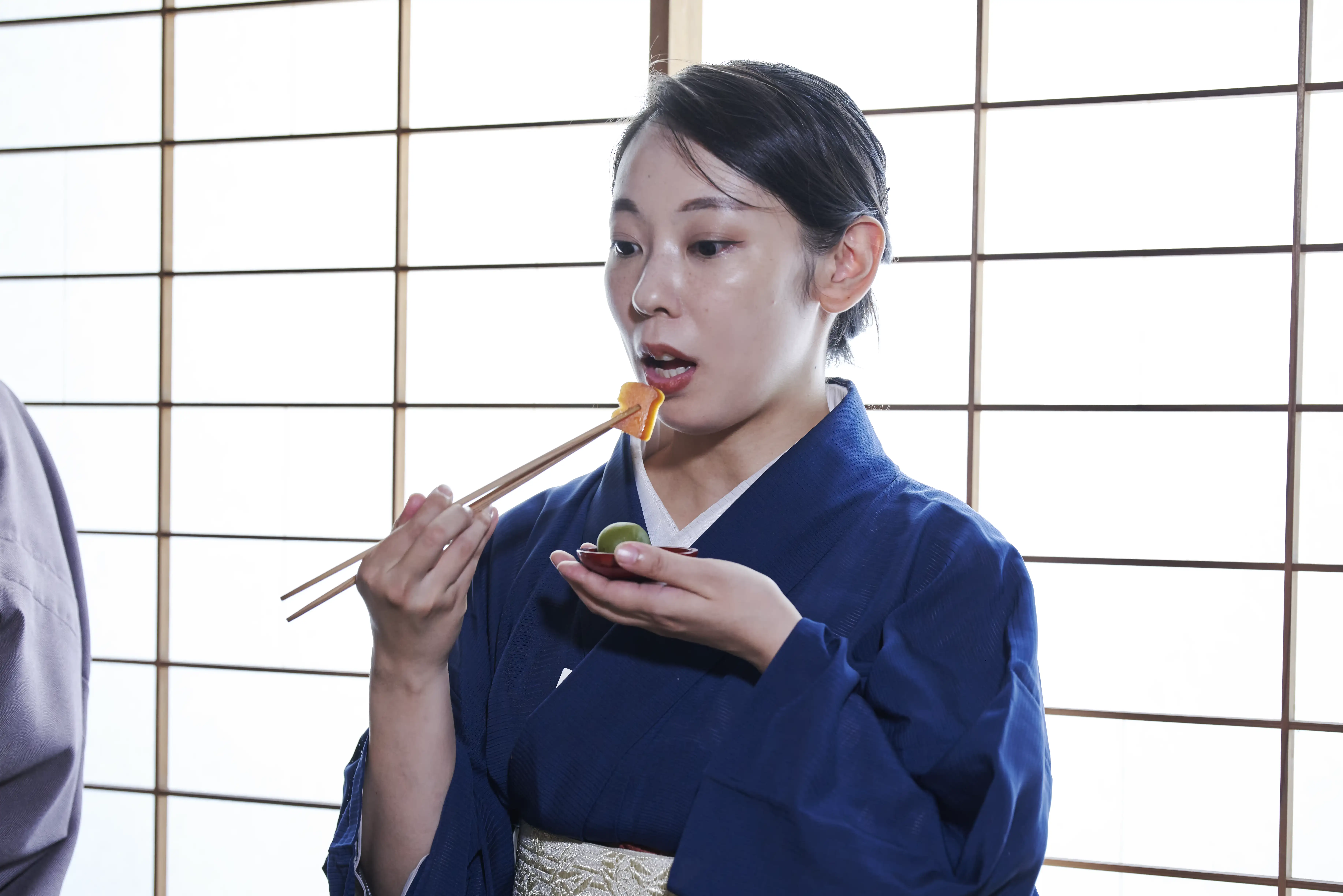
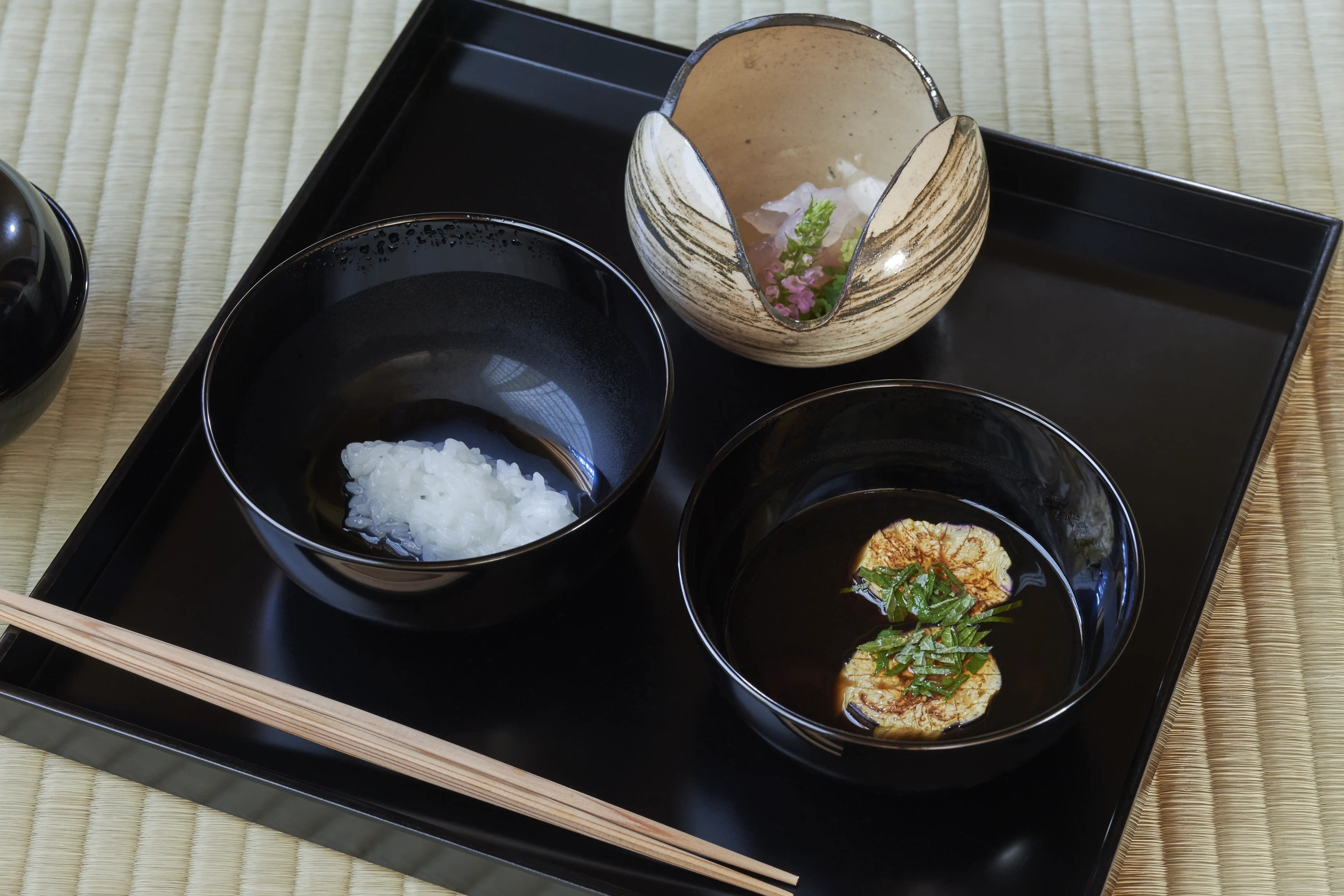
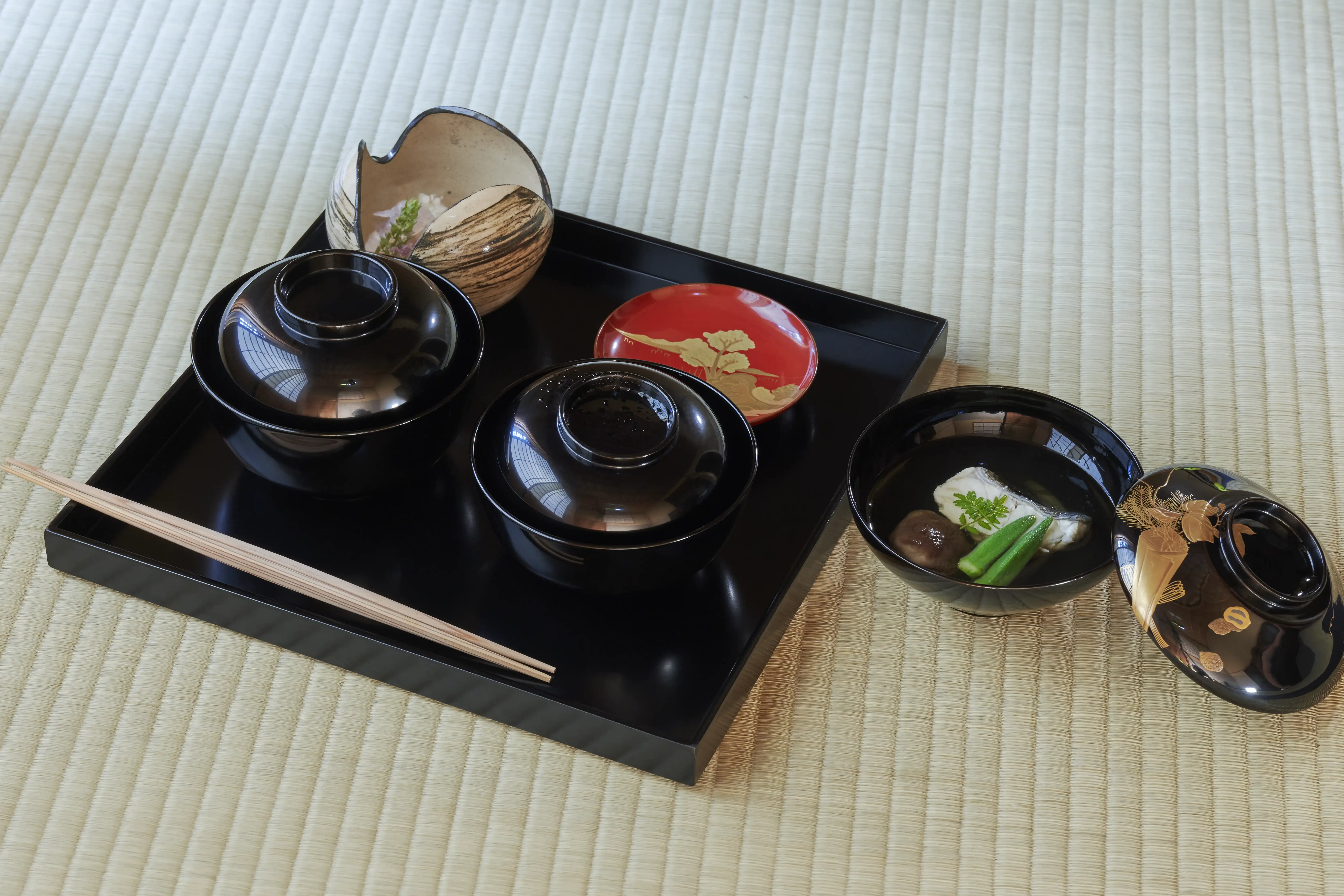
Udagawa: It starts with an invitation reaching the guests, and their reply that they'll attend. On the day itself, they gather and change in the yoritsuki, the waiting room, putting on white tabi. Once everyone has arrived, they sip kōsen to wet their throats and wait on a bench outside. The teishu comes out to greet them and leads them to their seats. Inside the tea room, a scroll hangs in the alcove, and the kettle waits, barely damp, with only a low ember lit beneath it. After the greetings, I do sumidemae — laying and lighting the charcoal to heat the water — and while the water comes to a boil, we serve kaiseki and sake.
This stretch of kaiseki and sake, he says, tends to grow livelier than one might expect.
Toguri: With sake involved, does the mood become quite relaxed?
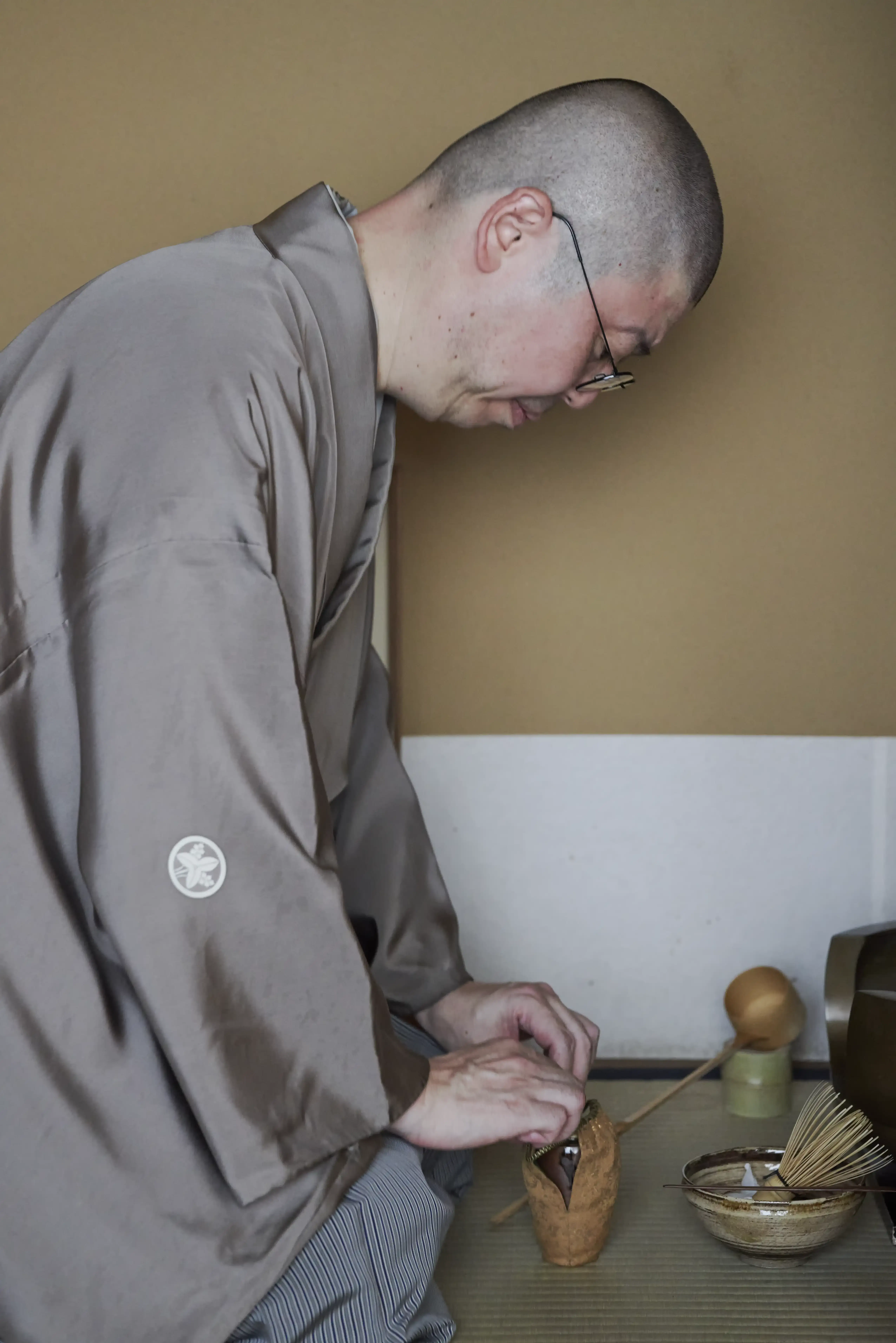
Udagawa: Yes — guests who start out tense loosen up as the sake takes hold, and the conversation picks up. Sometimes we'll have someone sing, or bring in some kind of game. Once the water's boiled, we finish the kaiseki, serve a sweet, and the guests step back out to the waiting area for nakadachi — a brief intermission while the host resets the room. In that time I clean the room, roll up the scroll, and arrange a single flower. Once everything's ready, a gong signals the guests back to their seats. From here it flips entirely: everyone falls silent and concentrates on the procedure until the koicha has been prepared.
This silence — the sudden reversal from a lively banquet — is, for Udagawa, the hinge on which the entire chaji turns.
Toguri: Which part of the chaji do you care about most?
Udagawa: Without question, the koicha — a thick, intensely flavored tea shared from a single bowl among guests — is what I care about most. If I haven't gotten the guests into a state where they can enjoy the koicha in silence, none of it means anything. However much thought you put into the rest, if the first half gets too rowdy to settle down, or if rich food and wine leave the mouth too oily to taste the koicha properly, you've defeated the whole point. So the first half stays close to a kaiseki in keeping with wabicha. If you want to serve something more lavish, better to save it for the banquet in the second half. Keeping the first half somewhat austere — even shōjin cuisine, on occasion — has its own charm, since it's all building toward the koicha.
This sense of contrast isn't simply a matter of taste — it's the design principle of time that runs through the entire chaji. And it isn't something Udagawa invented on his own; it's a shape of the way of tea handed down from those who came before him.
Toguri: Where does this sense of contrast come from, historically?
Udagawa: Historically speaking, honzen, the style of banquet that came before chaji, had a three-part structure: a ceremonial round of sake called shikisankon, then a meal, then a banquet — with the banquet and the meal kept as separate things. Within chaji, I think what happened is that this same structure fused into one: the kaiseki of the first sitting became the "meal," and the koicha and usucha that follow became the "banquet," joined into a single continuous form.
Toguri: Does anything change depending on the time of day a chaji is held?
Udagawa: Today, the standard form is the shōgo no chaji — the midday chaji, which begins around noon and moves from kaiseki through koicha and usucha into the afternoon. But in the old days, when life began at sunrise and ended at sunset, Rikyū's era and others like it saw a lot of asa-cha, morning chaji, too. These days we mostly hold asa-cha to finish before dawn, mainly in summer, since the tea room gets too hot once the sun is up. Starting even earlier is akatsuki, begun by candlelight and carried through until the sky whitens, when the candles are put out and the sunrise itself becomes part of the pleasure. The opposite end of the day gives us yobanashi, tea taken by candlelight at night — warmer still if you serve something like a hot pot in winter. And in between is yūsari, which carries guests from dusk into the dark. Now that lighting means we rarely notice the world actually growing dark, I think there's something genuinely luxurious in being able to taste that passage of time itself.
Toguri: How far in advance do you begin preparing for a single chaji?
Udagawa: I start preparing about a month before the invitations go out. The first thing to decide is who to invite, in what relationship to each other, and for what purpose. Rather than just throwing a drinking party, I settle on a theme — a farewell, a birthday, relief from the summer heat. Then I choose the utensils, the food, and the drink to suit that theme, and think through the guests' chemistry — right down to keeping two people apart if they don't get along. The day before, or the day before that, I gather the utensils to check the torikiawase — how they're paired and coordinated into a single theme — and go through tastings with the cook and the confectioner, so that an interesting theme doesn't end up tasting disjointed.
Each chaji, worked out this carefully, is never simply a ritual repeated — it becomes a one-time story, designed for that day and no other.
Toguri: Is there a chaji that's stayed with you?
Udagawa: At one point, I did a chaji built around a Noh play. I arranged the utensils, the food, and the scroll along the arc of the play itself, so that anyone who knew the story would think, "ah, so that's what this is." In the first half I'd bring out the quiet scenes from the play unobtrusively, and at the end, with a shift of scene, cherry blossoms would spread out everywhere. I've even had a rakugo performer come out partway through, once.
Another example he told us about, laughing, was one where the plainest possible staging left the deepest impression.
Toguri: Conversely, is there a simple approach that's stayed with you?
Udagawa: There's a chaji I hold every year at the close of the year, for a small number of close friends, where I don't bring in a cook at all — I do everything myself. I serve an entirely tofu-based, amateur meal, and handle everything from cleaning to serving the tea alone, without anyone helping backstage. Originally, wabicha meant the teishu handling everything alone, from cleaning to serving. In the West, it's taken for granted that one person serves and another runs the kitchen, but here you do it all yourself. Going that far, I think, is what makes it feel like tea.
The chaji he said had stayed with him most deeply, on the other hand, was neither about utensils nor food, but about the story of one family.
Toguri: Do you have an example of a chaji as a place for conveying something you feel?
Udagawa: There was a chaji I held for someone's parents, when their child — who had studied to become a writer at university — chose the path of a writer rather than a corporate job. I helped out behind the scenes. We built the whole thing around a theme the child had come up with — "we're apart, but looking at the same moon" — carrying it through utensils and homemade dishes the child had made themselves, and through the scroll. In the end, the parents were in tears, and said, "I feel like I finally understand, for the first time, what our daughter wants to do." It made me feel, all over again, that there are moments that communicate more than words can.
Utensils, food, the hanging scroll — none of these elements that make up a chaji are, for Udagawa, mere props for staging. They're vessels for carrying feelings that can't be fully put into words. And this kind of staging only works because the guests aren't simply an audience — they're participants who build the occasion together with the host.
Toguri: What kind of reactions do people have, the first time they take part in a chaji?
Udagawa: I've had people tell me they'd assumed the tea ceremony was quiet and tense throughout, and were surprised at how dynamic it actually was. There are moments meant to be enjoyed and moments that turn quiet, and with each change of scene, the arrangement of utensils and the air itself shift along with it. For a first-time guest, though, it's a bit like a full French course meal — your head fills up wondering what's coming next and how you're supposed to behave, so you can't fully enjoy the space around you. But as you get used to it, you're able to enjoy it more deeply. It's the same with sake: at first, you might not know the label and just enjoy what you like, but gradually you start to notice which brewery it's from, how many years the rice was aged — and it becomes more and more enjoyable.
Toguri: In the relationship between guest and teishu, is there something you particularly value?
Udagawa: A guest isn't merely a spectator watching — they're a player building the occasion together with the host. The teishu looks after the guest, and the guest looks after the teishu in turn. There's nothing more satisfying than the moment that timing lines up exactly. If people can enjoy that side of it in real depth, I think it becomes even more interesting.
Crows, Ghibli, and the Art of Improvisation
Apart from his public face as the 18th head of the Sowa school, Udagawa has another side to him.
Toguri: How do you spend your time privately?
Udagawa: I don't watch much television. Through the connection of receiving the name Kan'asai — "cold crow" — from the abbot at Shinjuan, Daitokuji, at my tokudo, I actually keep a crow at home. I'm often working at my computer with some anime playing on the side. I like subculture. I like drinking too, and I'll go anywhere without discrimination — from a polished bar to a standing bar in the old part of town.
This lack of discrimination carries straight through into the aesthetic sensibility he brings into chaji. It isn't only formal, first-rate utensils — even his connections with friends involved in anime and games become, just as they are, part of the tea gathering. What symbolizes this is the painting of Daruma that hung in the tea room.
Toguri: Could you tell us about this scroll?
Udagawa: I had the chance to serve tea for Studio Ghibli producer Suzuki Toshio, and when he asked what he could offer in thanks, I said, "Then would you paint me a scroll?" Suzuki had also written a book called Zen and Ghibli, and I'd seen how skilled he was at copying the Zen paintings of monks like Hakuin and Sengai. What came back was a painting of Daruma in the style of Hakuin. Normally, in gasan — a painting with an inscription — the form is to add an inscription praising an already-existing famous work, but this time I had my teacher, Yamada Sōshō of Shinjuan, Daitokuji, write the inscription, with Suzuki providing only the painting.
Another thing he told us about, laughing, was a scroll born out of pure improvisation.
Toguri: I understand there was another piece that came about improvised.
Udagawa: Isamu Kamikokuryo, who had been an art director on the Final Fantasy games, once came to one of my chaji, and when I handed him a brush and inkstone, he looked at the painting of Kannon I had hanging that day and, right there on the spot, painted his own vision of Kannon. He said it was his first time writing anything with a brush, and finished it in fifteen or twenty minutes. That kind of improvisation is part of what makes the play of the banquet interesting.
The phrase "play of the banquet" captures Udagawa's view of chaji well. For him, utensils aren't antiques meant to confer authority — they're tools for building relationships between the people gathered in that place. The same idea lives on in the venues he runs, Sokkon and Yobanashi Sahan.
Toguri: What's distinctive about Sokkon and Yobanashi Sahan specifically?
Udagawa: A chaji is something you arrange to suit the guests, and even if the teishu can't perform temae themselves, they can have someone else perform it on their behalf while explaining the utensils — enjoying it in whatever form suits you is characteristic of what we do. In fact, we sometimes bring in professionals to match the theme of the day — a professional bartender serving cocktails as if it were temae, an original sweet prepared specially, a Noh performer dancing, a rakugo performer appearing.
This flexibility isn't simply a love of novelty. It rests, instead, on a consistent question: how do you make an old sensibility work within the present era?
Toguri: How do you think about incorporating new materials and techniques?
Udagawa: I'm not someone with a particular gift for inventing something new myself, so I often work by taking an old sensibility and substituting in materials that exist today. For instance, copies of tenmoku tea bowls, originally from China, have been made in all kinds of forms by Japanese potters, but through my connection to "cold crow," I tried recreating a tenmoku bowl in glass. Making a dashi-bukusa with a crow pattern came from the same instinct.
As climate change shifts where ingredients are grown, Udagawa says he approaches food with the same posture.
Toguri: Could you tell us about your approach to food?
Udagawa: Since koicha is really the star of a chaji, I try not to let the food assert itself too loudly. Using ingredients that feel of the moment is something I actively want to bring in. With warming, the regions where things are grown keep shifting north, and what used to be said to be "in season" at a given time is gradually changing. So I don't think we need to cling too tightly to the old sense of seasonality. That said, whether something actually fits the overall flow of the tea has to be judged by your own sense for it, and whether it survives into later generations is a separate question again. Even so, I think all kinds of experiments are worth individual people continuing to try.
Toguri: Do you have a message for anyone considering the experience?
Udagawa: Please feel free to come with an easy mind, though if you spend the whole time carrying on as if it were just a drinking party, you may end the day without ever tasting the quiet of the koicha. I think it's best to bring some sense of respect for tea, without over-thinking it, and simply feel what you feel.
"That kind of improvisation is part of what makes the play of the banquet interesting."
— Sokou Udagawa
Closing
Chaji, in the end, may be nothing more or less than a technique for weaving relationships between people within a limited stretch of time. Across its history, tea has changed shape again and again, swallowing cultures that arrived from outside and refining them into something distinctly Japanese. What Sokou Udagawa embodies isn't inheriting that work as a fixed form, but the posture itself: designing time around a single bowl of koicha, and continuing to choose utensils and words for the person in front of him. A teishu who dotes on a crow, adds a Zen inscription to a Ghibli producer's painting, and simmers tofu alone on New Year's Eve quietly teaches us that tradition can only ever stand on the accumulation of small daily choices. Chasing that instant when the breathing of teishu and guest happens to align, he is, today as ever, assembling the next chaji.