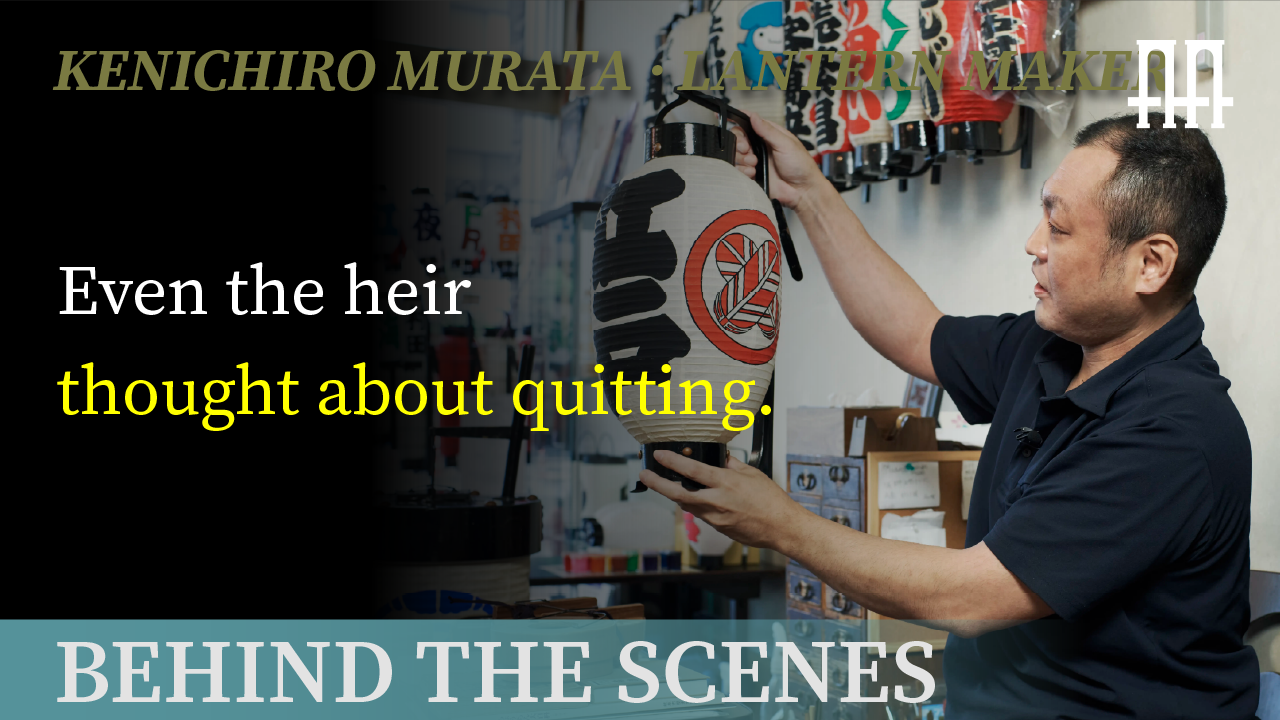
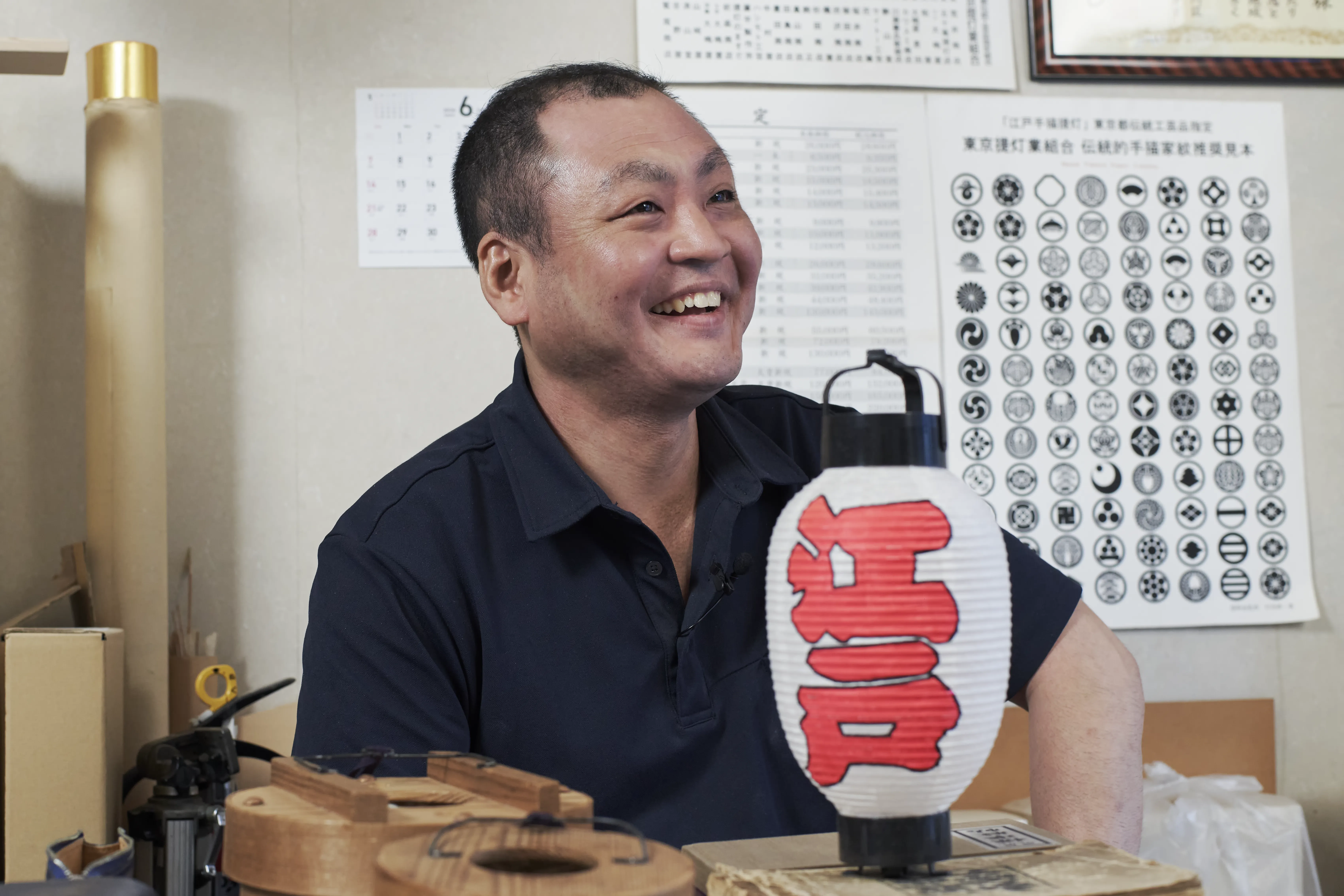
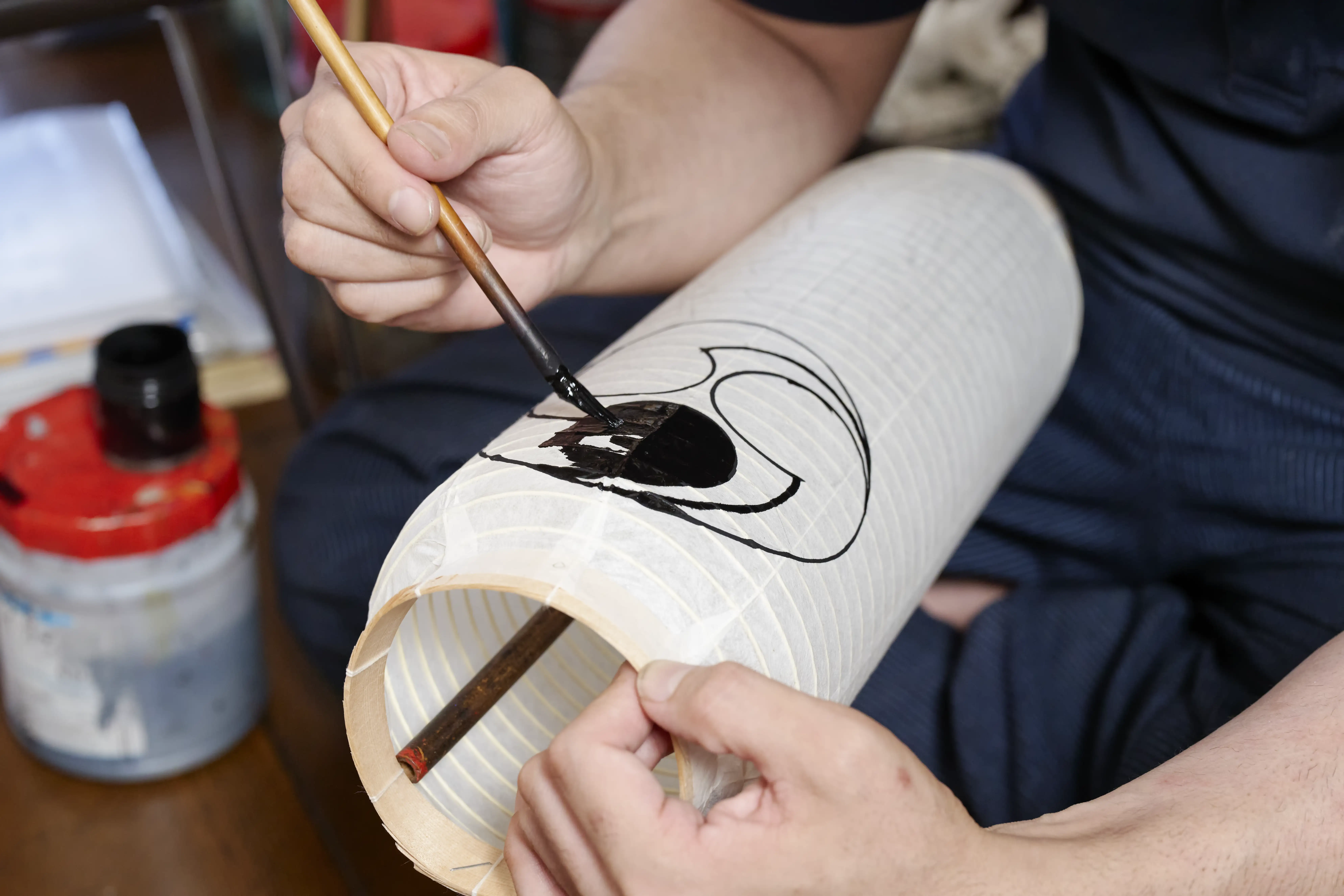
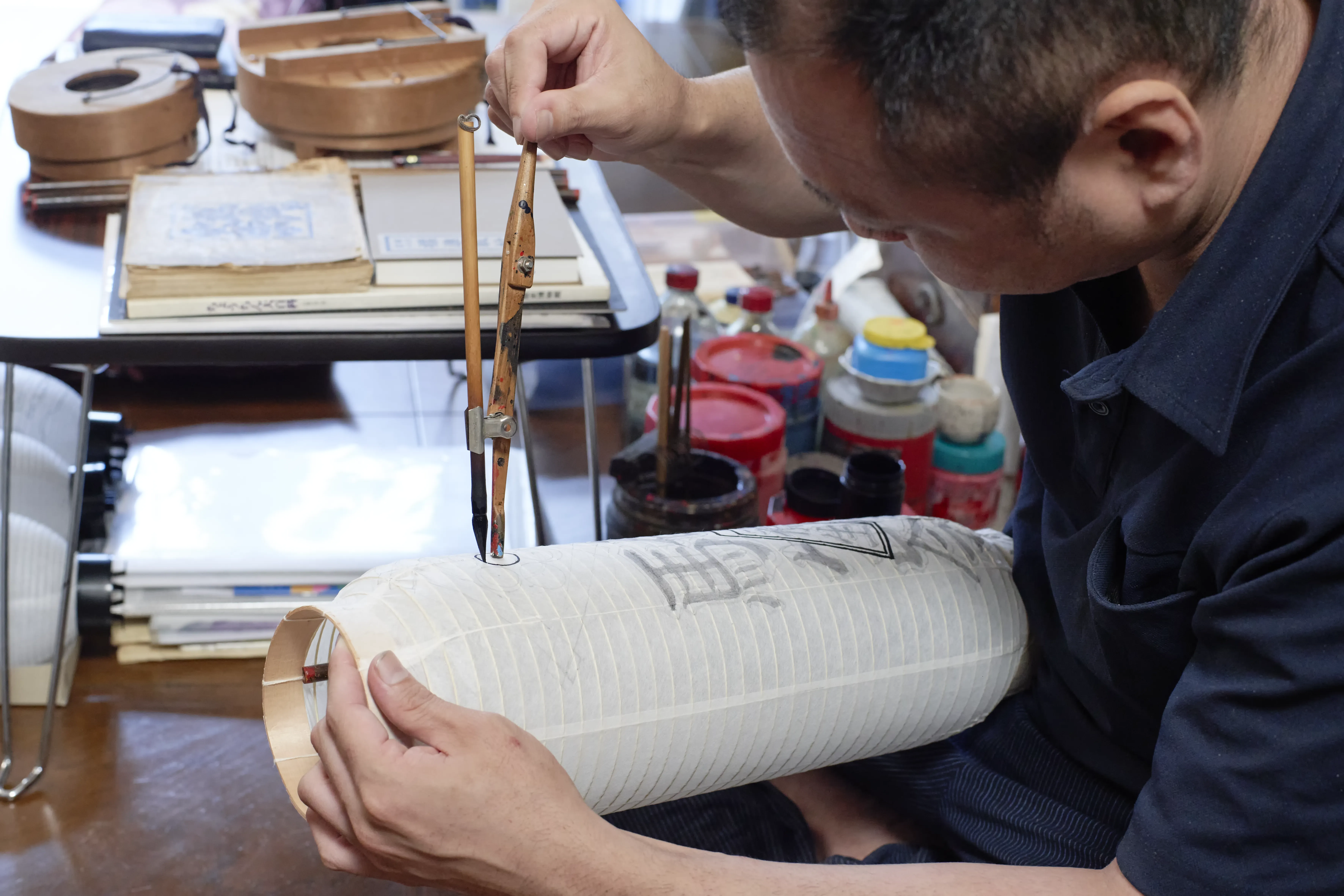
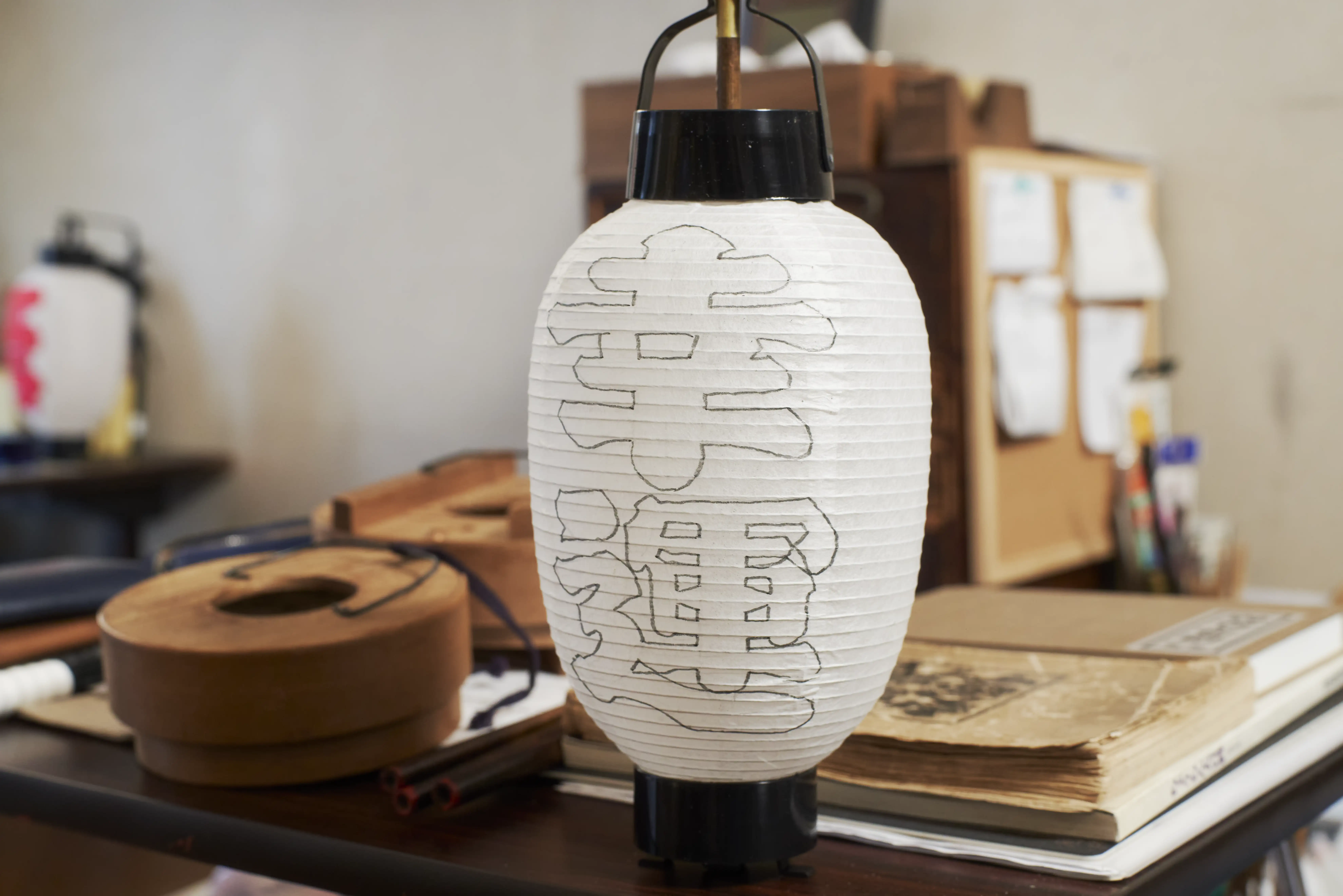
The workshop sits in a corner near the Namidabashi intersection. A folded chōchin (paper lantern) arrives, and three stretcher rods go in, followed by a light mist of water to draw the paper taut. A thin pencil outline appears, and then the black edging goes in — because if you ran a brush across it in one stroke, the way you would in calligraphy, the bumpy surface would scratch and skip almost instantly. Here, then, a character is edged before it is ever written.
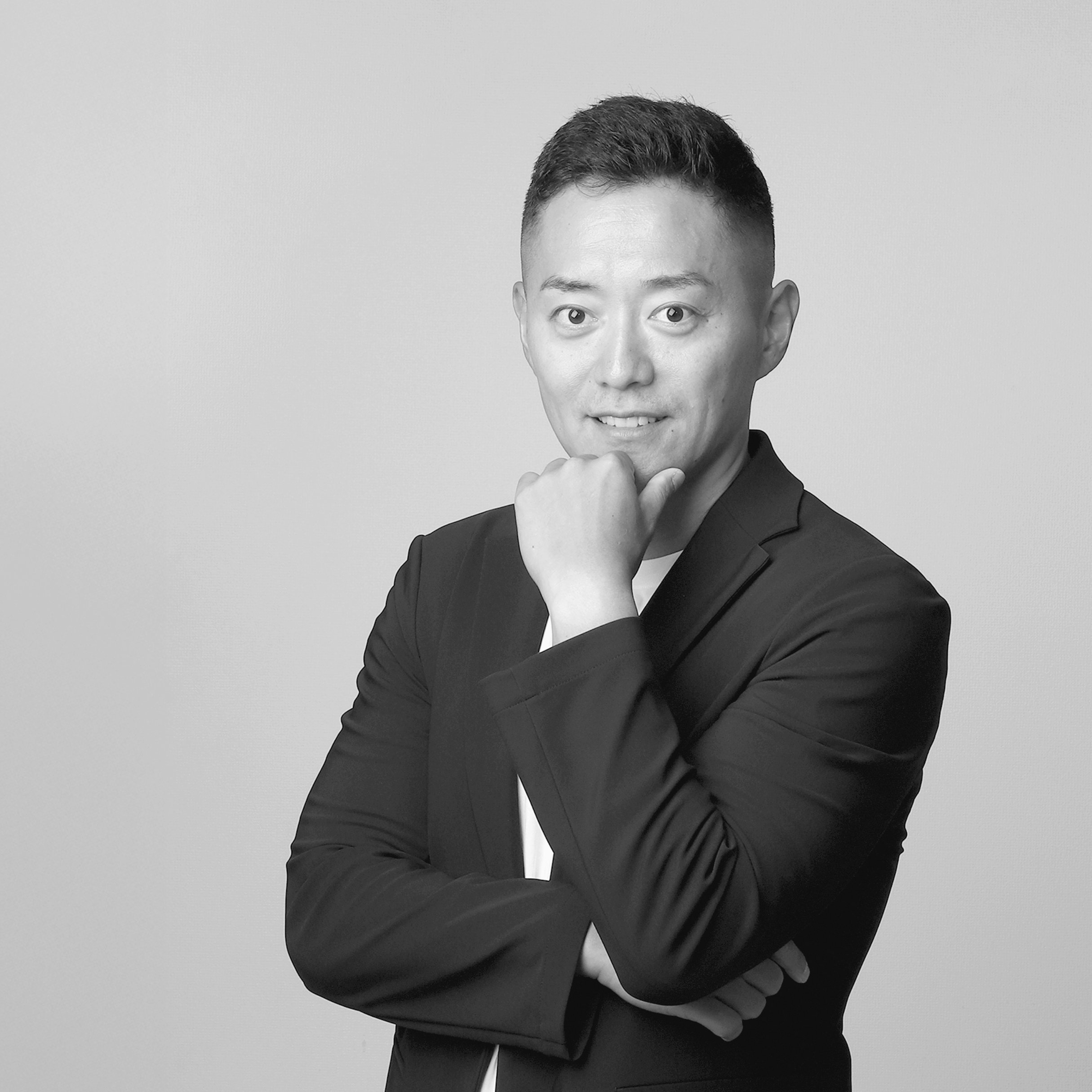
In the back, the third-generation father is still moving his brush the same way he always has. Our narrator is the fourth generation, Kenichiro Murata — heir apparent to Namidabashi Ōshimaya Chōchin-ten, a shop founded in Taishō 2 (1913) and now 113 years old.
This piece follows, in Murata's own words, how the chōchin that arrived from China worked its way into Japanese daily life, the lineage carried by the trade name Ōshimaya, and the singular technique of making letters sit on a curved surface.
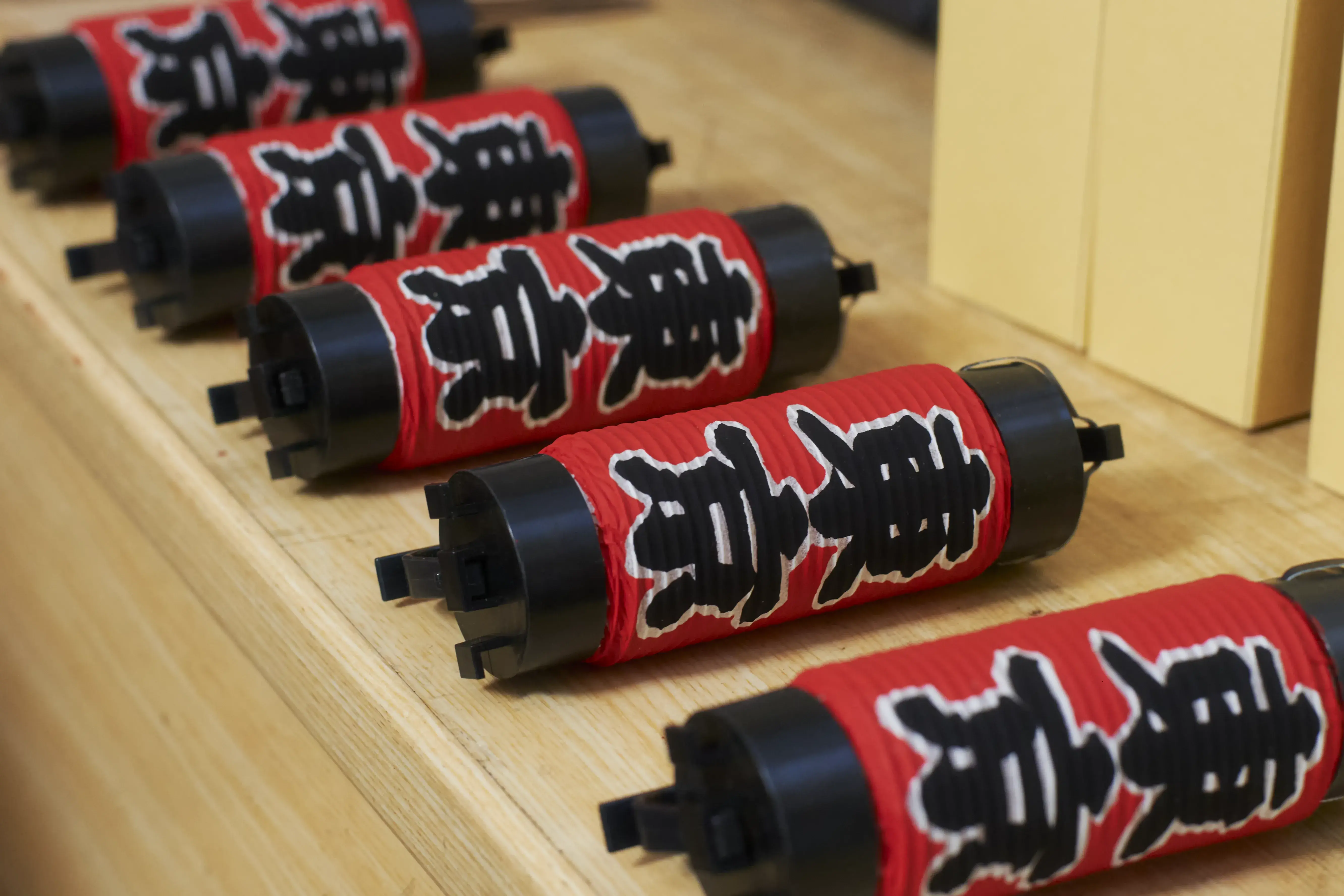
A Trade Chosen, Then Claimed
Growing up inside a family trade and taking that trade on as your own work are not the same thing. Murata's decision to become the fourth generation came, surprisingly, quite late.
Toguri: When did you decide to take over the family trade as the fourth generation, and what prompted it?
Murata: Since lantern-making was our family trade, it was always there as an option for me. Growing up, having this work close at hand was simply normal. But I only really decided after I finished technical college and started helping with the trade. After actually getting my hands into it, I made up my mind, a year later, to take it on.
Toguri: Your master would be your father, the third generation. Is there a particular piece of advice from your training that's stayed with you?
Murata: "Make work that holds up to a fellow professional's eye." That's stayed with me to this day. I take it to mean: make something that reads as professional work even to another professional — not just to an amateur's eye. Whether it can withstand the eye of someone doing the same work, rather than an untrained one — that standard is always somewhere in the back of my mind.
Murata was equally direct about the particular difficulty of learning a craft from a parent.
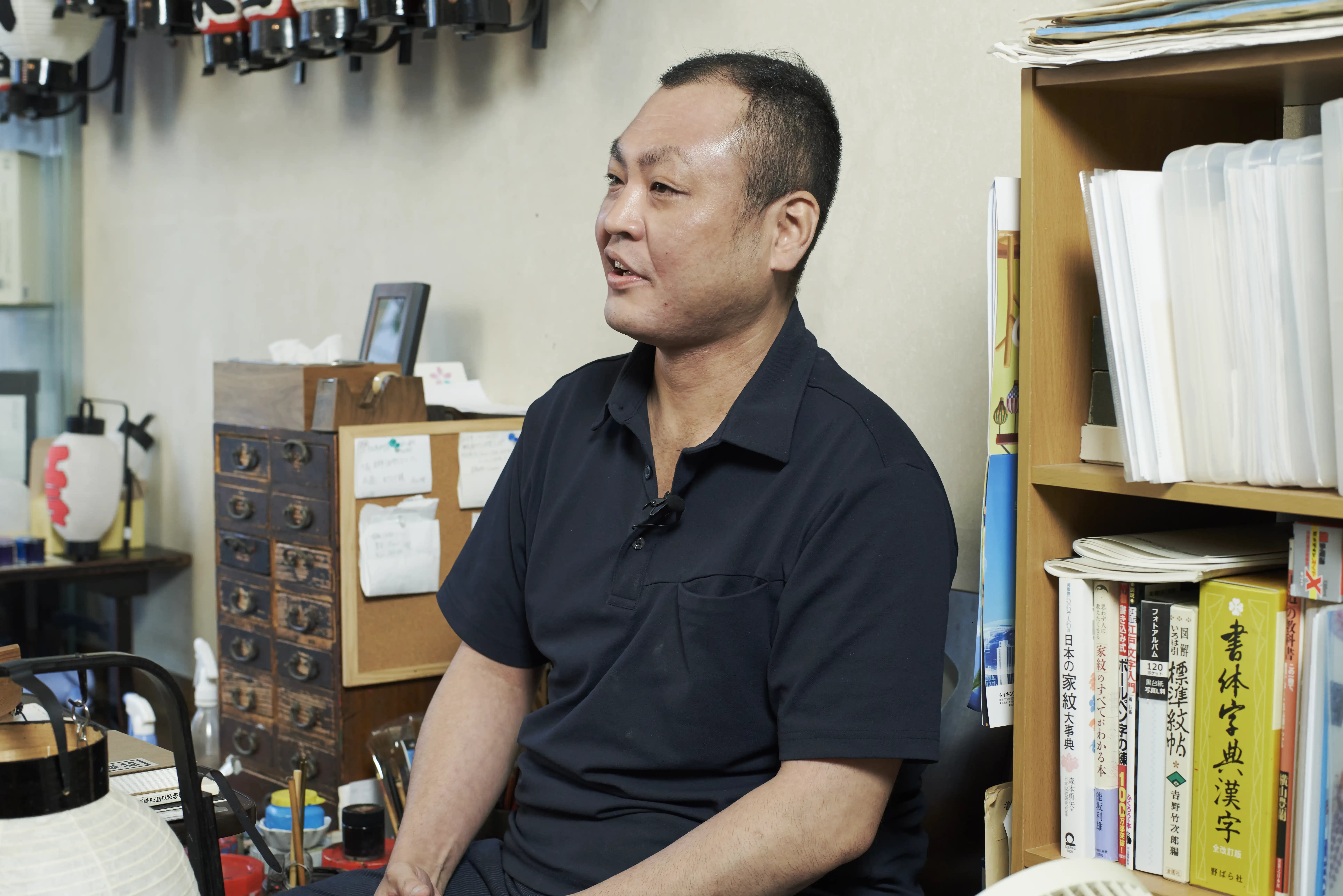
Toguri: Is there a specific difficulty to learning a technique from your own parent?
Murata: Growing up, my father had this Shōwa-era stubbornness about him — a little intimidating, honestly. That impression stayed the same once I started the work itself. But ours wasn't a "watch and learn" household — if I asked, he'd explain things thoroughly. For a craftsman of that generation, someone willing to teach that carefully is pretty rare, so I was grateful for it.
Toguri: Was there a particular stage of training you struggled with?
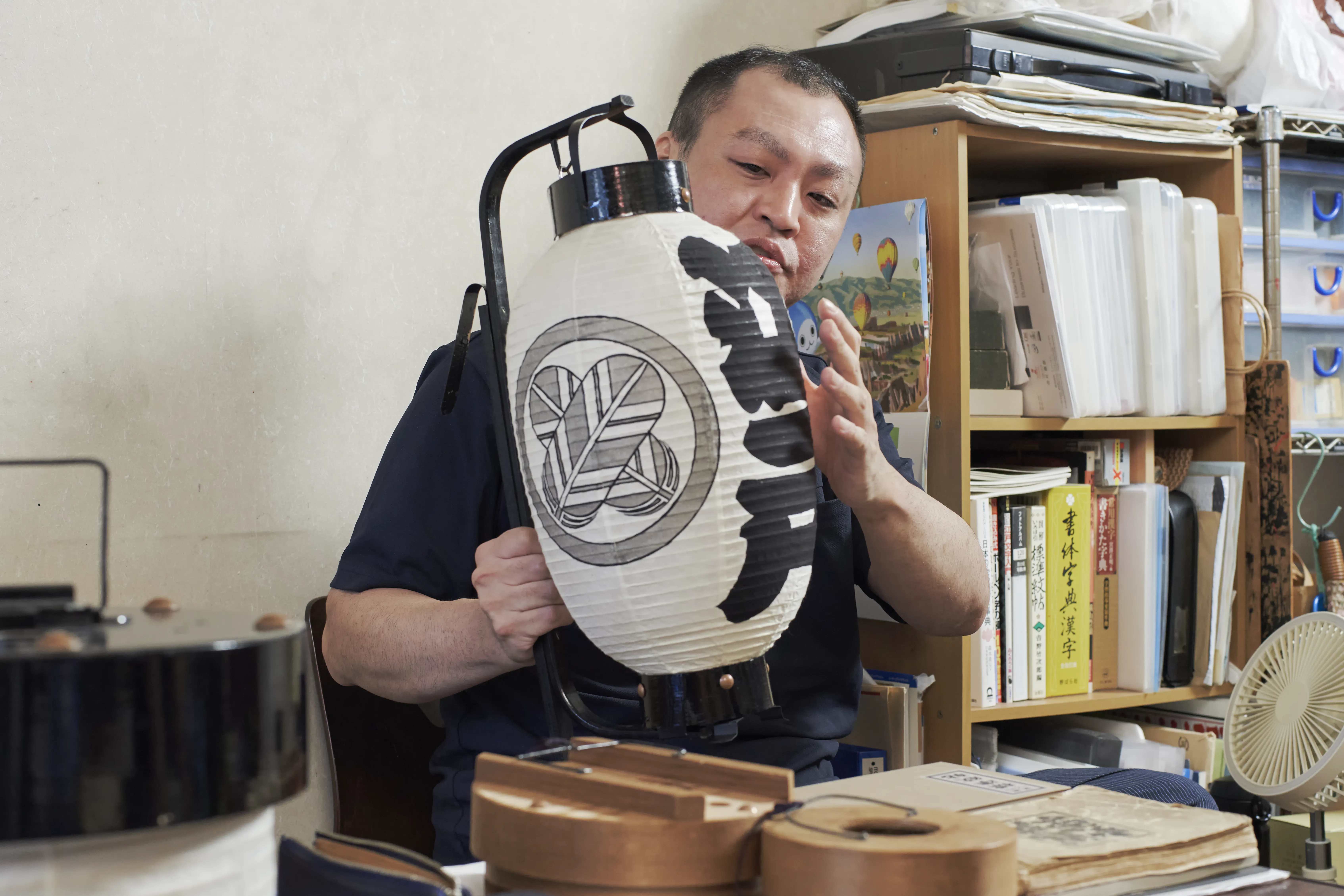
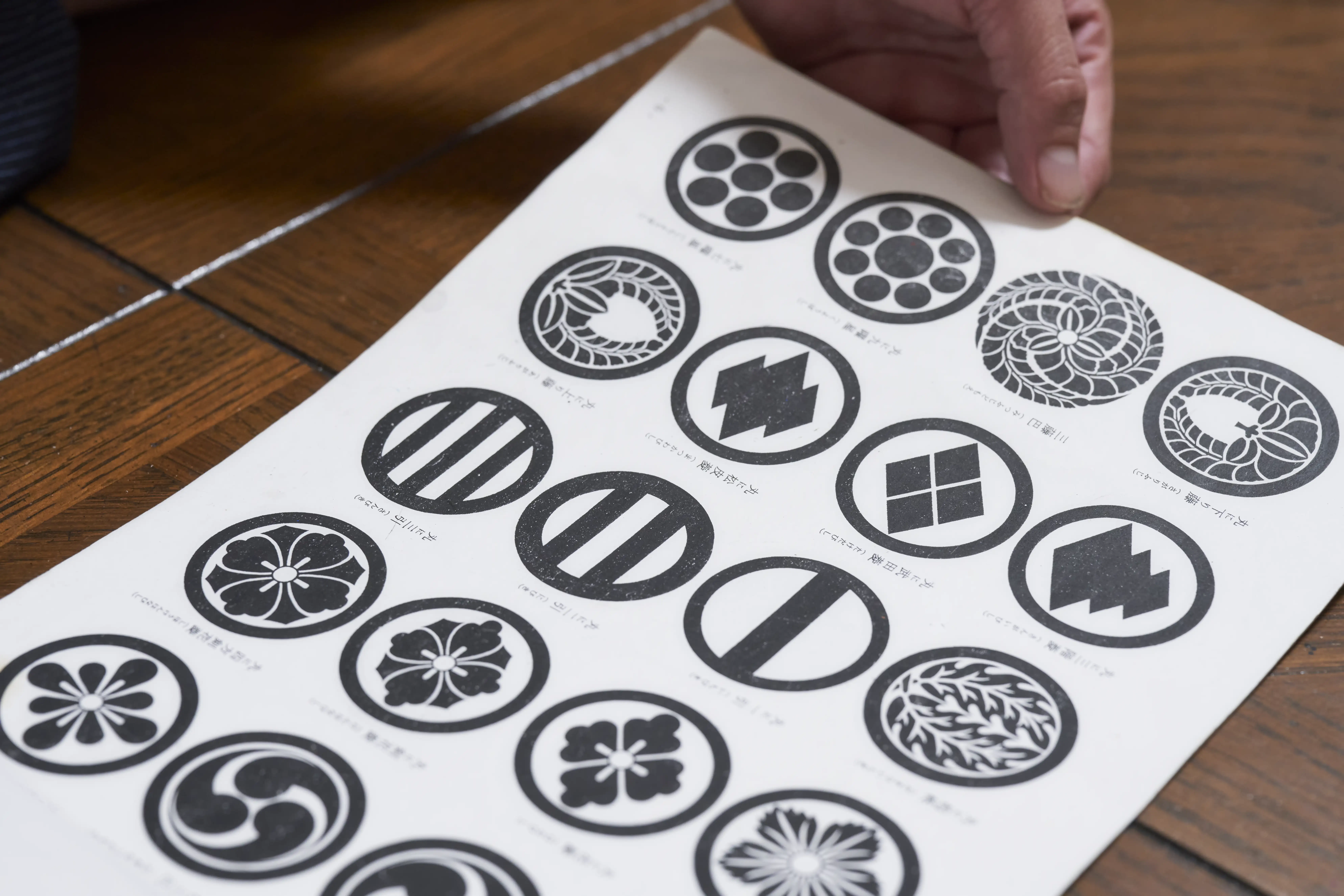
Murata: When I started, my father — my master — made it look easy, writing everything smoothly, but when I actually tried it, I couldn't do it at all. It took real effort just to get to the point where I could. In our house, the first thing I did was kamon — I was made to draw family crests, over and over, for three straight years. Only once I could draw a kamon reasonably well was I finally allowed to learn lettering.
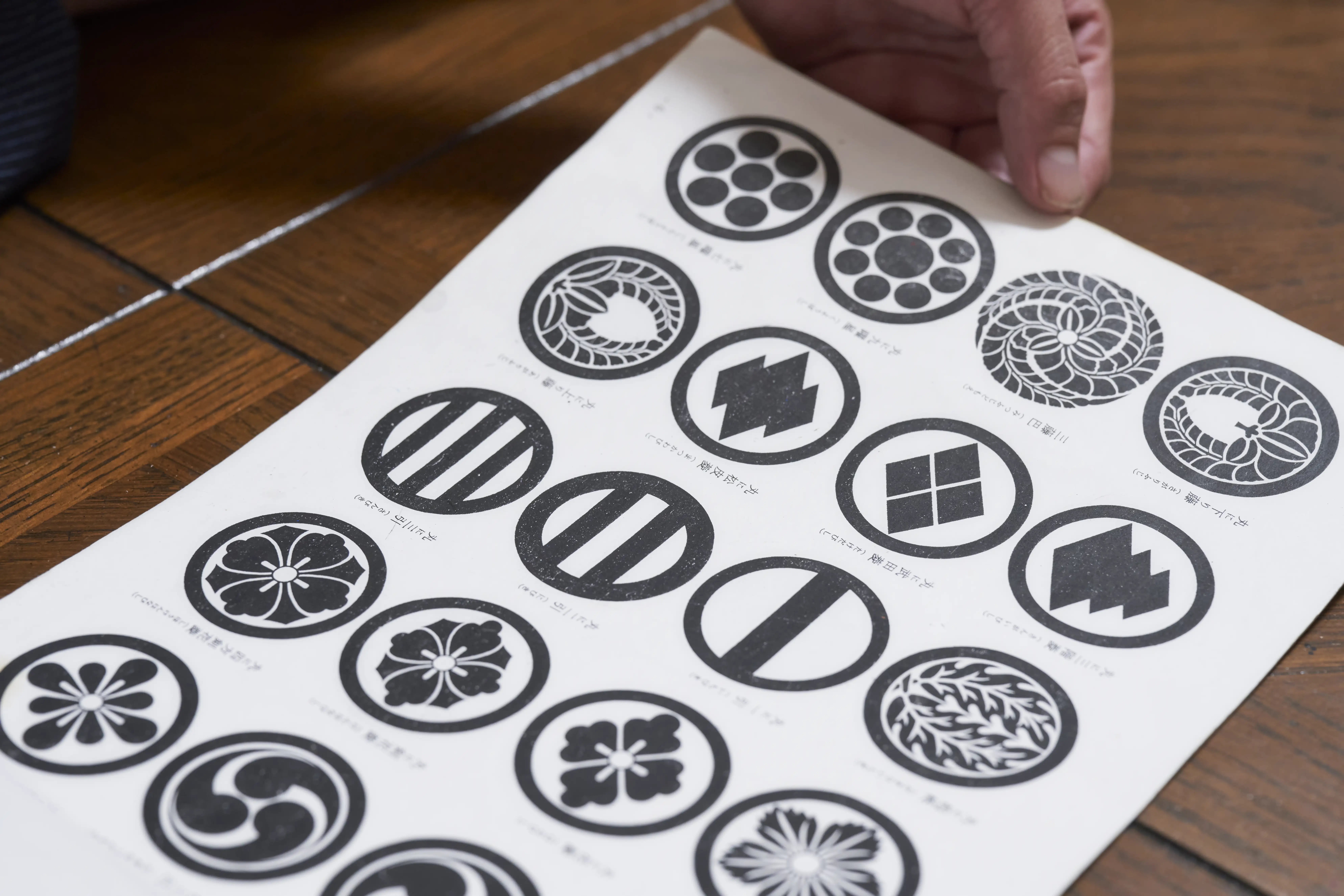
Toguri: Starting with the kamon rather than lettering — why that order?
Murata: According to my father, a kamon actually takes longer to draw. Lettering, honestly, has no fixed rules. His idea was: get good at the kamon, which has a fixed form, before you move on to lettering. If you learn lettering first, your kamon work gets sloppy. So for three years, all I drew was kamon.
Toguri: Is finding the right balance something you learn by feel?
Murata: It really is by feel. Rather than being taught in so many words, early on I'd be given a sample written on paper and copy it out. That's how I gradually worked out my own sense of balance. Sometimes a customer's order comes with a sample from another lantern maker, and if I think it's good, I might imitate it. But if I think my own father's version is better, I still want to write it our family's way.
That three-year span quietly tells you where the center of gravity in this work actually sits. What the hand needed to learn wasn't the lettering that could be loosened up, but the form that could not — and that order became the foundation the fourth generation stands on. The next chapter follows the chōchin itself: where it came from, and how it took root in Japanese life.
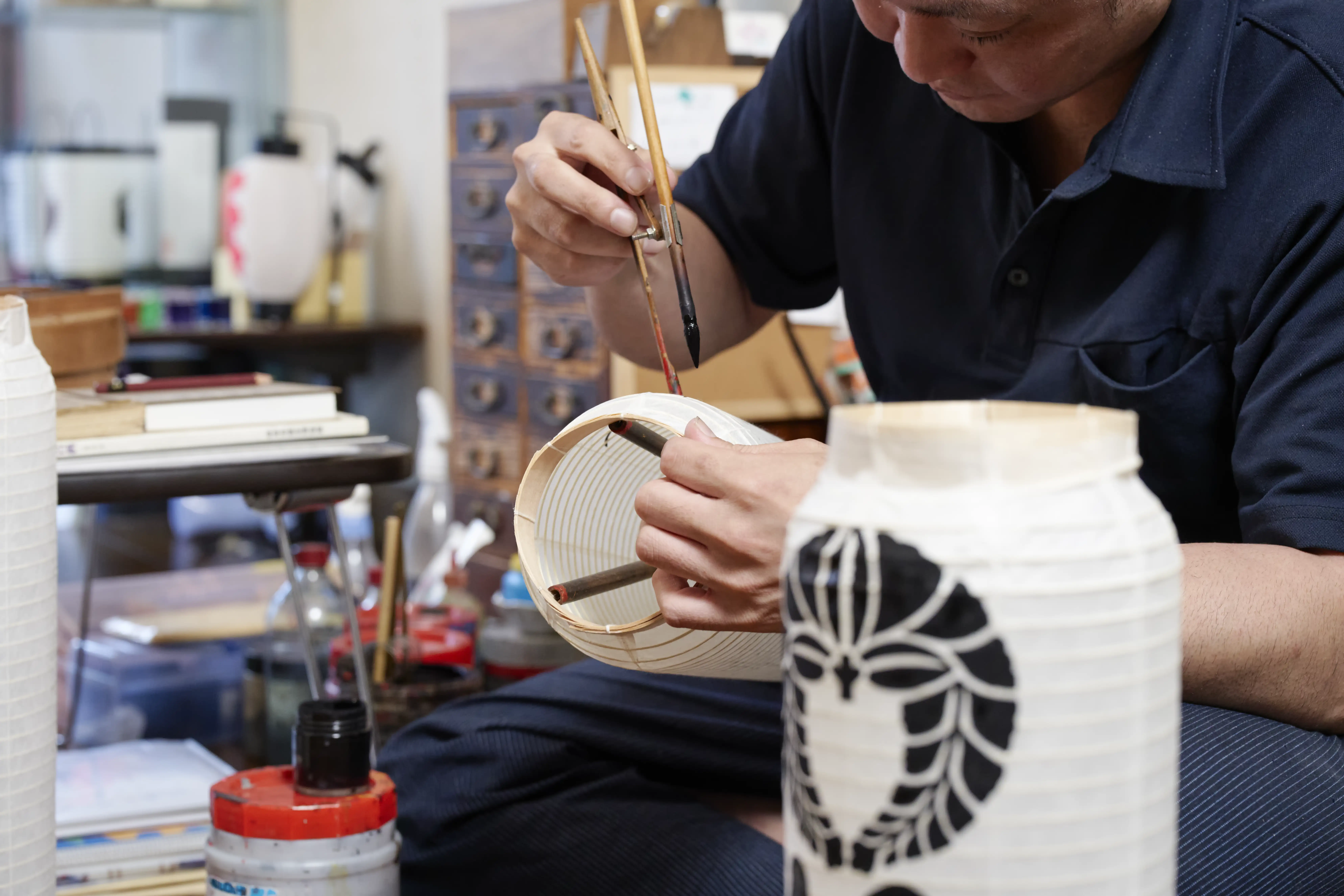
"Make work that holds up to a fellow professional's eye."
— Kenichiro Murata
From China to the Edo Street
The chōchin wasn't foldable from the start. Its evolution traces the very process by which the nights of ordinary people grew brighter.
Toguri: When did the chōchin first take root in Japanese daily life, and how?
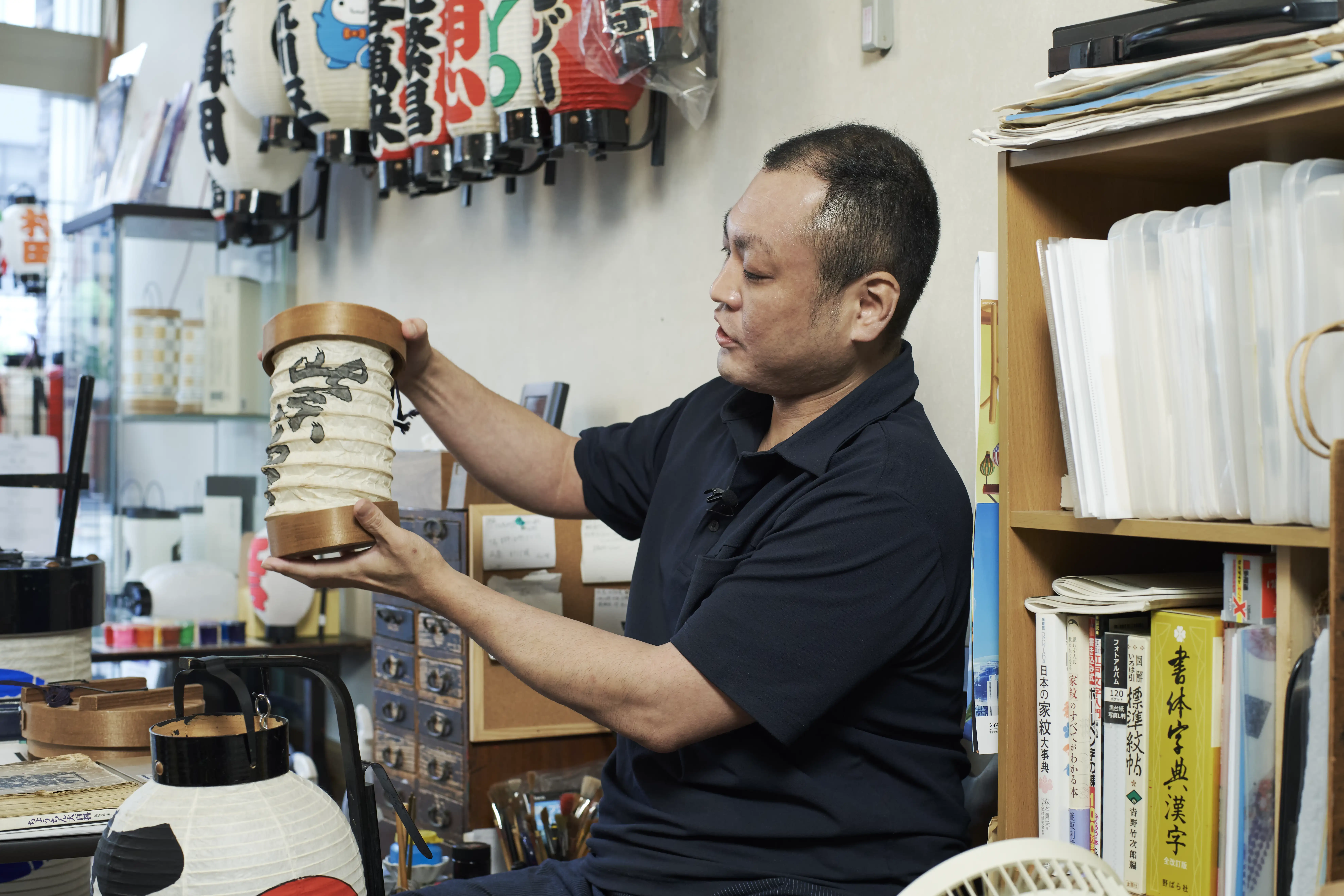
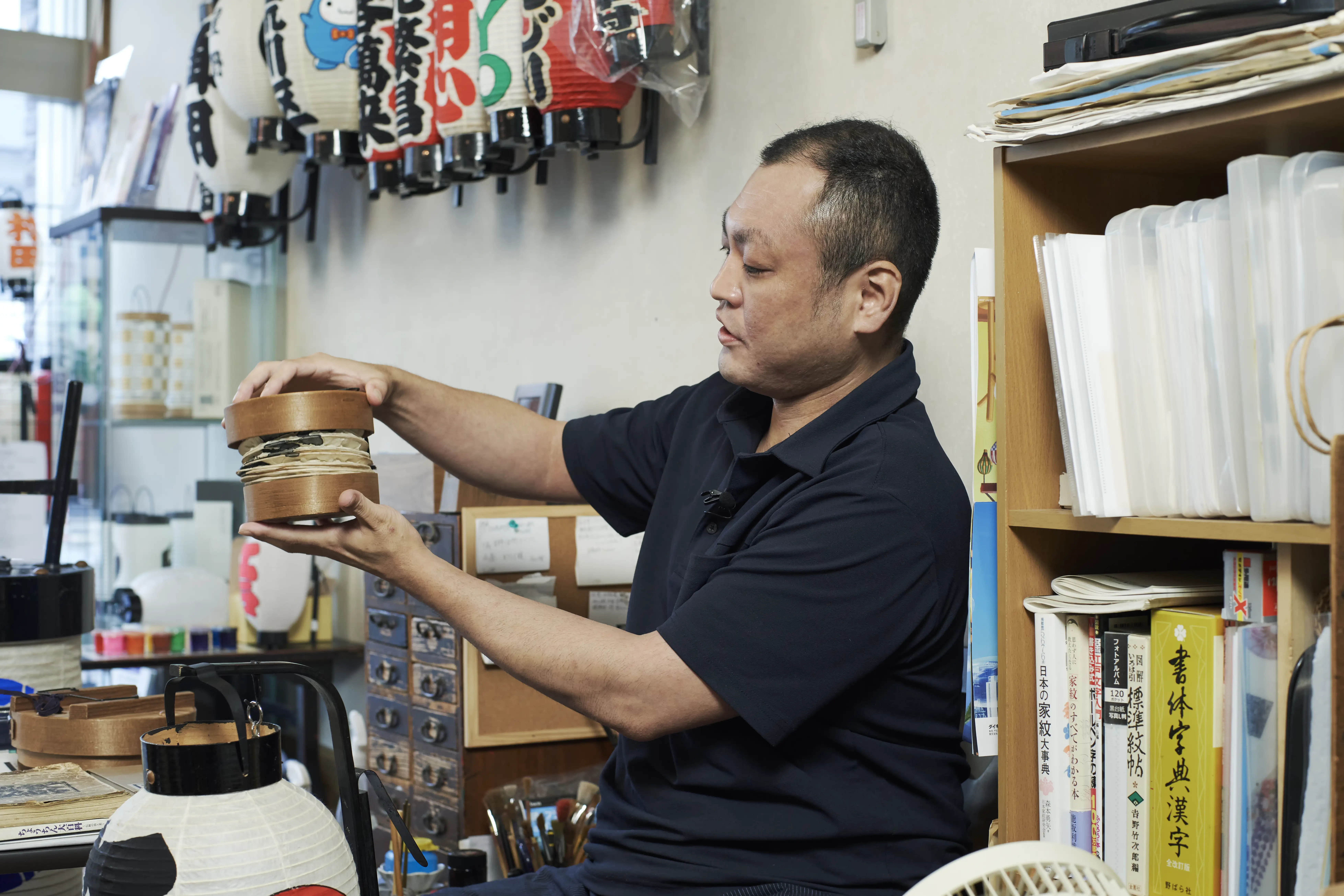
Murata: It originally came from China, in an age before electricity, when candle flame was the only light there was. When it first arrived, it wasn't the foldable kind — it was what people called an andon or a kago-jōchin, a caged lantern. I've heard it arrived in the Muromachi period. Candles later became common, and the chōchin spread to ordinary people along with them.
Toguri: What lay behind its wider spread in the Edo period?
Murata: The first foldable design was the Odawara jōchin — you'd carry your candle, and when you folded the lantern, it fit in your robes. Very convenient to carry. But the frame was expensive, and candles themselves were once a luxury, so at first only samurai families and the wealthy could use them. Once the Edo period arrived, candles got cheaper, and lanterns themselves were made smaller to cut costs, which brought them within reach of ordinary people.
Toguri: What situations were chōchin actually used in, back then?
Murata: There was no lighting in the Edo period, so it was a genuine daily necessity. I'd guess most households kept at least one. And since kabuki has existed since the Edo period too, chōchin were used on stage as well.
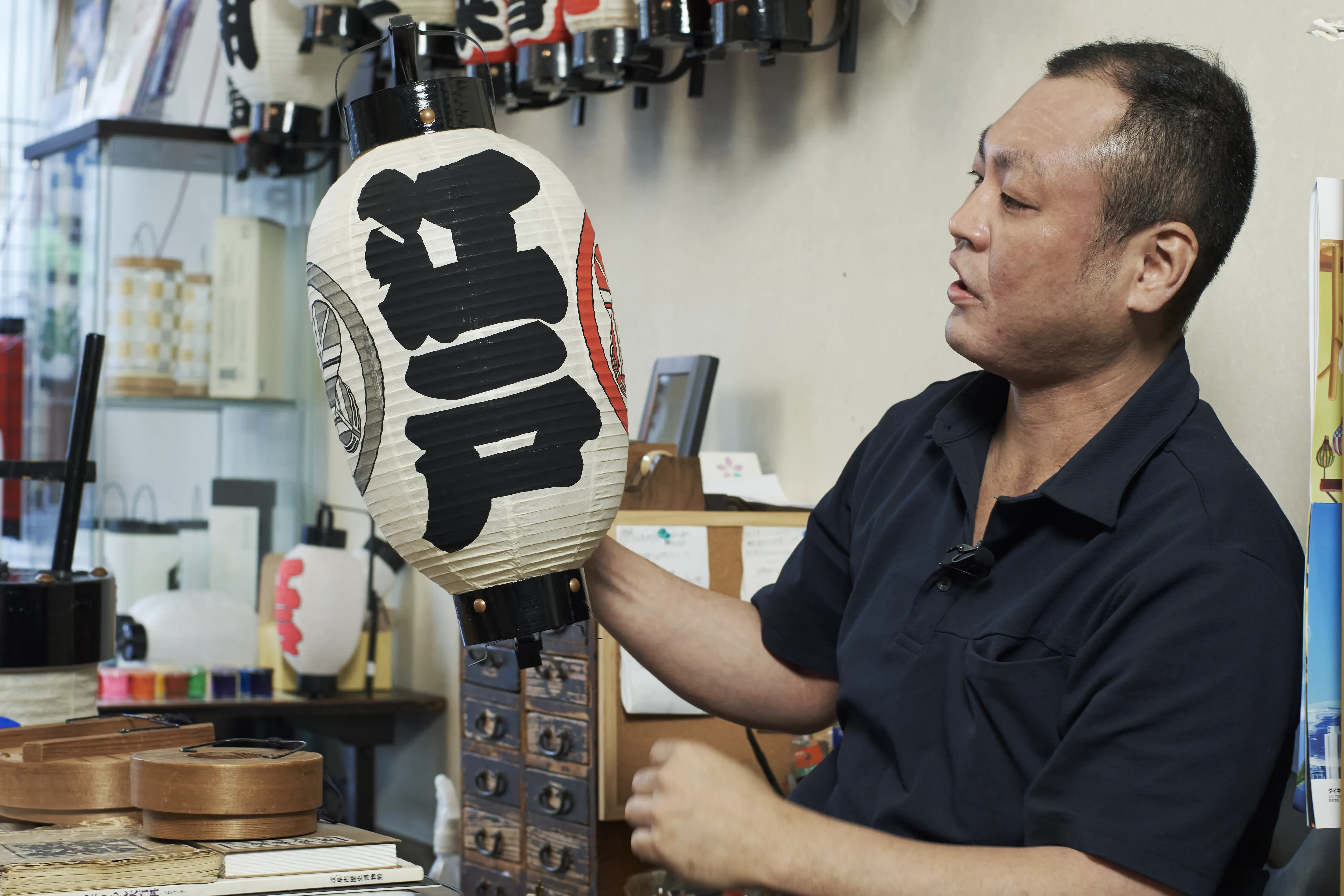
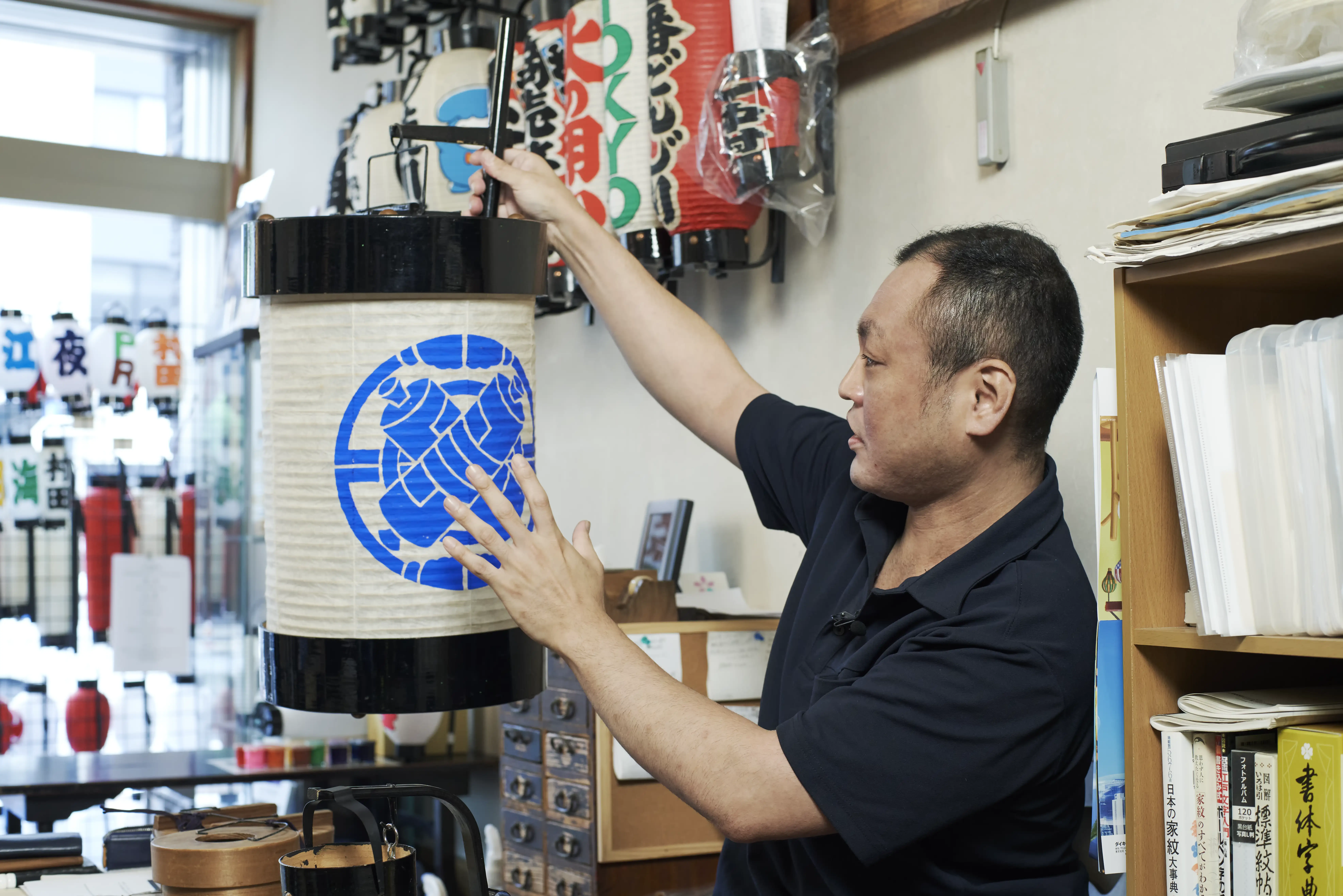
The evolution of its shape, too, played out in the tension between cost and function.
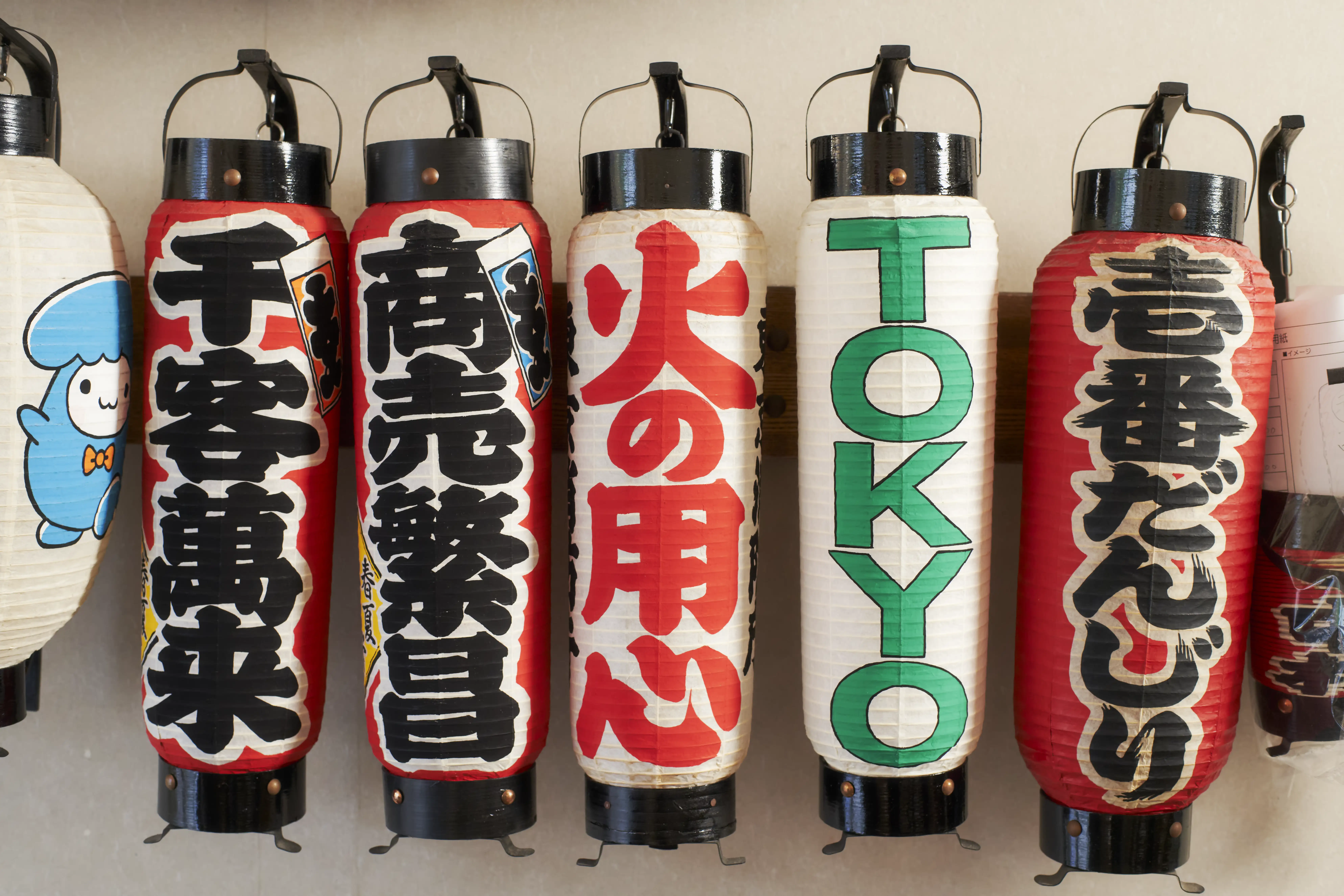
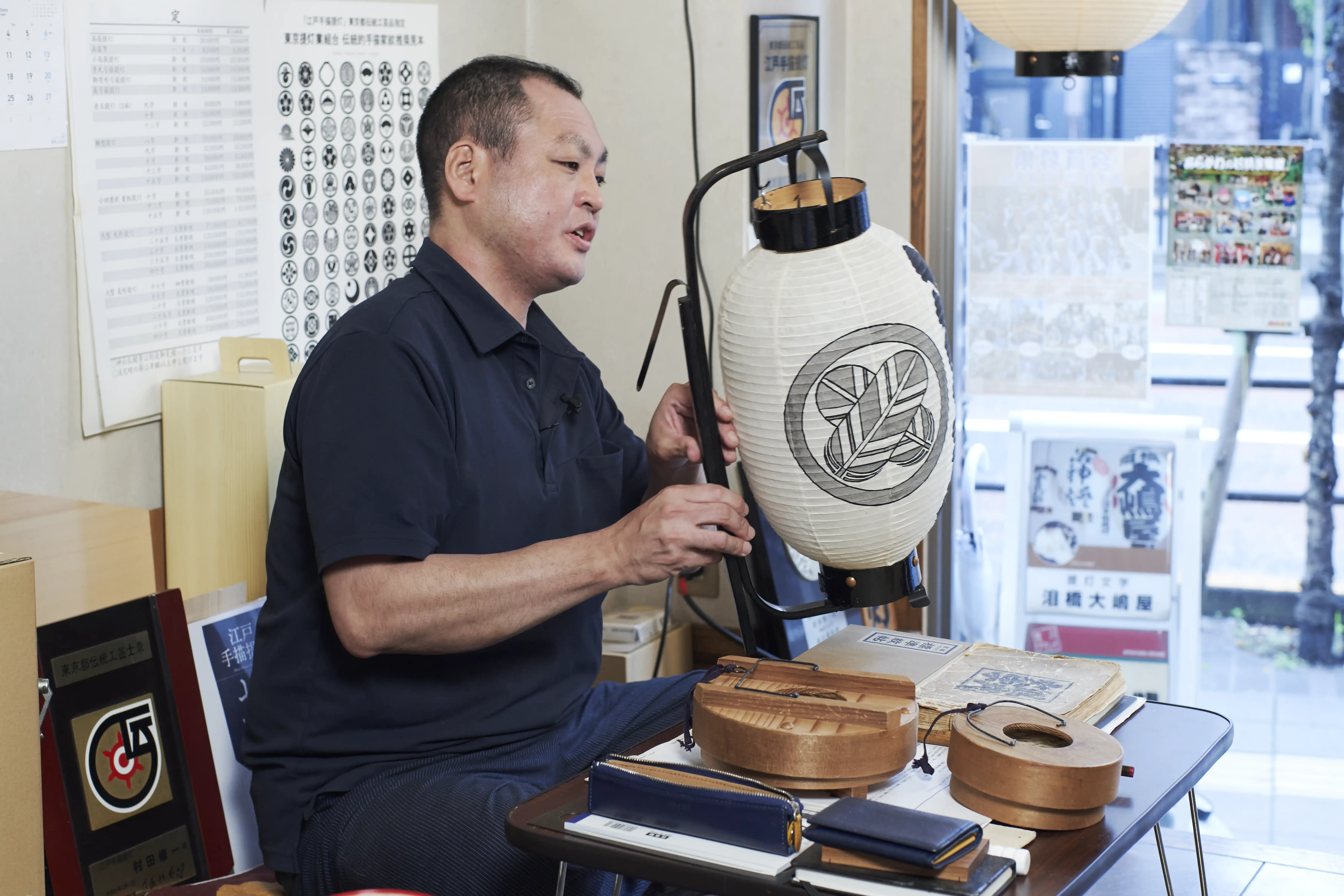
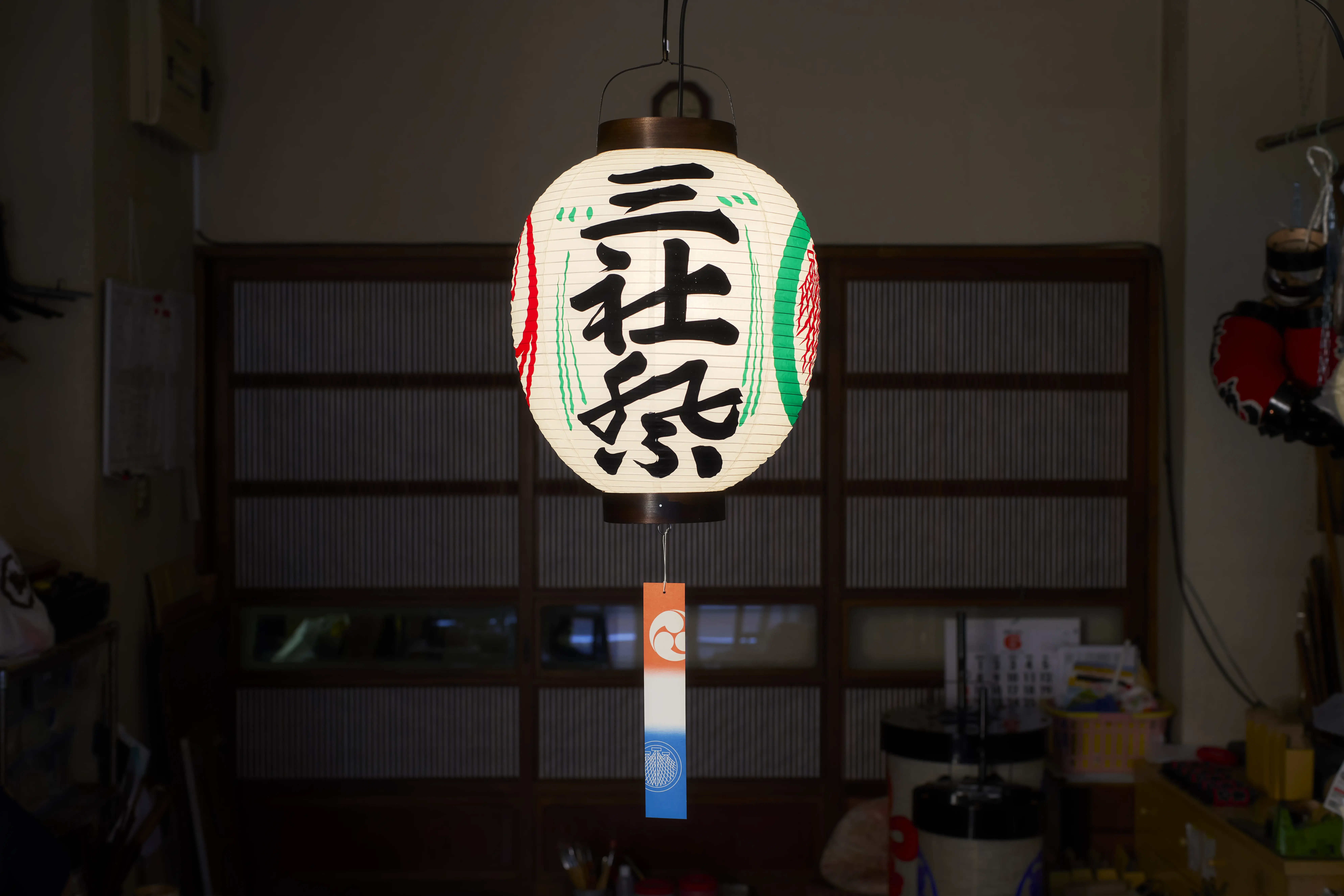
Murata: From the simple Odawara jōchin came the larger hako-jōchin, box lantern, and then the frame was made smaller and the paper section larger to bring the cost back down. The long, narrow nagagata, the round marugata, and the egg-shaped kind — these three have existed since the Edo period and remain the classic examples today. Then there's the yumihari-jōchin, the bow-strung lantern. An Odawara jōchin would tip over, but this one has a bow-shaped piece built in, so it can stand upright or be set on its side. This, too, came about in the Edo period and remains one of the standard forms today.
The range of sizes is wide as well.
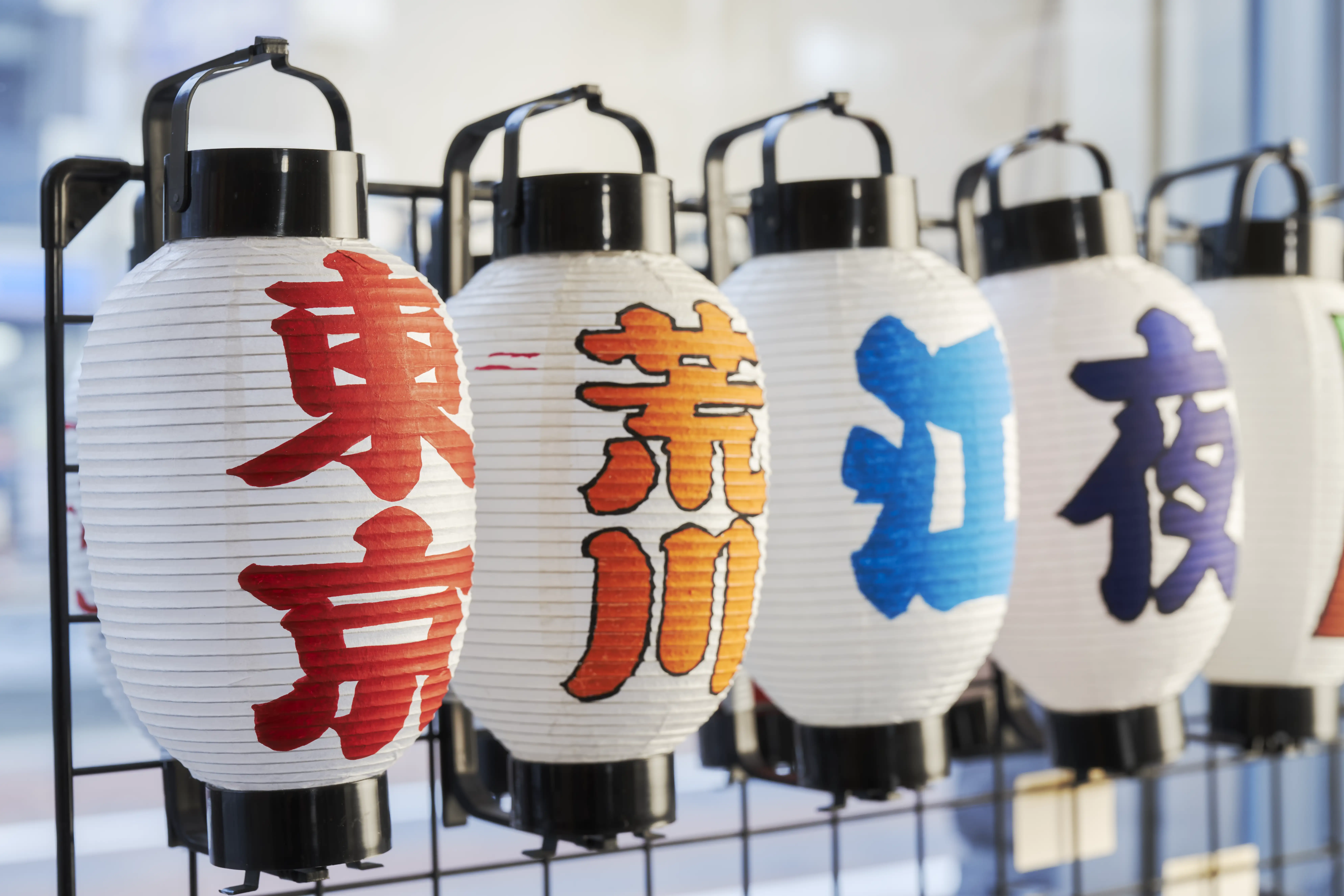
Murata: As for types, you've got the long narrow ones, egg-shaped, round — and sizes are counted in gō, right up to the size of the great lantern at Kaminarimon. Now there are gourd-shaped chōchin too, and a long, narrow kanban jōchin, a signboard lantern. All sorts of types exist. And there's a regional difference too: Kantō lanterns, in Tokyo, tend to be rounded, while Kansai ones are a bit more angular.
Toguri: The lantern most people picture first is the huge one at Kaminarimon. Is that an Edo chōchin too?
Murata: Actually, that one's made in Kyoto. It comes up by truck from Kyoto. There are various connections to different shrines there, and it's made in Kansai — which is why it's a bit more angular rather than rounded. It's a Kansai piece. There's a real wish to make it in Tokyo someday, but apparently there are various circumstances involved.
Once electricity spread, through the Meiji and Taishō periods, the chōchin — which had played the role of a flashlight — stopped being a necessity. Murata explains why it never disappeared entirely.
Murata: Once electricity existed, honestly, it stopped being a daily necessity. From there, I think its use shifted toward something more like signage. But the culture of festivals has remained, and a chōchin is always used at a festival — it carries something of a signboard's character too. I think that's how it managed to survive.
A lantern maker's work never stopped at lanterns alone.
Toguri: I understand that writing the master copy for senjafuda used to be a lantern maker's job as well.
Murata: That's right. Beyond chōchin, since our specialty is really kigō — brushwork itself, writing characters on commission — we've also taken on jobs like "write me a master copy," or writing signboards. There's a history of answering all kinds of requests, simply because we handle lettering as our craft.
Toguri: What settings is a chōchin mainly used in today?
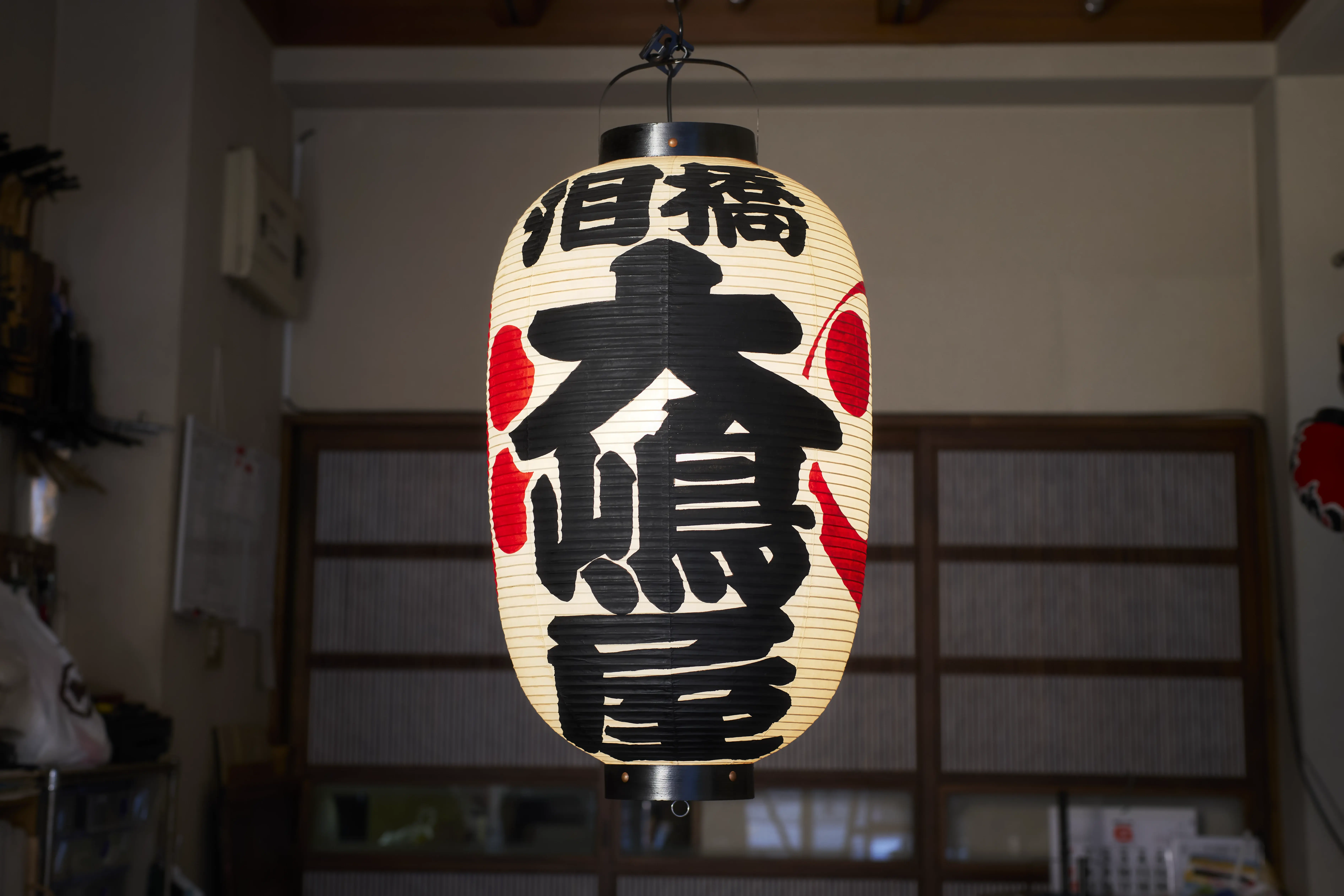
Murata: Shrines and temples, and festivals, above all. From general customers, it's mostly restaurant signs, and lately we also get orders as gifts for births or weddings. At festivals, we write the name of the neighborhood association, or the names of neighborhood association members, or group names, and hang them on a mikoshi. Sometimes people carry a large takahari-jōchin raised on a pole and walk in procession by neighborhood association. For visitors from abroad, I imagine it's hard to tell what a chōchin is for at a festival, or where it's meant to go — but that's the kind of use it has.
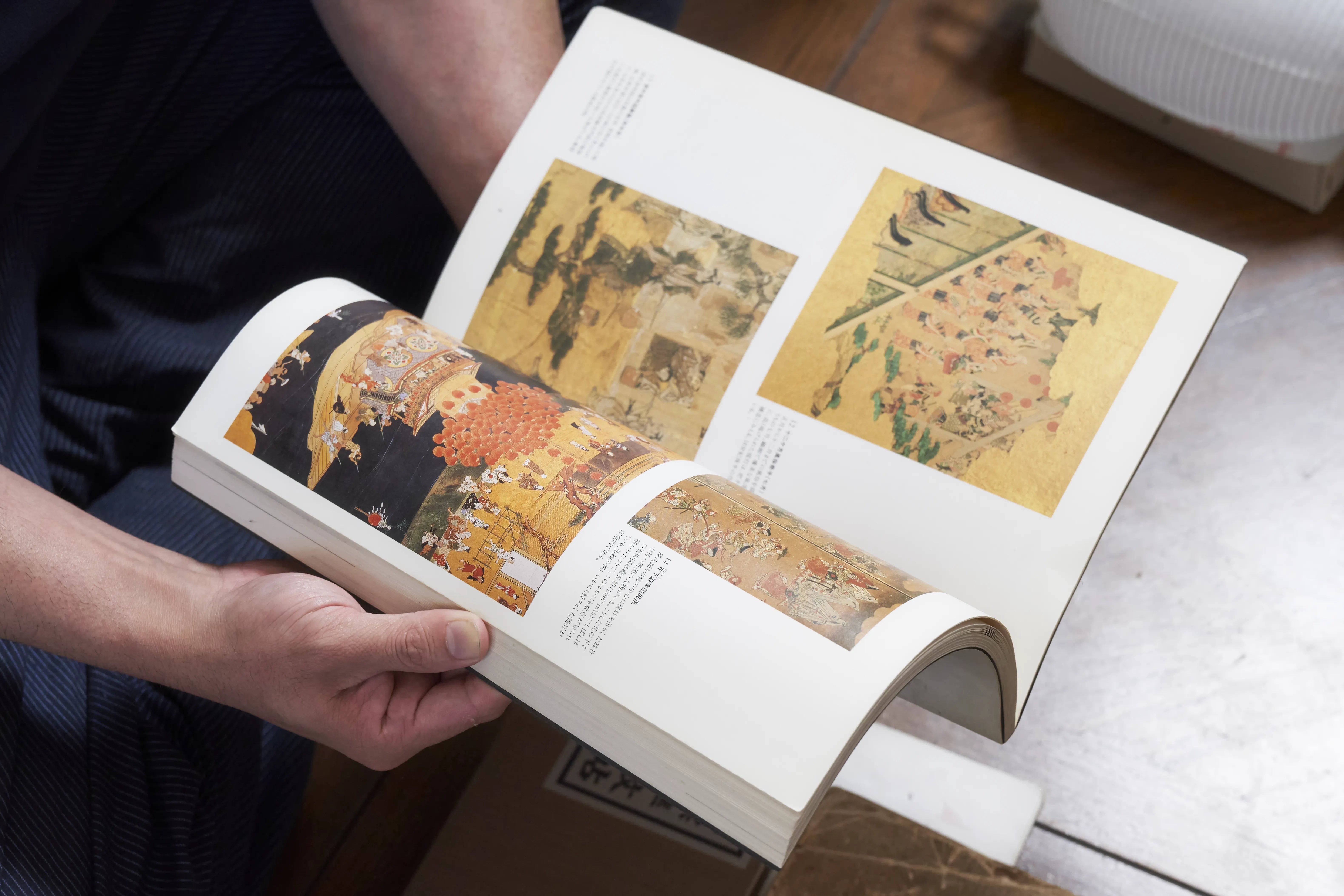
From China, through the Muromachi period, to Edo — the history of the chōchin is the very process by which light climbed down from privilege into daily life. And it survived past the age of electricity, inside the work of festivals, signage, and lettering. The next chapter looks at the lineage of the house that has carried this lantern forward as Ōshimaya, and the ground the shop itself stands on.
The Ōshimaya Name and the Ground Beneath It
A trade name often folds a place and a bloodline's memory into itself. Ōshimaya is no exception.
Toguri: What roots does the trade name Ōshimaya have?
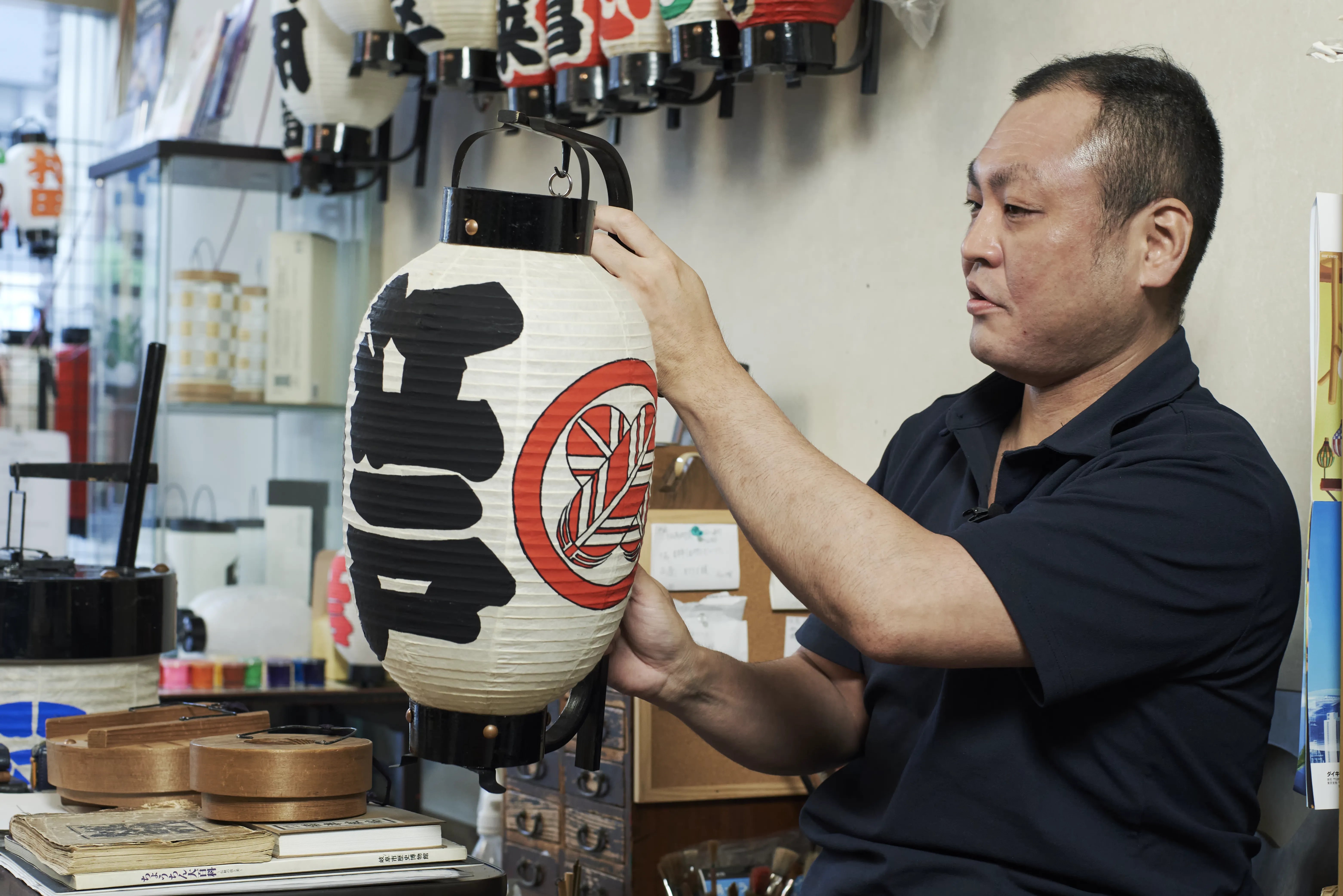
Murata: The main house dates from the Edo period, and it was from there that the name was passed down through noren-wake. The main house stood in Asakusa's Kotobuki-chō, but it was lost in the wartime bombing. Several Ōshimaya that branched off from it are still around today. The shop on the Kotsu-dōri shopping street is "Kotsu-no-Ōshimaya"; the one on Dote-dōri is "Dote-no-Ōshimaya." Ours is at the Namidabashi intersection, so we took the place name and became "Namidabashi Ōshimaya."
The main house was lost, and each branch house has kept its own character since — how does Murata see that arrangement?
Toguri: How do you feel about the way each shop that received a noren-wake has held onto its own craft?
Murata: Every lantern maker, every craftsman, has their own distinct lettering character. In our case, my master is my father, so I was taught his particular character — smooth but forceful, writing as thick and large as possible — and that's what I work in. Compared to other shops, the shape of the flicks and stops, the balance, is all slightly different. Each has its own lantern character, you could say.
Division of labor, too, is part of the skeleton of this trade.
Toguri: Could you tell us about the background of lettering becoming its own specialty?
Murata: The division of labor goes back to the Edo period. The craftsman who stretches the chōchin, pasting the washi on, is separate from the one who does the lettering. The processes are different, so it's more efficient to split them. And since Edo — Tokyo — has always had so many festivals and so much demand, dividing the labor makes even more sense.
This place's year turns on the calendar of its festivals.
Toguri: Which part of the year tends to be busiest?
Murata: Around here, it's the Sanja Matsuri and Kanda Matsuri in May. In June there's the local festival and the Torigoe Matsuri, and from there festivals keep coming almost every week across the city. July and August bring festivals and Bon dances out in the regions. Tori-no-ichi falls in November. For Tori-no-ichi we have to deliver a hundred lanterns in a month, so working backward, we need to make at least five a day just to keep up. Whenever festivals keep coming week after week, that's the real busy season.
The workshop is continuous with the life around it.
Toguri: How does a typical day begin?
Murata: The shop opens at nine in the morning, and we live right above it. I come down at nine, check email on the computer first, and once that's done I get into the work. There's no fixed rule like "this has to be done first thing" — if there's something left over from the day before, I do that; once it's finished, I move to the next job. As long as it's done by the deadline, that's the approach. If a workshop experience is scheduled, I clear that time and work around it. I move forward in fairly distinct chunks like that.
In the same space, the third generation is at work.
Toguri: How do you and the third generation coordinate with each other?
Murata: When I first started, I couldn't do it all myself, so the division was: I'd do the kamon, and the third generation would do the lettering. Now that I can do both, we mostly split by job. It's more like, "I'll take care of this, you do that." Whoever has free hands at the time takes whatever has the earlier deadline. I might take on the Bon dance orders myself, or pass something to my father if I'm backed up. That's how we keep things moving. Once the two of us have done the outlining, honestly, even my mother can handle the filling in.
"Once the two of us have done the outlining,
honestly, even my mother can handle the filling in."
— Kenichiro Murata
A main house lost in Asakusa's Kotobuki-chō, several Ōshimaya branching off from it, and one point on the map called Namidabashi — a trade name holds both what was lost and what remains. And it's under that name that Murata faces, day after day, the work of the next chapter: writing itself.
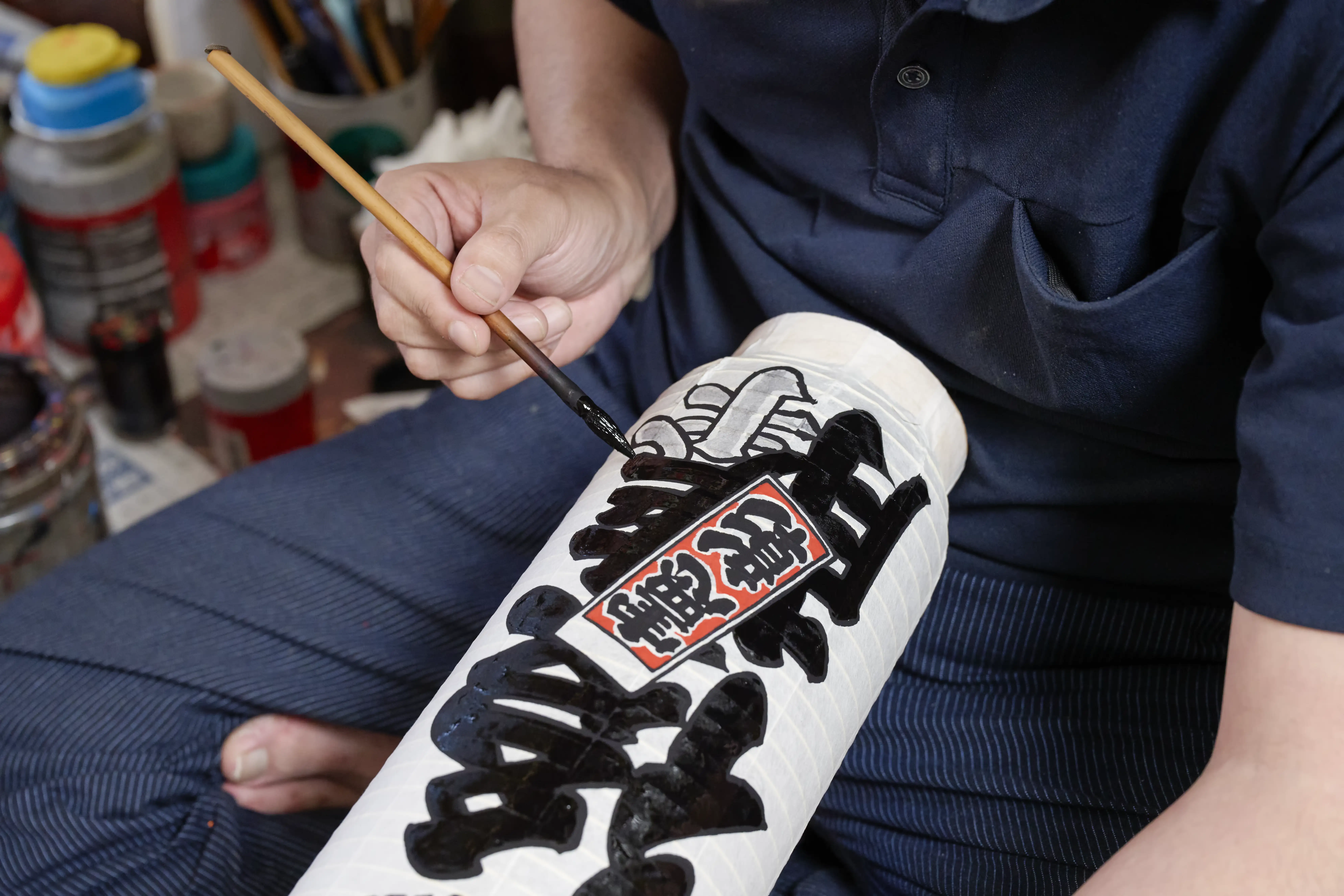
Kago-moji — Letters Drawn from the Outline In
The lettering written on a chōchin has its own name. And that lettering follows a fundamentally different sequence from calligraphy done on flat paper.
Toguri: How would you classify the lettering used on a chōchin?
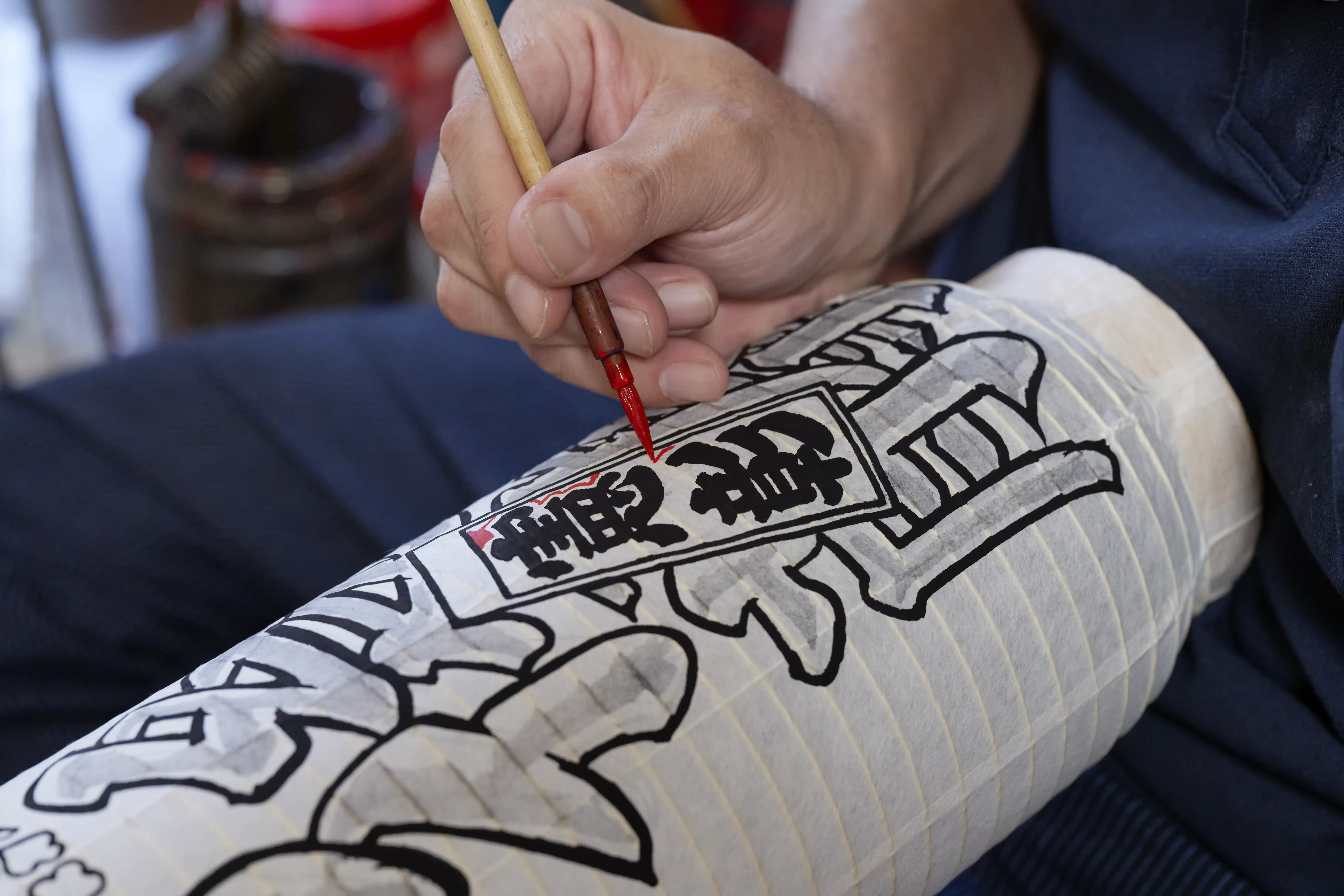
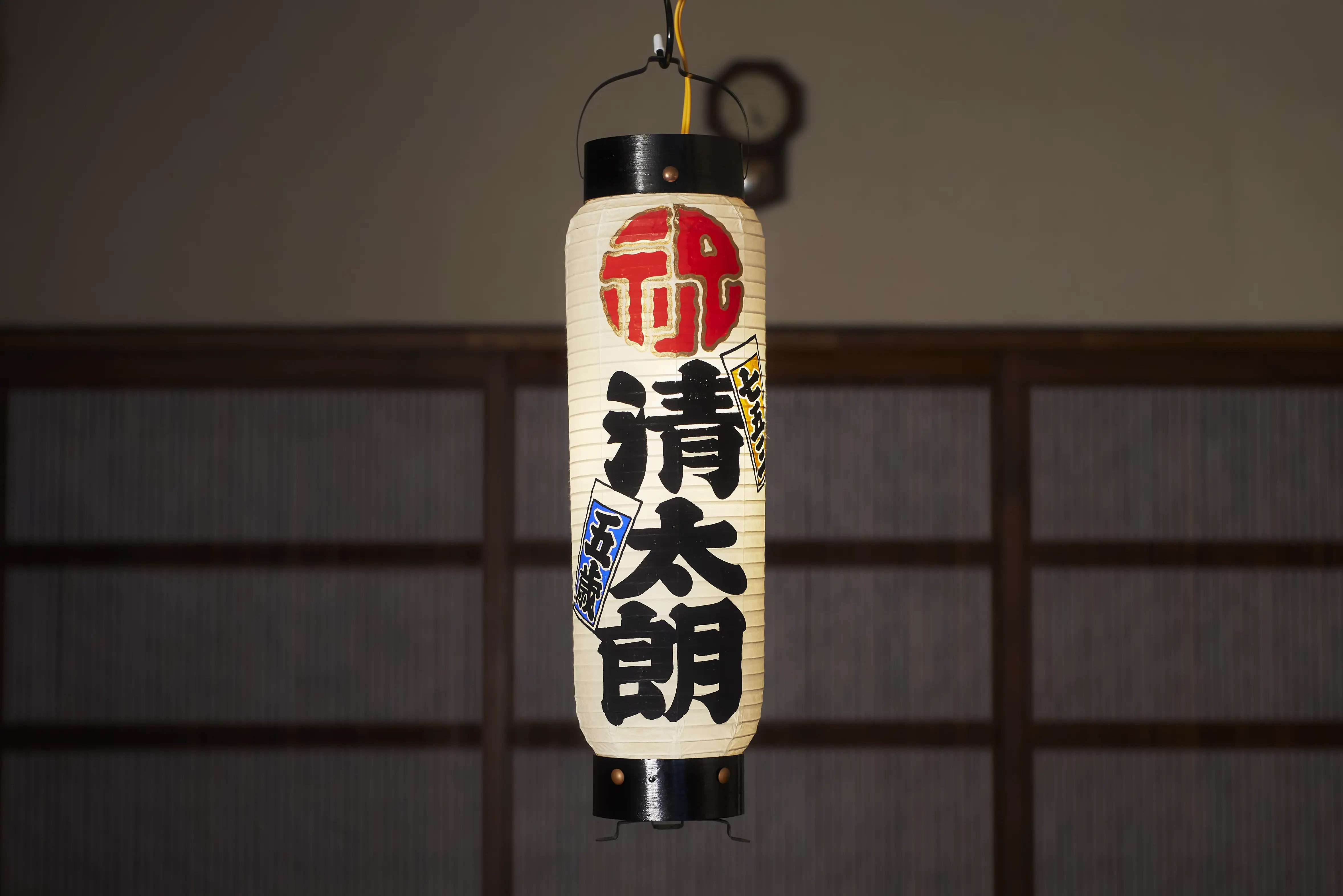
Murata: What's written on a chōchin is called Edo-moji — a general term for lettering styles created in the Edo period, and there are several kinds. For kabuki it's kantei-ryū; for rakugo halls, yose-moji; for sumo, sumō-ji. All of these fall under Edo-moji. Within that, what's drawn on a chōchin is a style called kago-moji — literally, lettering where you take the outline first, then fill in the inside.
Toguri: What's distinctive about Edo hand-painted lanterns specifically?
Murata: As I mentioned, the shape differs between Kantō and Kansai — rounded in Tokyo, a bit more angular in Kansai. But rather than that being the real distinguishing feature, an Edo chōchin is really defined by its emphasis on the writing itself: making the letters as thick and as large as possible. That's what characterizes an Edo hand-painted lantern.
The process that makes this "thick and large" possible, on top of a bumpy, three-dimensional surface, sits at the very heart of kago-moji.
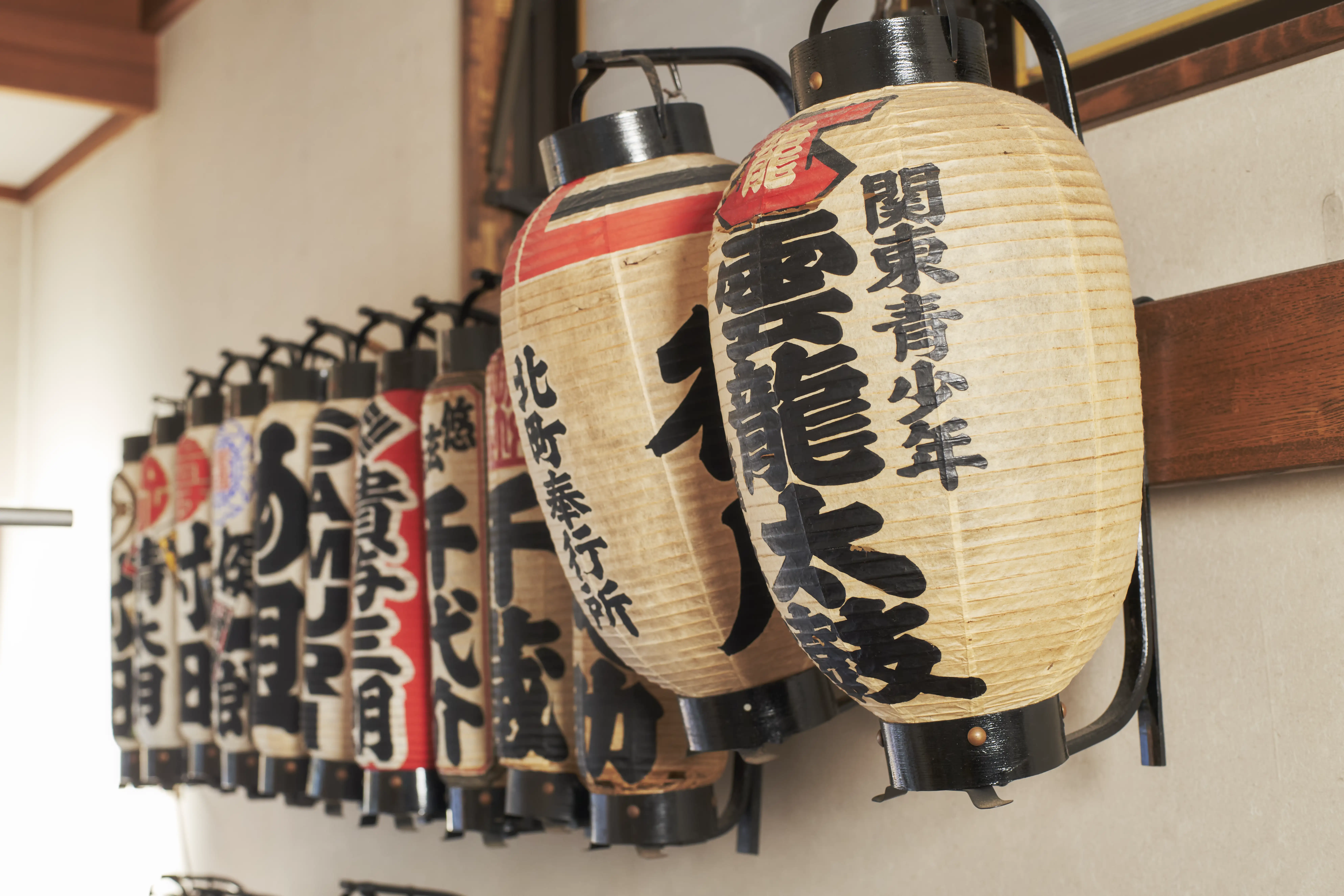
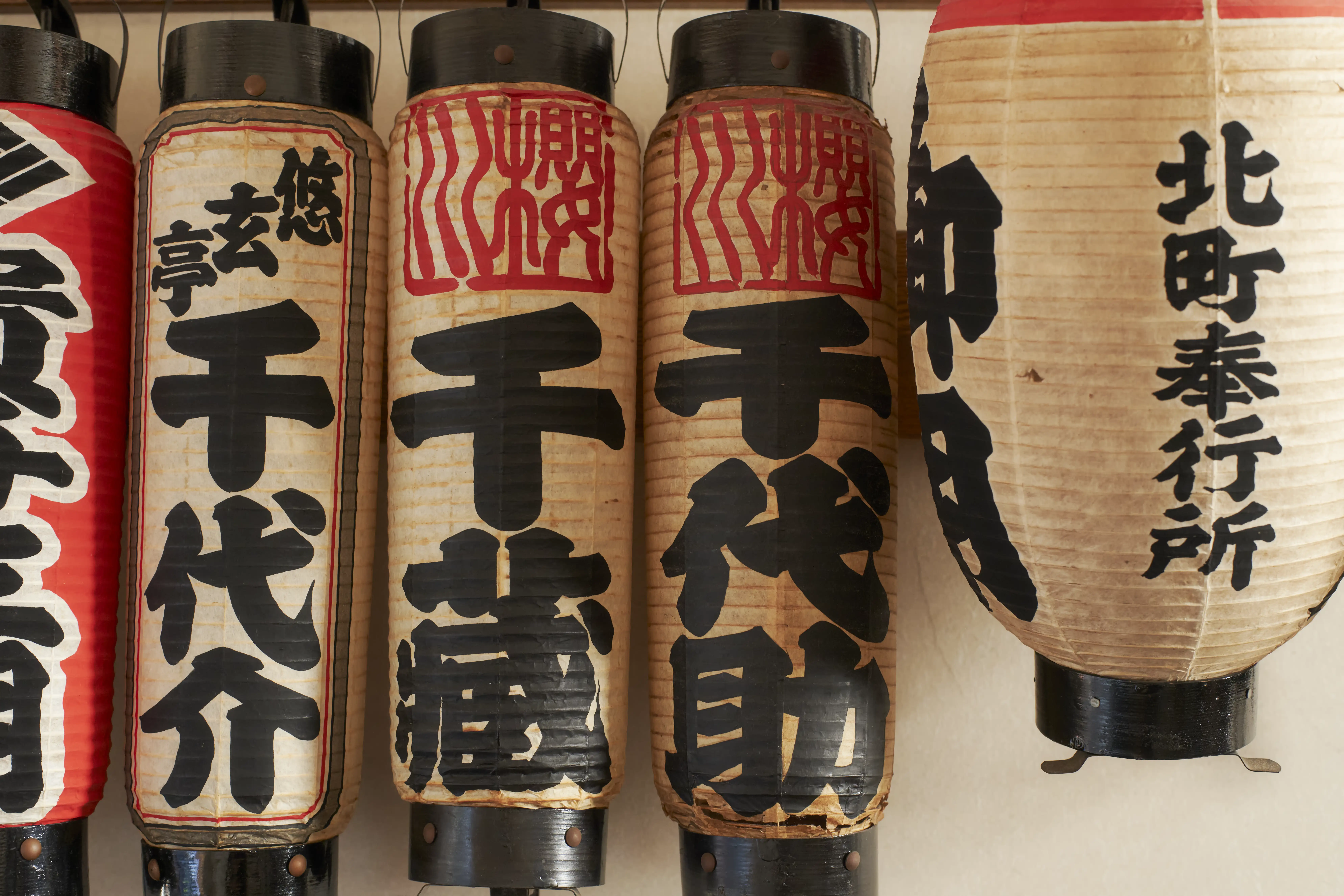
Toguri: What kind of care goes into writing on a chōchin specifically?
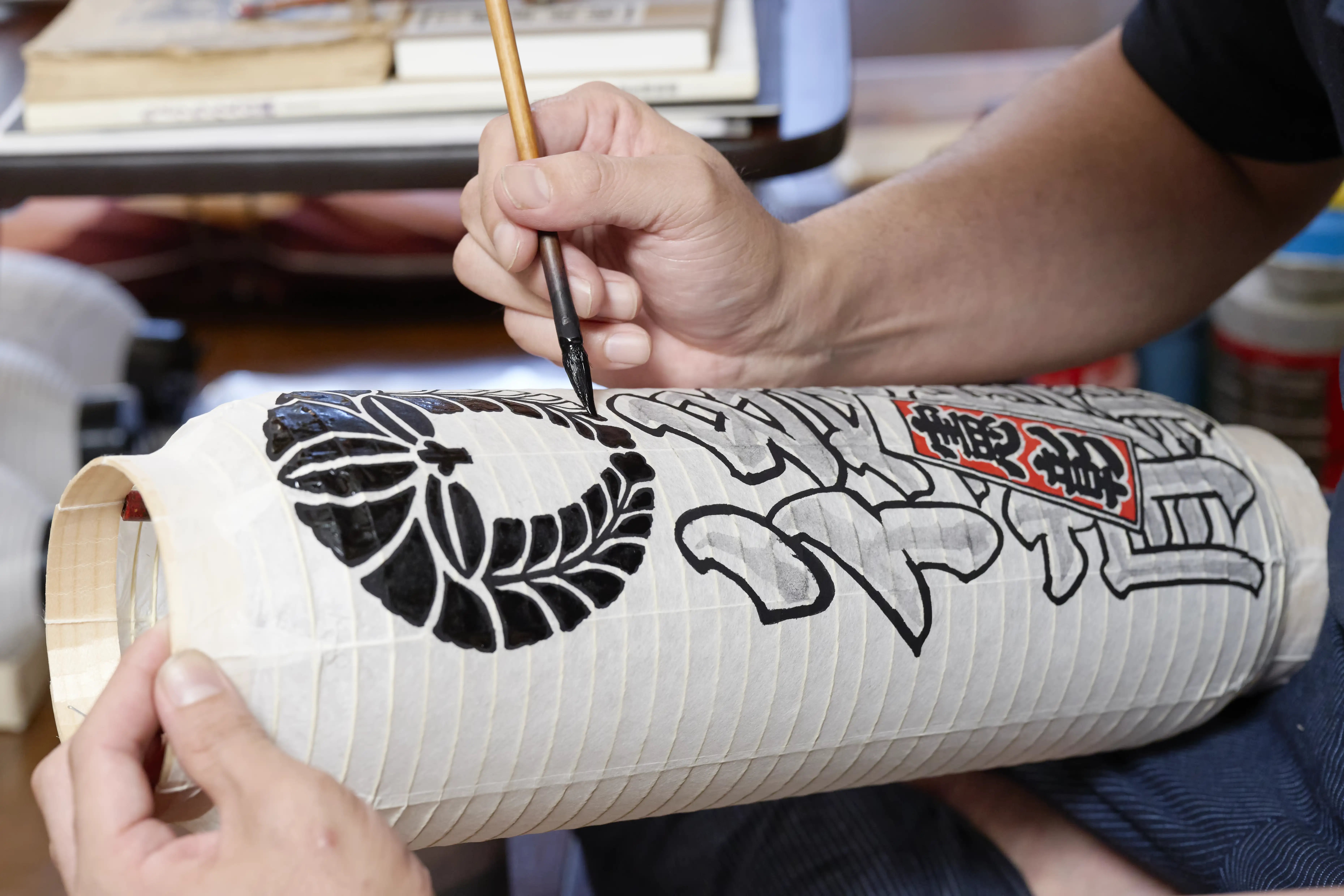
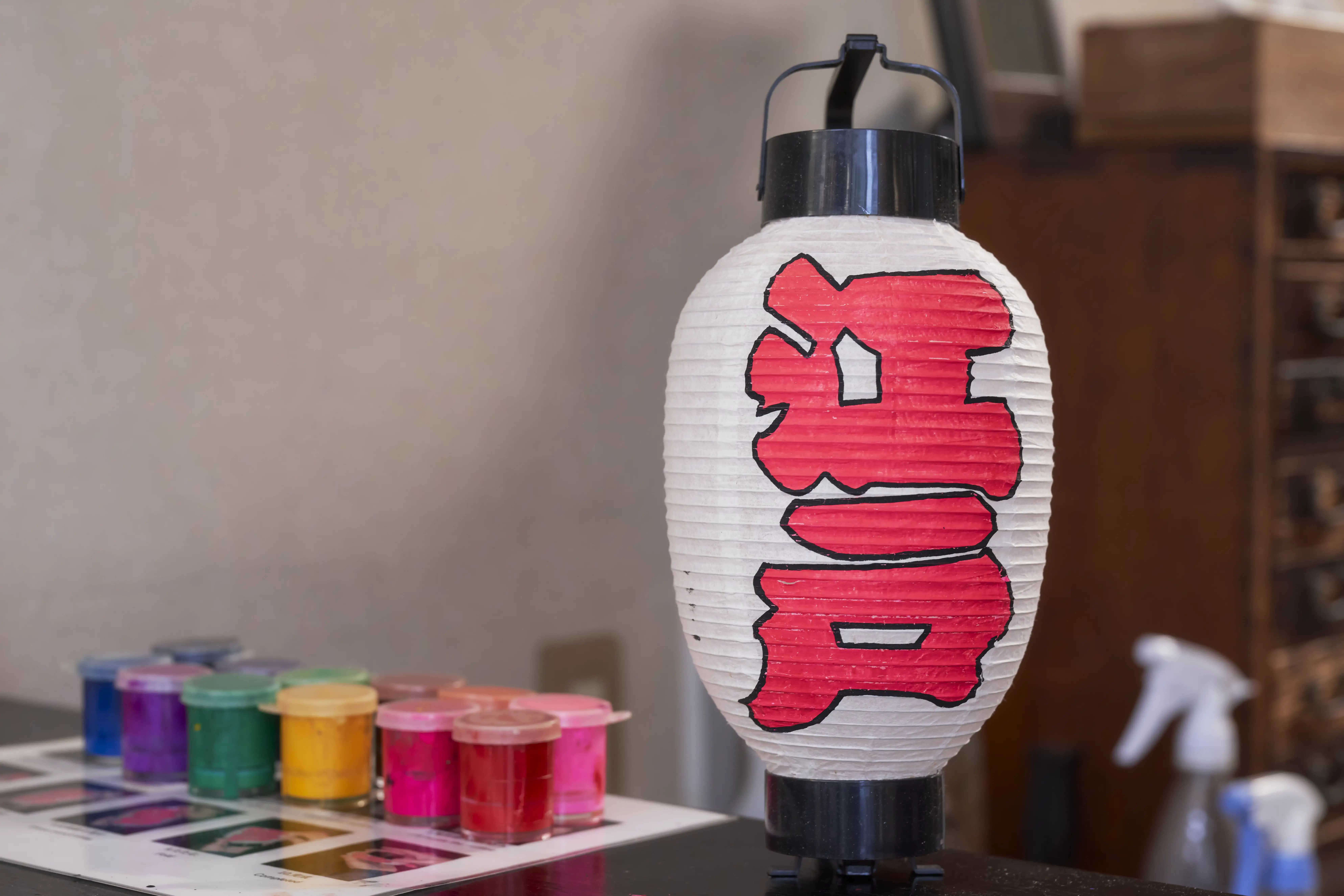
Murata: Because a chōchin is bumpy, if you wrote it in a single stroke the way you would in calligraphy or handwriting practice, it would come out rough and broken. So you take the outer edge — the outline of the character — first, then fill in the interior. First you do a pencil rough sketch and get the balance roughly right. Over that, you draw the outer line in black paint — the sobyō, the outline drawing — and once that's done, you fill in the interior, and it's finished.
Toguri: Which part of that process is especially difficult?
Murata: The initial rough sketch is what matters most. If it's off at the pencil stage, everything ends up off. So that stage is the hardest. Beyond that, the skill is in adjusting little by little as you follow the sketch. The balance also changes with the number of characters — a three-character chōchin and a ten-character company-name chōchin are different, since with ten characters you have to compress the width, so the letters get smaller. That means widening the spacing, and adjustments like that. Drawing the outline is really where the balance is hardest to get right. The filling in, honestly, my mother could do.
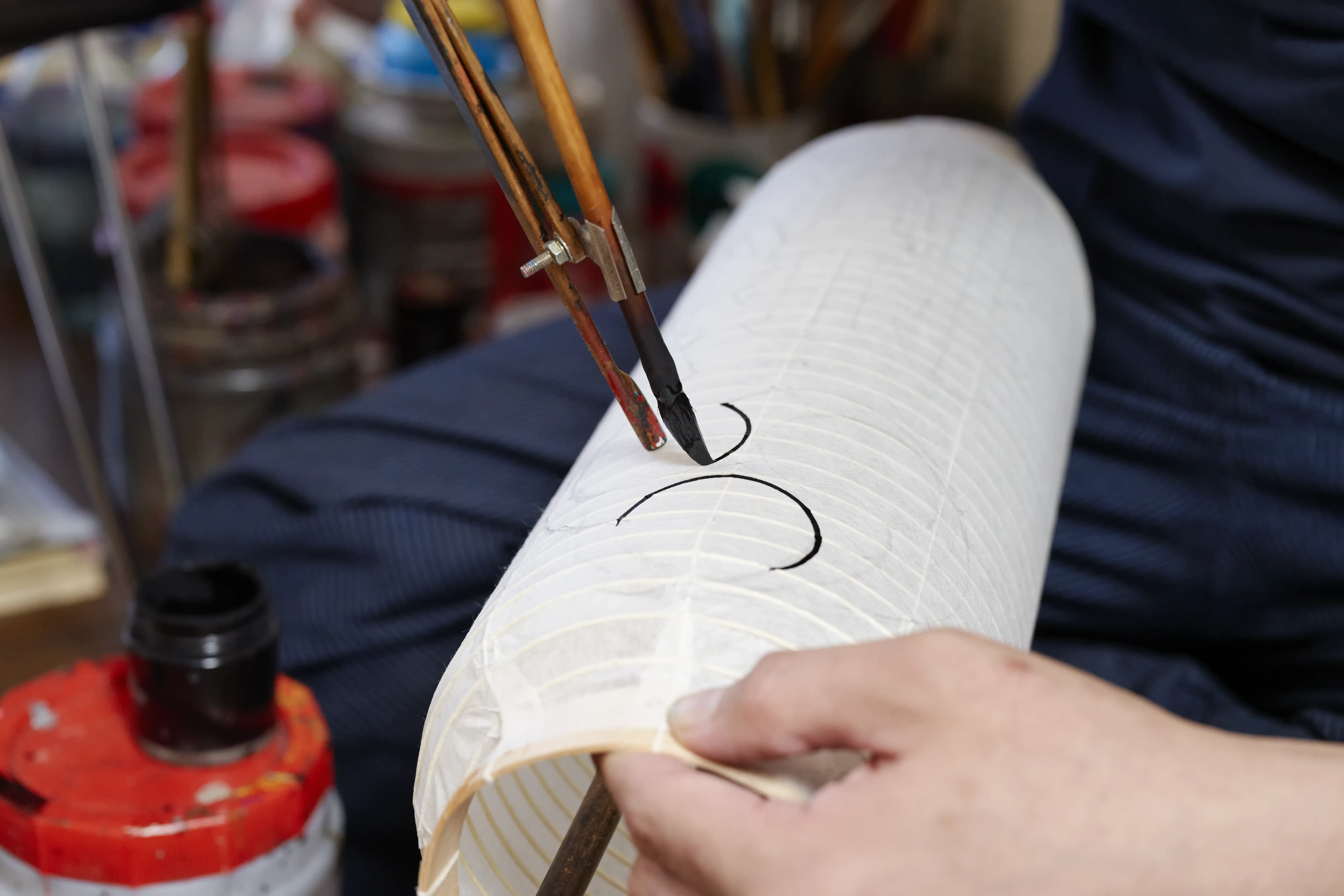
Toguri: There must be times when you make hundreds of chōchin with the same content — is there still room for adjustment even then?
Murata: If it's genuinely identical content, there's not much to adjust, but for something like Tori-no-ichi, every single one is different — different character counts, different balance, different sizes. So unless it's truly identical, I'm thinking as I write. It looks like the same task every day, but really, I'm working out the layout freshly each time.
The kamon, too, follows its own set of conventions specific to lanterns.
Toguri: I understand there are different rules from the kamon used on a kimono.
Murata: A kimono has a colored ground, so on a black kimono, for instance, the kamon goes in white. A chōchin has a white ground, basically, so the kamon is drawn in black. Something drawn in white and something drawn in black call for a different sense of balance. So the way you handle a kamon on a chōchin is different from how you'd handle one on a kimono. And these days, you can just look a kamon up on your phone, but that's a bit different from the traditional way of drawing it. I want to keep that traditional way of writing alive.
And why this work has to be done by hand — Murata's answer was direct.
Toguri: Where is it that a machine simply can't substitute for you?
Murata: You're not pasting something you've written onto a chōchin — you're writing directly onto something that's already three-dimensional. I don't think there's any technology that can write by machine onto something in that state. You can paste on something printed, but then, because it's three-dimensional, the letters distort. Doing it by hand, you can adjust for that — widening out a part that's caved in, for instance. Once a chōchin is finished, I think a machine would struggle.
"You're not pasting something you've written onto a chōchin
— you're writing directly onto something that's already three-dimensional."
— Kenichiro Murata
This isn't work copied onto a flat surface — it's work that moves the hand to match a curve, and the outlining of kago-moji is one continuous act of adjustment. The next chapter turns to the tools this hand holds, and the materials that make up the hibukuro.
Ink at Dawn, Acrylic Today
The white body of a chōchin — the washi that makes up its hibukuro — and the brush Murata holds both carry the history of this trade folded into them.
Toguri: What kind of washi do you use?
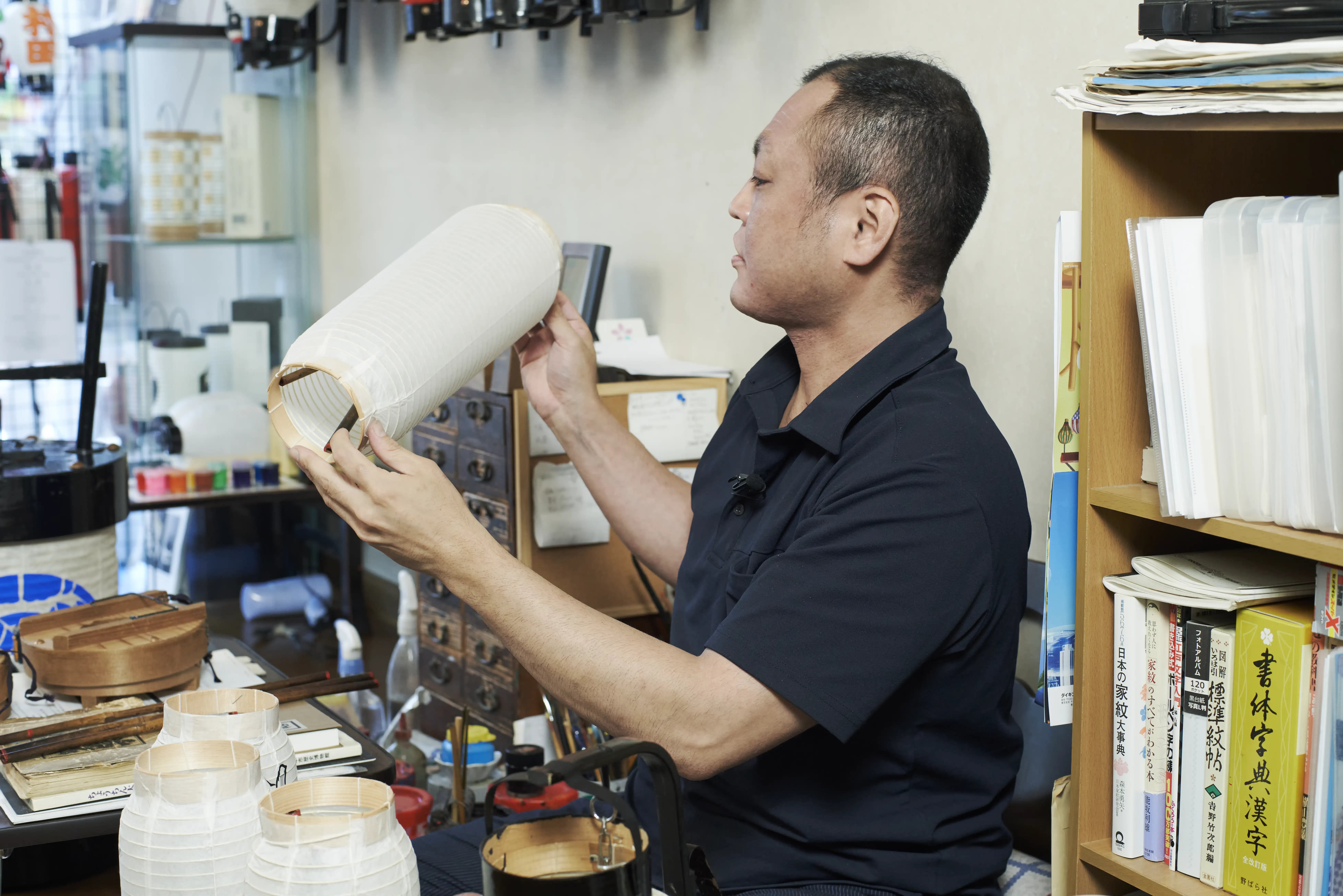
Murata: We use a brand of washi called Nishinouchi, from Mito in Ibaraki. It's an extremely durable paper. But since this is a divided trade, it isn't really something we choose ourselves — when you order a chōchin, it arrives already stretched with that washi. So it's less a matter of choosing the material itself than choosing the chōchin.
That hibukuro has an unexpected weakness, too.
Murata: The washi is pasted on with glue, and since it's a starch-based glue, if there happen to be cockroaches around, this area gets eaten. When you notice, "huh, this has been eaten," that becomes, "ah, there are cockroaches around." So we keep an eye on that. It's precisely because the material is a natural one that things like that can happen.
There's also a deliberate matching of material to use.
Murata: If someone's going to carry a takahari-jōchin on a bamboo pole, we recommend bamboo, since it's lighter — better to have something light when it's held up high. Bamboo comes out roughly a third lighter than wire, in my sense of it. On the other hand, if it's just going to hang, we might recommend wire instead, since bamboo has no knots and looks tidier. And for anything that'll get rained on outside, we use vinyl. Bon dances are entirely outdoors, so vinyl that can take the rain. Tori-no-ichi could use vinyl too, but temple staff often feel that vinyl and washi carry a different character. So for Tori-no-ichi we make it in washi and then put a clear vinyl cover over it for outdoor display.
The history of the paint itself carries the very mornings of the craftsmen who came before.
Toguri: I understand ink used to be the material of choice.
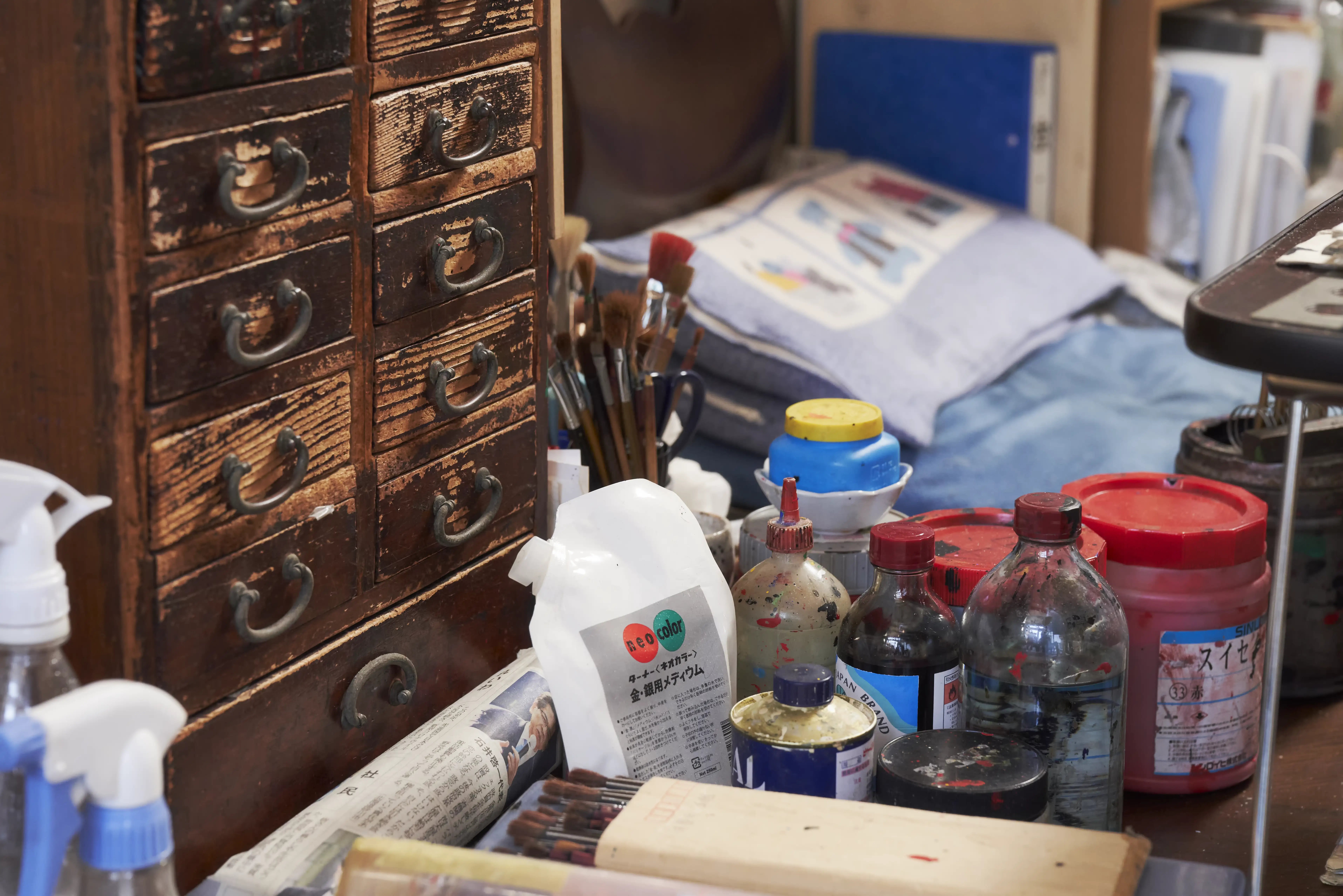
Murata: In the lantern trade, playing off the saying "peach and chestnut, three years; persimmon, eight," people used to say "three years grinding sumi, eight years drawing." The three years meant nothing but grinding ink. My father, the third generation, apparently used to grind a full day's worth of sumi first thing every morning, back then. Ground sumi goes bad by the next day, so you use, that day, only what you'll need that day. That was genuinely hard, and once acrylic-based water paints came out, I hear everyone switched over to those. These days we use commercially available acrylic-based water paint ourselves.
Toguri: Do you have particular preferences when it comes to brushes?
Murata: The fine lines of the sobyō are drawn with a mensō-fude, a brush made for thin lines. For filling in, we use a larger hake for a larger chōchin, and so on — the brush matches the scale of what's being written. But brushes are consumables. As you use one, the tip splits or stops holding its shape, and once that happens, you replace it. There are actually fewer brush shops handling this kind of brush these days, and it's become something people in the trade ask each other about — "where are you buying yours?" Some of us still have old stock left over, but the question is where to buy once that runs out. Some other lantern makers order through Monotaro. It's not that we fuss over brushes the way you would in an art form like calligraphy — more that we just need something that works for the purpose.
As tools and materials grow scarcer, the larger-scale jobs still stay in memory.
Toguri: Is there an order that's stayed with you as the most memorable, over the years?
Murata: Large lanterns are rare, so those stand out. When I was still training, I once saw my father working on a lantern about 180 centimeters tall, and that's the one that made the strongest impression. Round, big enough to fill the whole shop — large enough that I could have climbed inside it myself. I remember characters that looked like Namu Amida Butsu (a Buddhist invocation of Amida Buddha) on it, so I think it was a lantern for some regional temple — something meant to be displayed at a temple, the way the Kaminarimon lantern is. Nothing I've seen since has topped how big that one was.
Tools and materials speak to both an unchanging procedure and a changing supply of what feeds it. And within that, Murata has also produced work that belongs to his own generation.
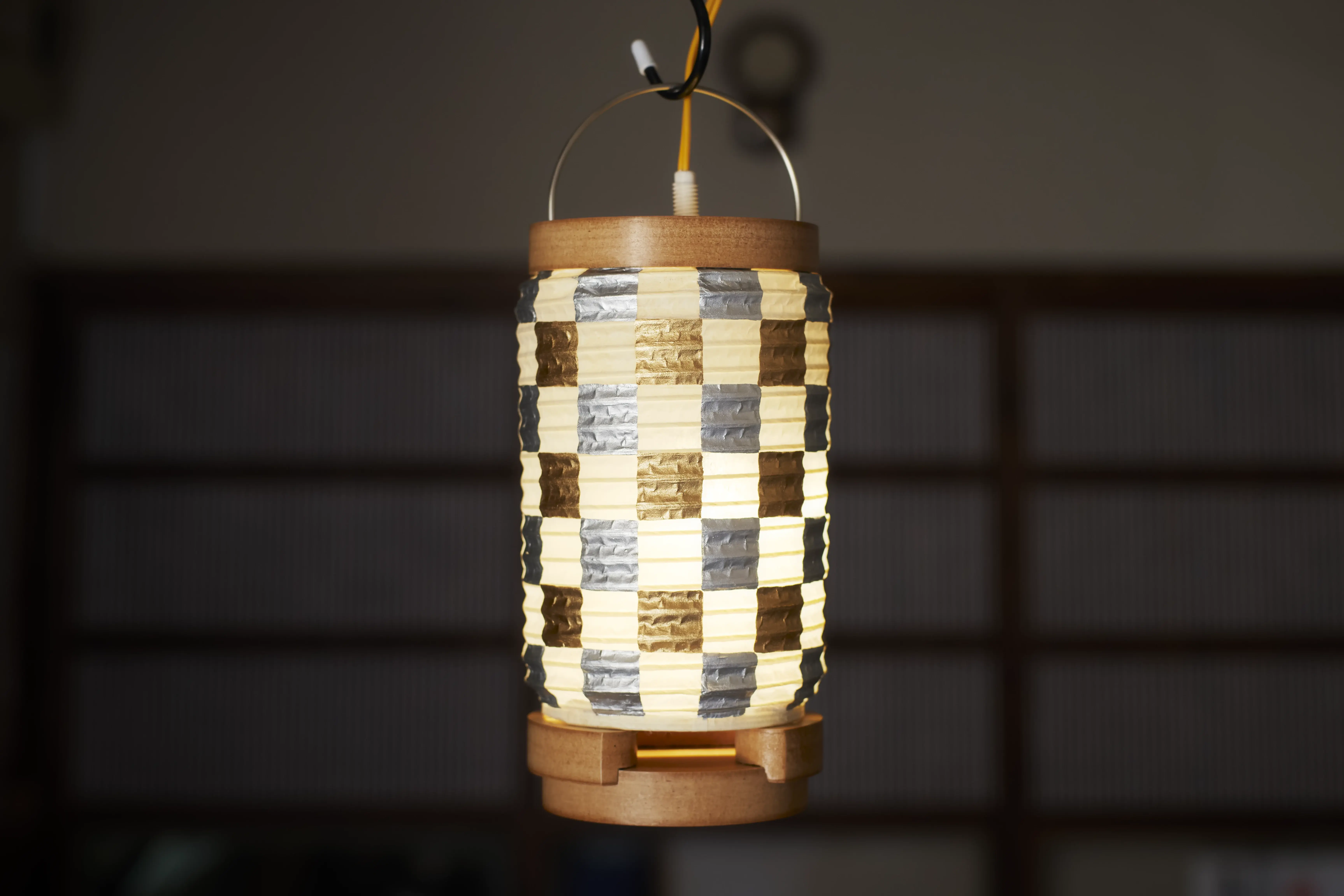
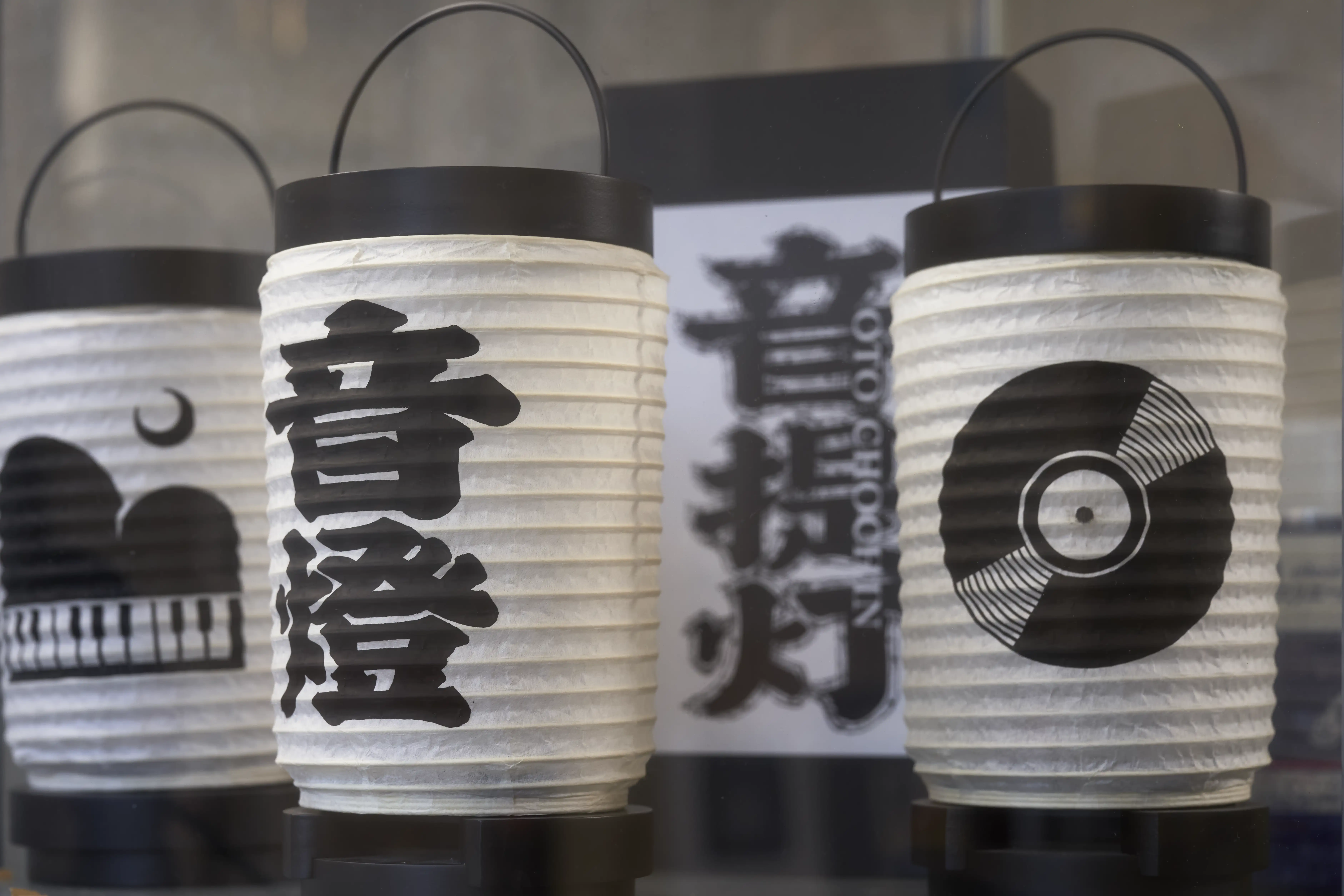
Murata: I developed a chōchin that's exclusive to our shop. It came out of a Tokyo Metropolitan Government project, where a designer and a craftsman team up to create a new product — this one took about a year to develop. It's a one-of-a-kind lantern, unlike anything other lantern makers have.
From mornings spent grinding ink to acrylic paint today — materials and tools have both changed, and yet the single sequence of outlining, then filling in, has been carried through unbroken. The next chapter is where a visitor gets to touch that same motion for themselves.
Writing Your Own Lantern
At Ōshimaya, visitors can actually write characters, a kamon, or a logo onto an already-stretched chōchin, and take it home the same day. Followed step by step, the process looks simple — but there are things you only understand once you've tried it yourself.
Toguri: What kind of person would you like to have this experience?
Murata: People interested in traditional crafts or chōchin, and people who just want to try writing by hand. This is a traditional craft that's continued since the Edo period, so I'd love for people to feel both the appeal and the difficulty of doing it by hand, and the chōchin itself, which has survived all this time.
The experience isn't something thrown together on the spot.
Toguri: What kind of preparation do you do before a customer arrives?
Murata: Beforehand, I ask what they'd like to write. If it's a logo, I put together a master copy sized to fit the chōchin, and do the pencil rough sketch myself in advance. That way, the customer isn't writing cold — they can trace along the sketch. Even so, it never quite goes the way people expect.
Toguri: What tends to surprise first-timers?
Murata: People often say, "this is harder than it looks." Because a chōchin is bumpy, that's the hard part — it doesn't go the way you'd think. Color is another one. Since a chōchin has light inside it, any unevenness becomes very noticeable once it's lit. So people try to paint as evenly as possible, and quite a few really struggle with that too. What we, as craftsmen, treat as second nature turns out to be genuinely difficult in the experience.
Toguri: With other crafts, people often work in complete concentration, silently — how is it with a chōchin?
Murata: With a chōchin, actually, it's fine to keep talking while you work. A lot of families come together, and since even children can do it, they often enjoy it together as a family. Some couples chat normally the whole time; some people work in complete silence. Either way is completely fine. I think it's also an easy thing for a group to take on together.
The way people choose what to write has its own particular scenes, unique to this experience.
Toguri: What kind of words do visitors from abroad tend to choose?
Murata: Kanji don't mean anything to visitors from abroad, so we've made a list of characters people tend to like. More often than a name, people choose a favorite word — ai, love; kazoku, family; fuku, good fortune, that kind of thing. Those are pretty popular choices. For color, we use acrylic-based water paint, and people can choose freely from about ten colors we keep on hand — red, orange, pink, blue, purple, brown, and so on.
What actually draws people from abroad in has become clearer through the day-to-day of running these experiences.
Murata: There are things you stop noticing once you've lived in Japan your whole life, and visitors from abroad make me notice them again. A chōchin, to start with, simply doesn't exist outside Japan. Since it exists nowhere else, it works as a souvenir — "chōchin means Japan." We do sell printed souvenirs too, but when I say, "this one's printed, this one's hand-written," people choose the hand-written one even though it costs more. I've come to feel, lately, that people really do like the hand-written version. And being able to make it to order is probably a strength too — once, we even had a request to write a French visitor's name on a large chōchin.
The experience never happens alone. A craftsman stays close at hand, and in the back, the third generation is at work.
Toguri: What's distinctive here that you can't get anywhere else?
Murata: If the third generation happens to be working in the shop, you can actually watch him while you write. I stay one-on-one throughout the experience, so even if someone can't do it at all at first, we can keep teaching as we go. Being able to talk with a craftsman at this kind of distance, I think, isn't something you find easily elsewhere.
Toguri: How do customers seem once the experience is over?
Murata: Beforehand, everyone tends to worry, "can I really do this?" But with the rough sketch in place, and me helping along the way, people usually end up doing better than they expected, and leave satisfied. That's the case for most people.
"This is harder than it looks."
— a first-time visitor to the experience
What you understand by watching, and what you only understand once you've moved your own hand — that gap itself sits at the core of this experience. The bumpy surface, the unevenness that shows once it's lit, the practice of writing thick and large — the texture of it, the part reading alone can't quite capture, is what stays here.
Closing: A Fate, Carried Forward
What does an Edo chōchin mean to the fourth generation? Murata describes it as the family trade, and something more than that — a fate, and a calling, that comes with simply having been born the fourth generation. There's no strain in how he says it. But in that single word sits not resignation, but the weight of taking something on: if he doesn't do this, the work itself disappears.
Murata has no intention of treating that fate as something closed off. During the years when he couldn't yet do the work, he says he thought about quitting more than once. Even so, more than a decade on, he can now write on his own, see a finished chōchin bring someone joy, or come across a piece he wrote himself hanging at a shrine — a chōchin looks slightly different, hung outside, than it did in the workshop where it was written, and confirming that difference is what carries him toward the next one. The reward lives in the accumulation of small, unglamorous confirmations like that.
At the same time, the ground beneath this trade is quietly thinning. Lantern makers are dwindling, and without a successor, the line simply ends — something true, Murata says calmly, not only of chōchin but of artisans across traditional crafts generally. It can't survive as a hobby. If it doesn't work as a livelihood, no one comes forward wanting to inherit it. So Murata treats carrying on the technique and building the work itself into a viable livelihood as one inseparable task. In the old days, a lantern maker could get by almost entirely on local trade. That's no longer quite true — but the flip side is that this is also an age when a website or social media can carry the work out to the whole country, to the whole world. Wanting to spread Edo hand-painted lanterns beyond the neighborhood and out into the world — that's the language of someone who has taken up his fate and carried it forward, willingly.
His son, the prospective fifth generation, apparently says he wants to be a pilot, for now. Murata has no intention of forcing the issue. He's simply working out various small strategies — sharing the appeal of the work, having him help out here and there — and as he talks about it, he seems, somehow, to be enjoying himself. Whether three years of drawing kamon will one day be asked of someone else again is still an open question.
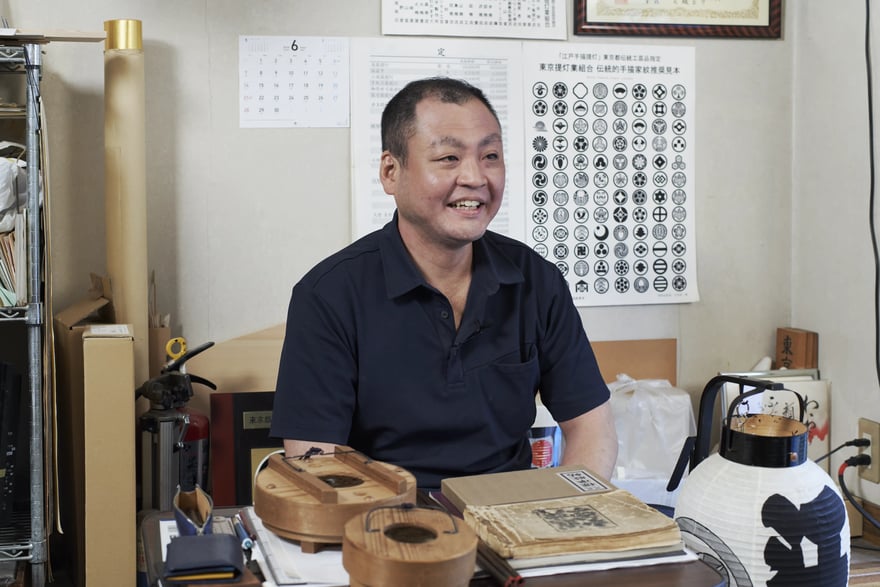
At the shop in Namidabashi, lanterns from Tori-no-ichi hang overhead, well-worn tools sit in their places, the fourth generation has come down from upstairs, and the third generation sits where he always sits. This is as far as words can carry it. The speed of a brush tracing a pencil line, the faint held breath of drawing an outline — these are things film conveys far better than text. If this person, and the air of this particular place, have made you want to come a little closer — that continuation opens onto Behind the Scenes.