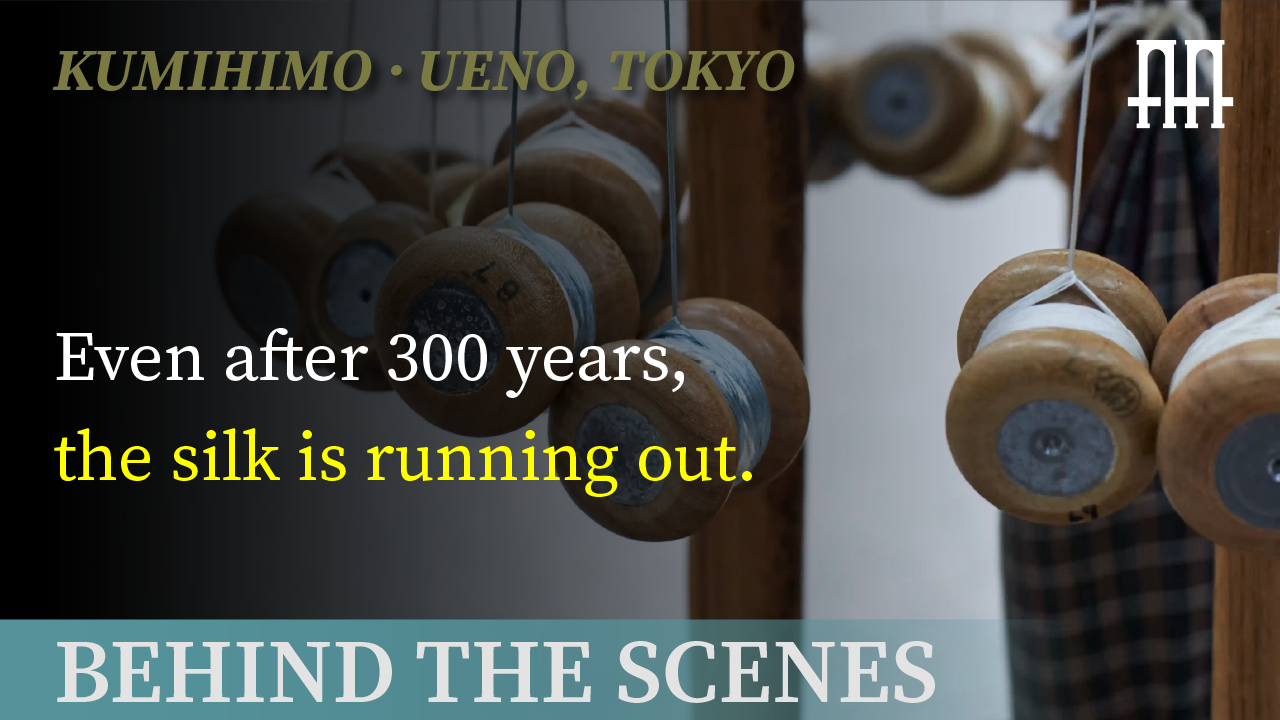
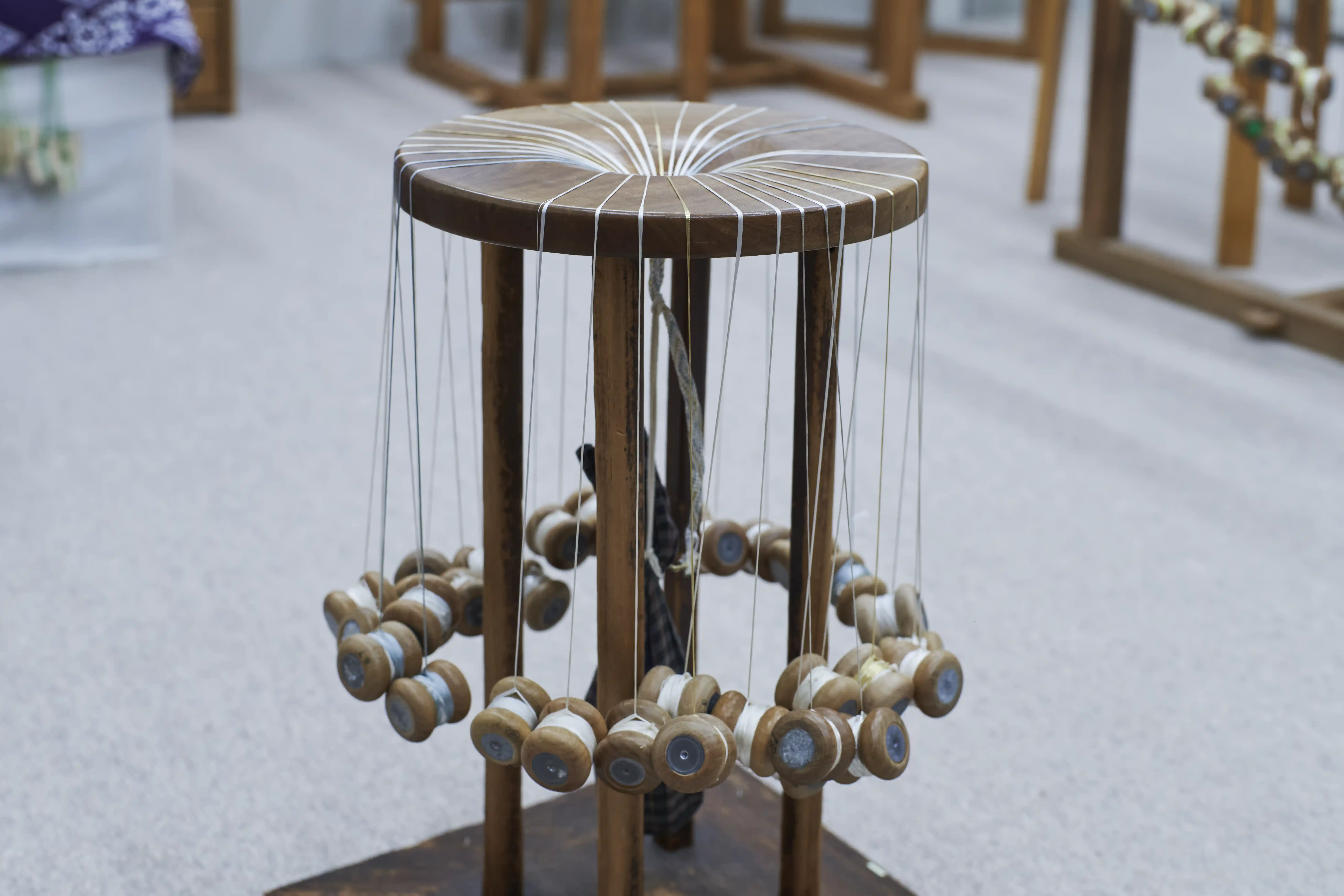
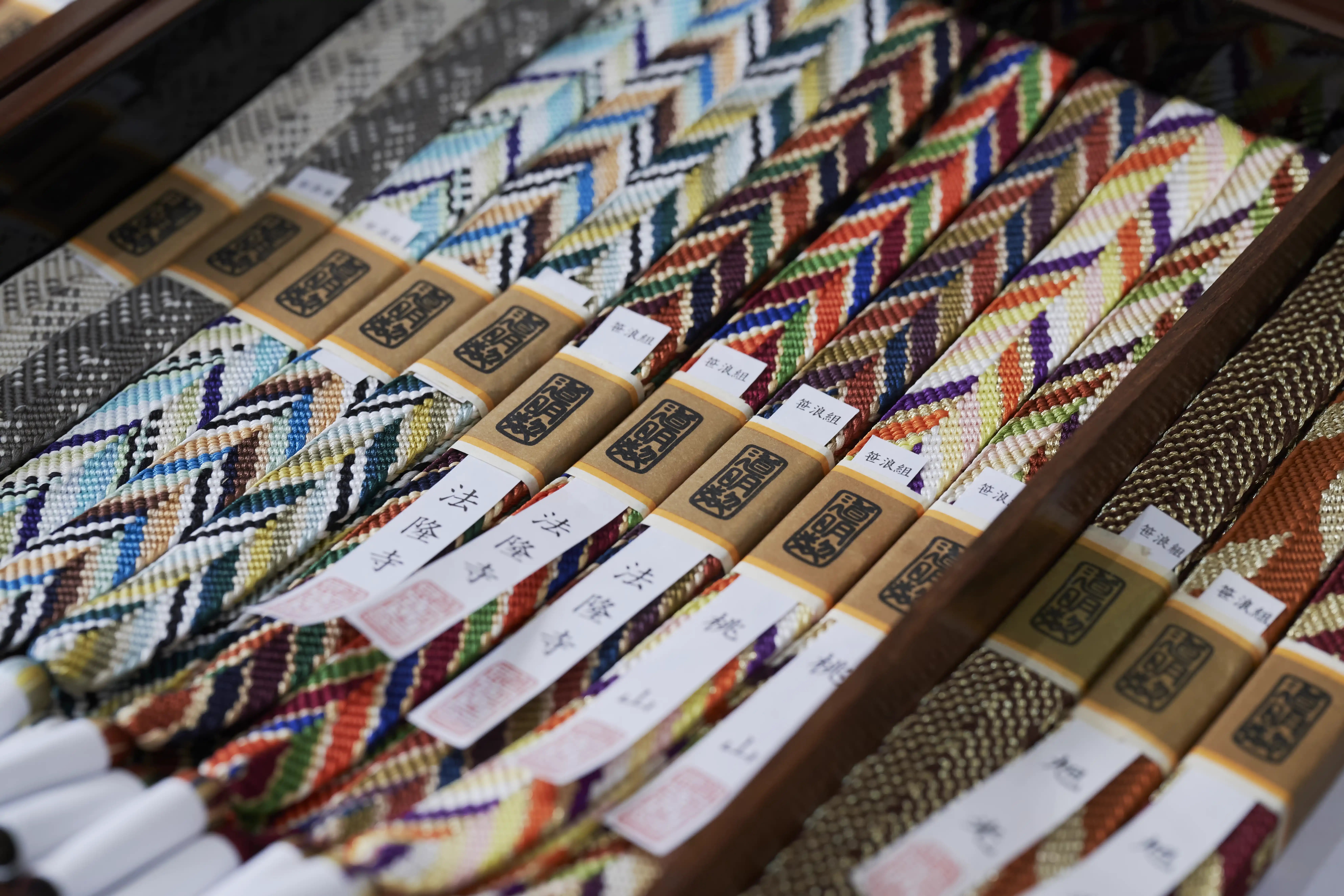
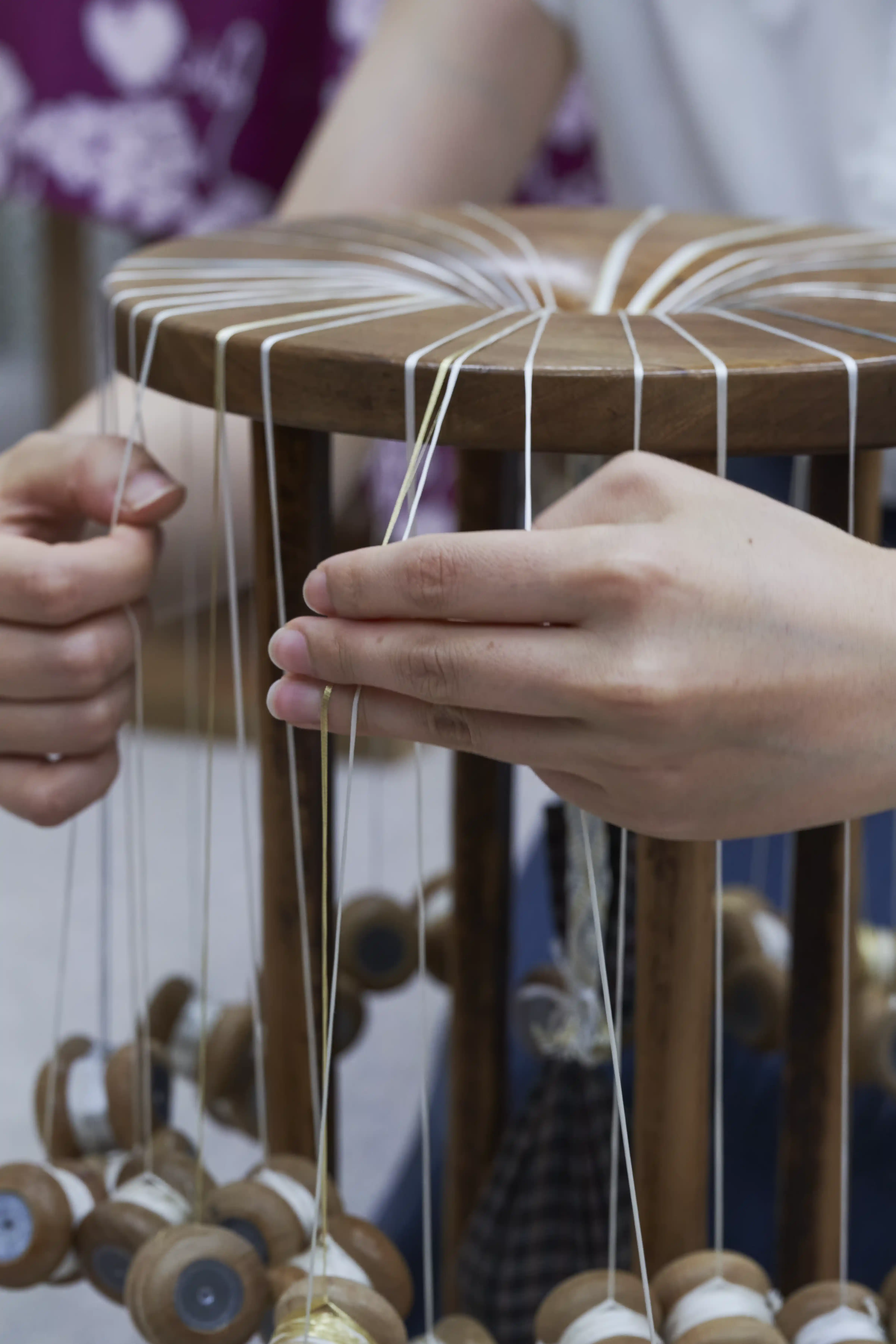
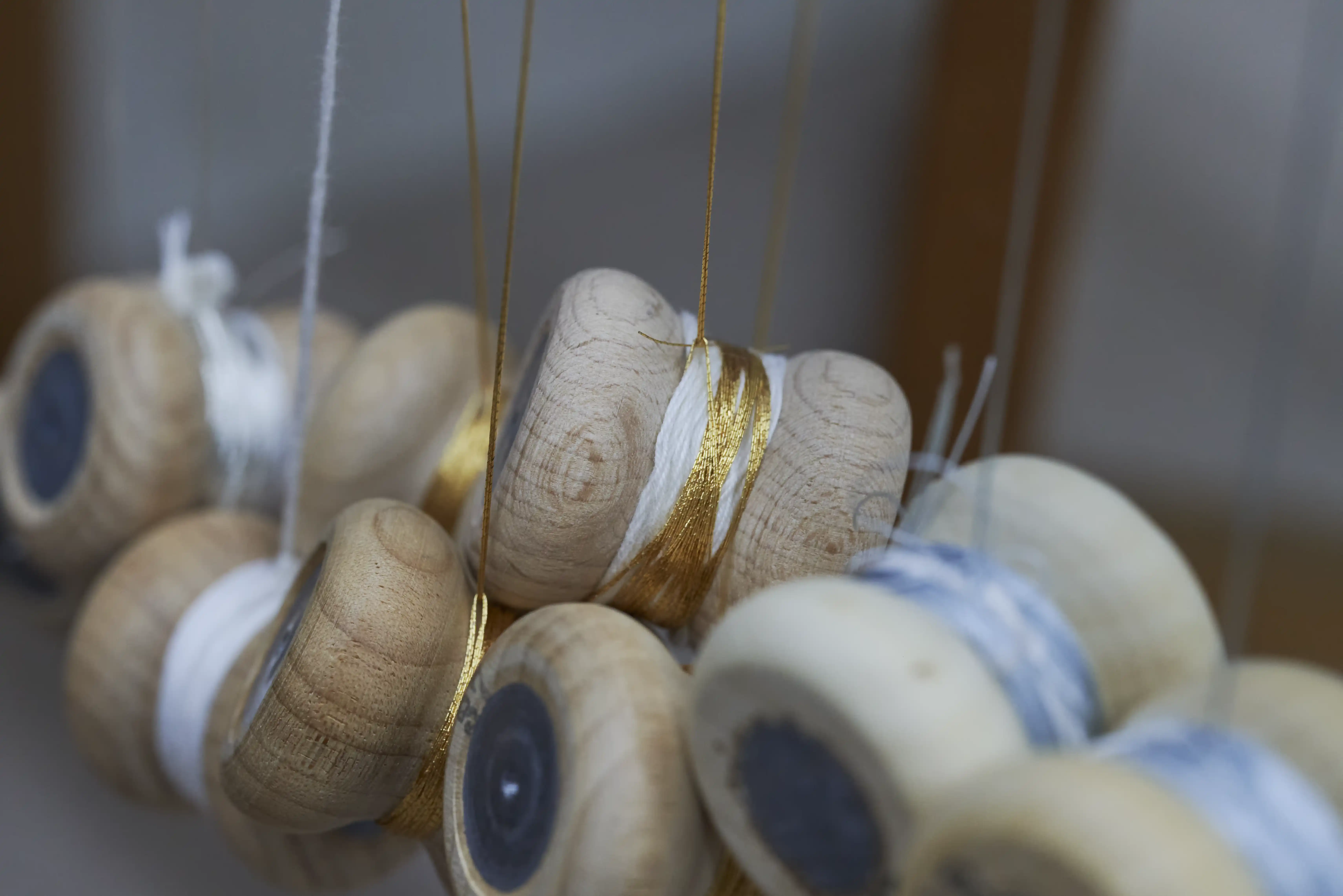
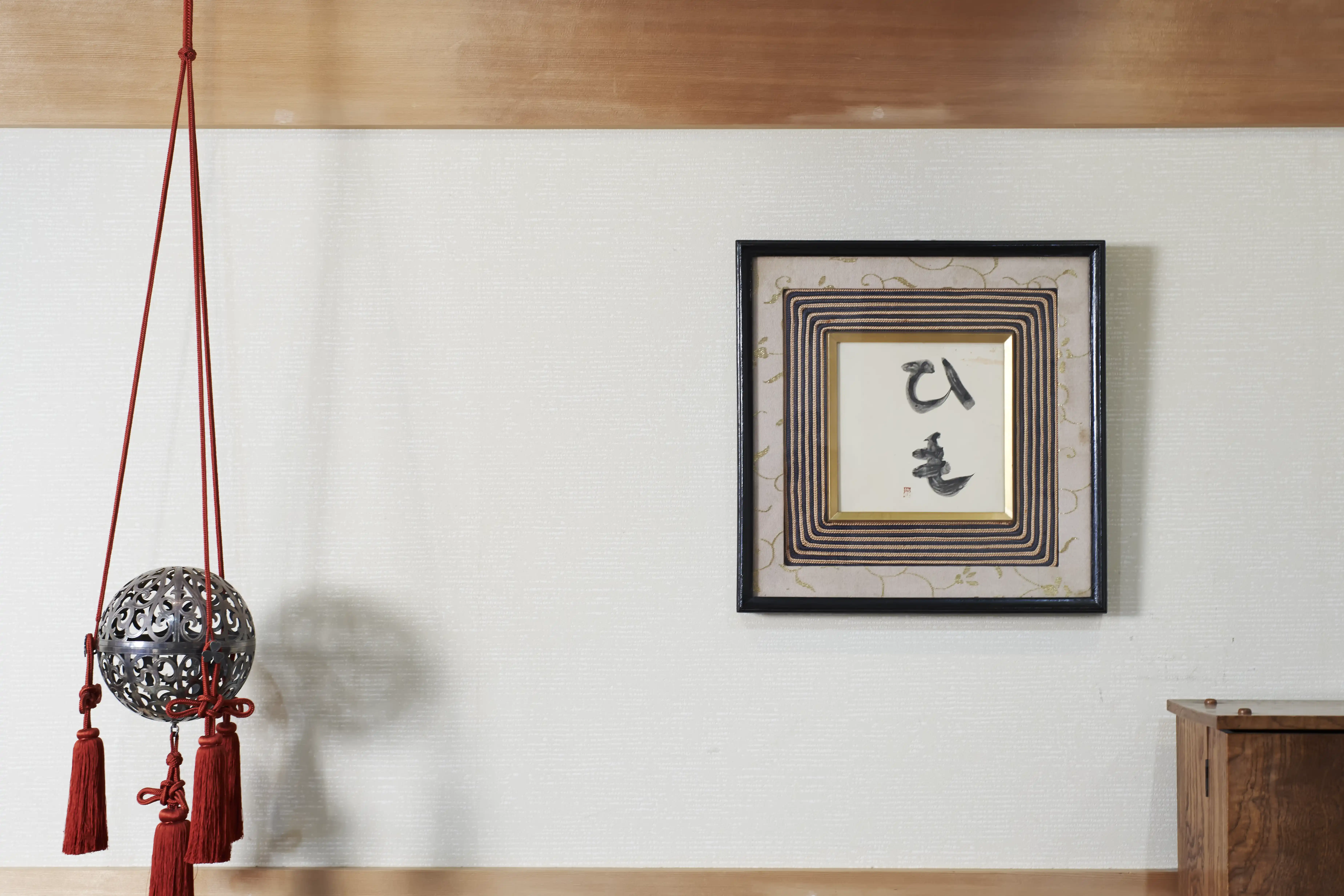
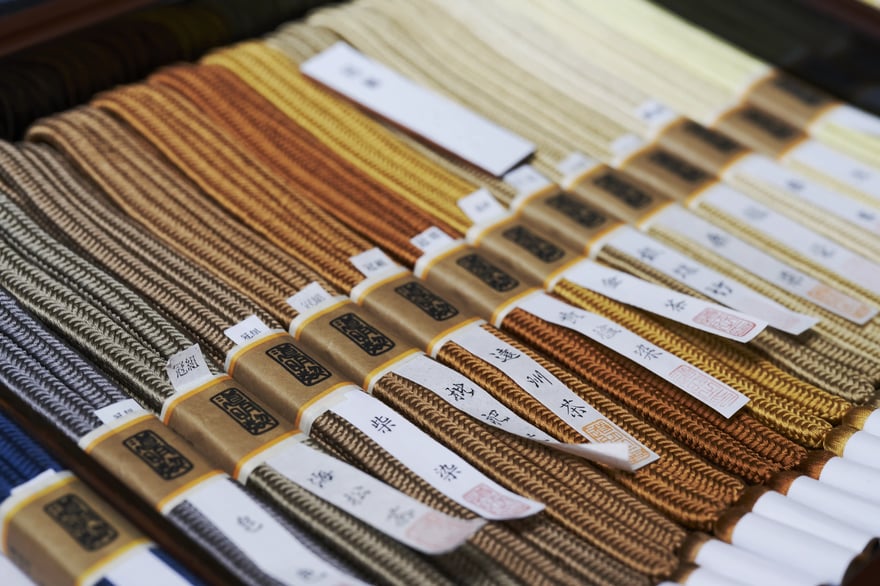
Ueno, Tokyo. Stepping into Domyo's building, which stands quietly among the office blocks, the first thing to come into view is Kumihimo — braided silk cord — in every color. Going up to the floor above, what reaches the ear is a small, dry sound of tama striking against tama, the weighted bobbins that hold the silk. Karan-karan, karan-karan. Behind that sound, which continues in a steady rhythm, an artisan sits before a braiding stand — the dai — strung with bundled silk threads, moving the threads through a fixed sequence. On a floor higher still, light falls on a bundle of silk threads just dyed, and the reds and golds and indigos rise up with surprising vividness. Nowhere in this process of making Kumihimo was there any sign of hurry.
Kumihimo refers to the Japanese craft of braiding silk into cord, historically used for sword cords, obi sashes, and ceremonial items.
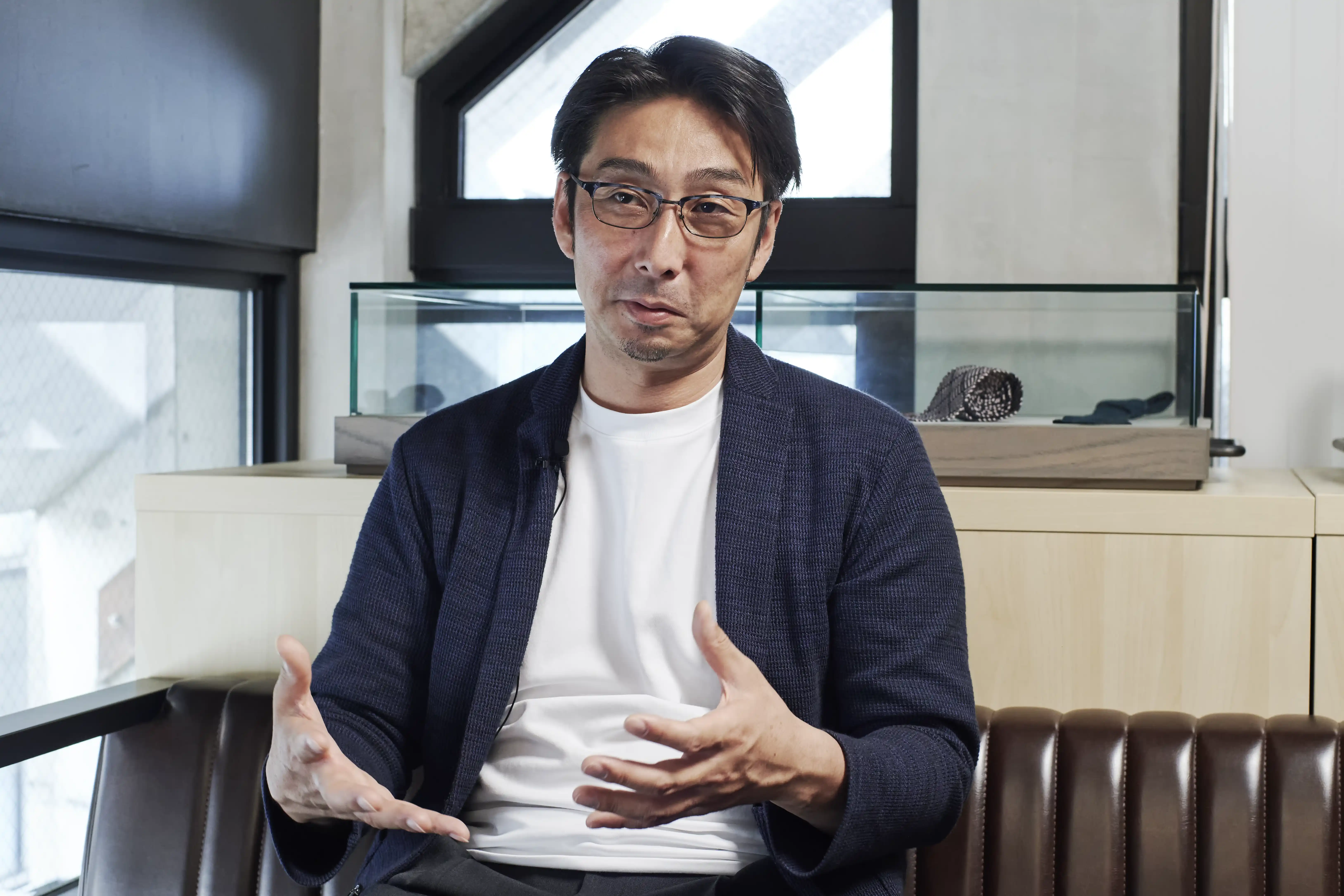
The person we spoke with this time is Kiichiro Domyo, President and CEO of the Yusoku Kumihimo house "Domyo." As Domyo Co., Ltd., this company has kept making Kumihimo for over three hundred years, and while many of its peers turned toward mechanization after the Meiji era, it chose instead the path of holding to handwork alone.
The president is also, for this industry, a person of an unusual background: he first set out to become an architect and for a time ran his own design office. In this interview we listened, at length, about the history of Kumihimo — said to have come from the mainland in the sixth century — and the distinctiveness of the research Domyo has accumulated; about the president's own philosophy, having passed through the wholly separate field of architecture before coming to succeed the family business; about the meticulous process by which thread changes into a single cord; and about the doorway of the hands-on experience, through which anyone, with no specialist knowledge, can touch Kumihimo. Carrying the weight of three hundred years, why does he still braid cord with the hands alone? This is a record of a visit in search of some clue to what dwells at the depth of the act of braiding.
History and Identity of Yusoku Kumihimo
Even those who have heard the word Kumihimo are not many who can explain accurately what it is. We began by asking about its history.
Toguri: Could you start by telling us your name and the work you do?
Domyo: My name is Kiichiro Domyo, and I serve as President and CEO of Domyo Co., Ltd. As for my work, I handle general management — the company's numbers, personnel, that side of things — but as a company with a traditional Kumihimo practice, alongside the management work, I spend a great deal of thought on how we, as a company, should carry out the making of Kumihimo. Devising new patterns, new ways of braiding; while inheriting the long history of Kumihimo in Japan and drawing on it, considering what new things we can make from it. That is mostly what I think about and do.
Toguri: To begin with, could you tell us what Kumihimo is — including its characteristics and its types?
Domyo: Japanese Kumihimo is said to have come over from mainland China around the sixth century. It is a craft in which silk threads are bundled and combined through a fixed sequence to make an elastic cord. It has been put to various uses depending on the era — as woven sashes worn by civil officials in the Nara period, in the garments of the nobility in the Heian period, and, from the Kamakura, Muromachi, and Edo periods onward, in the arms and armor of the samurai. The ways of braiding fall broadly into three kinds: cords round in cross-section, cords square in cross-section, and flat cords called hiragumi. Even the representative types number around thirty, and including variations and specialized ones, several hundred braiding methods are said to have been devised.
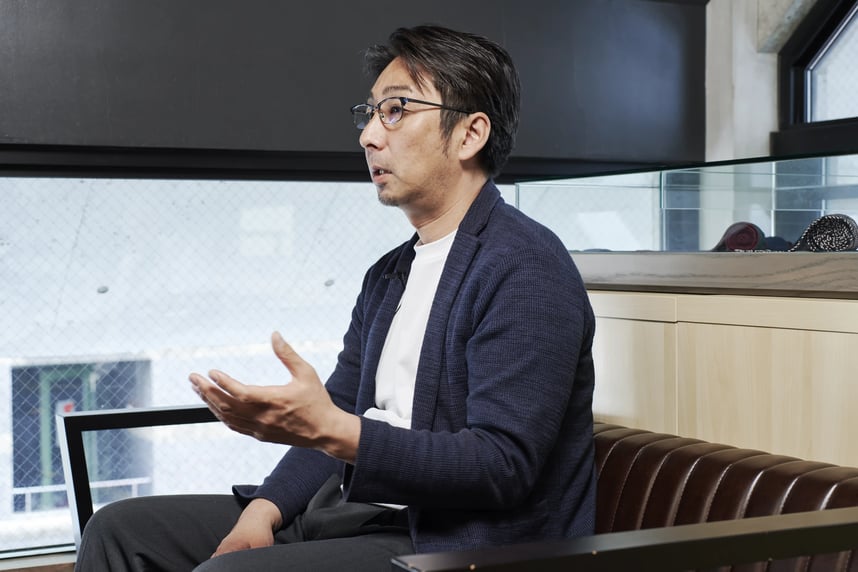
When he speaks the name of the company, Domyo, he begins — curiously — with the history of Kumihimo itself, before "I." In the very order of his telling, this person's stance seemed to show itself. Before how he himself came to be involved with Kumihimo, he first tries to share how long a span of time this craft has been nurtured within.
It also looked like a sign that, even while going by the title of President and CEO, he regards himself not as the custodian of this history but as one point of passage within it. The next thing we asked about was the relationship between the land of Tokyo and Kumihimo.
Toguri: Could you also tell us about geographical differences — for instance, the difference between Kumihimo in Tokyo and in Kyoto?
Domyo: For much of Japan's history, various craft cultures grew up centered on the Kansai region — around Kyoto, from Heian-kyō onward. We are an Edo–Tokyo company, so we developed from the Edo period on; the cords of Edo were something the samurai of the time researched in various ways, and gradually good-quality Kumihimo came to be made in Tokyo as well. In coloring, too, the Kyoto and Kansai manner favored things a little more showy and soft, while in Tokyo, for a long stretch of time, more understated things were favored — plain, yet with a depth of color.
Toguri: Could you tell us, as far as you know, about the background of its development in the Sengoku and Edo periods?
Domyo: Its development is said to have peaked roughly from the late Heian period through the Kamakura and Muromachi periods. The Kumihimo that first came from the mainland and took root in Japan in the Nara period was a very beautiful craft, but structurally it was still very simple. From there, over the several hundred years of the Heian period, development began in a distinctly Japanese way. By linking many simple ones together, they became able to make Kumihimo of more complex structure. For example, from the late Heian period through the Muromachi period, cords of a structure some four to eight times more complex than those made in the Nara period came to be seen. Abroad, too, Kumihimo developed in the direction of making knots and ornaments, but the structure itself did not advance much.
Toguri: The Meiji Restoration greatly changed ways of life. What effect did it have on Kumihimo?
Domyo: The change from Edo to Meiji was an enormous change for the Kumihimo industry. The cord that samurai wound on their swords, called sageo, had always been made as Kumihimo, and thread merchants like us supplied a great many craft braids. But in the Meiji era, once the Haitōrei — the edict abolishing the wearing of swords — was issued, they could no longer carry those swords at all. Amid this, in the late Edo period a way of tying the kimono sash called otaiko-musubi had become established, and to hold that sash in place the obi-jime came into use — the decorative cord that secures the sash, or obi, of a kimono. There they found a new path forward, and began to apply the craft-braiding techniques once used for the sageo of swords. Today's women's obi-jime is almost identical to the sword sageo of that same era in length, width, and braiding method; only the coloring grew vivid to suit women's attire.
The moment the sword — the samurai's emblem — disappeared, many Kumihimo shops must have lost their place. Yet what he spoke of there was not closure, but the words "a new path forward." Filling the rupture of an era by repurposing a technique. This suppleness of thinking is surely not unrelated to the career as an architect he would speak of later.
Even when one use is lost, the technique itself remains. Rather, the question of how to pour that technique into the next vessel may be the very history of the company called Domyo. This perspective connects, too, to the meaning of the word "Yusoku," which we asked about next.
we found a new path forward, and applied the braiding techniques
once used for the sword's sageo to the obi-jime."
Toguri: Regarding the term "Yusoku Kumihimo," could you tell us what makes it "Yusoku"?
Domyo: The word Yusoku came from yūshiki — "having knowledge" — which shifted into Yusoku. The sense in which we use it is this: that we hold every technique of the Kumihimo that has a history of well over a thousand years in Japan, and that we bring it to life in present-day making — in that sense we call ourselves Yusoku Kumihimo. In fact, in today's belts and neckties, techniques and patterns called anda-gumi, many of which remain in the Kumihimo of the Shosoin Repository, live on just as they were; and the cord used in the scroll called Heike Nokyo at Itsukushima Shrine is used in present-day obi-jime. The fruit of our research over more than a hundred years is reflected, as it is, in present-day products.
Yusoku denotes a lineage of Kumihimo knowledge historically authorized within Japan's imperial court culture; the "traditional" alone would lose that sense of courtly authority.
Toguri: We understand your company has an unusual, fully integrated system in which all of the manufacturing processes are done in-house. Could you tell us about this commitment?
Domyo: Our company, too, from the Meiji era onward saw many Western braiding machines come in, and many companies mechanized. But in the time of our sixth-generation head, the feeling was that this would cause the handmade culture of Kumihimo to be lost, and so the policy was set to use no machines at all and to make Kumihimo by handwork alone. That is another point where we differ from many companies, and from there, conversely, we went back into the past, traced the history, and came to make things that draw on that history — that is a major characteristic of our company.
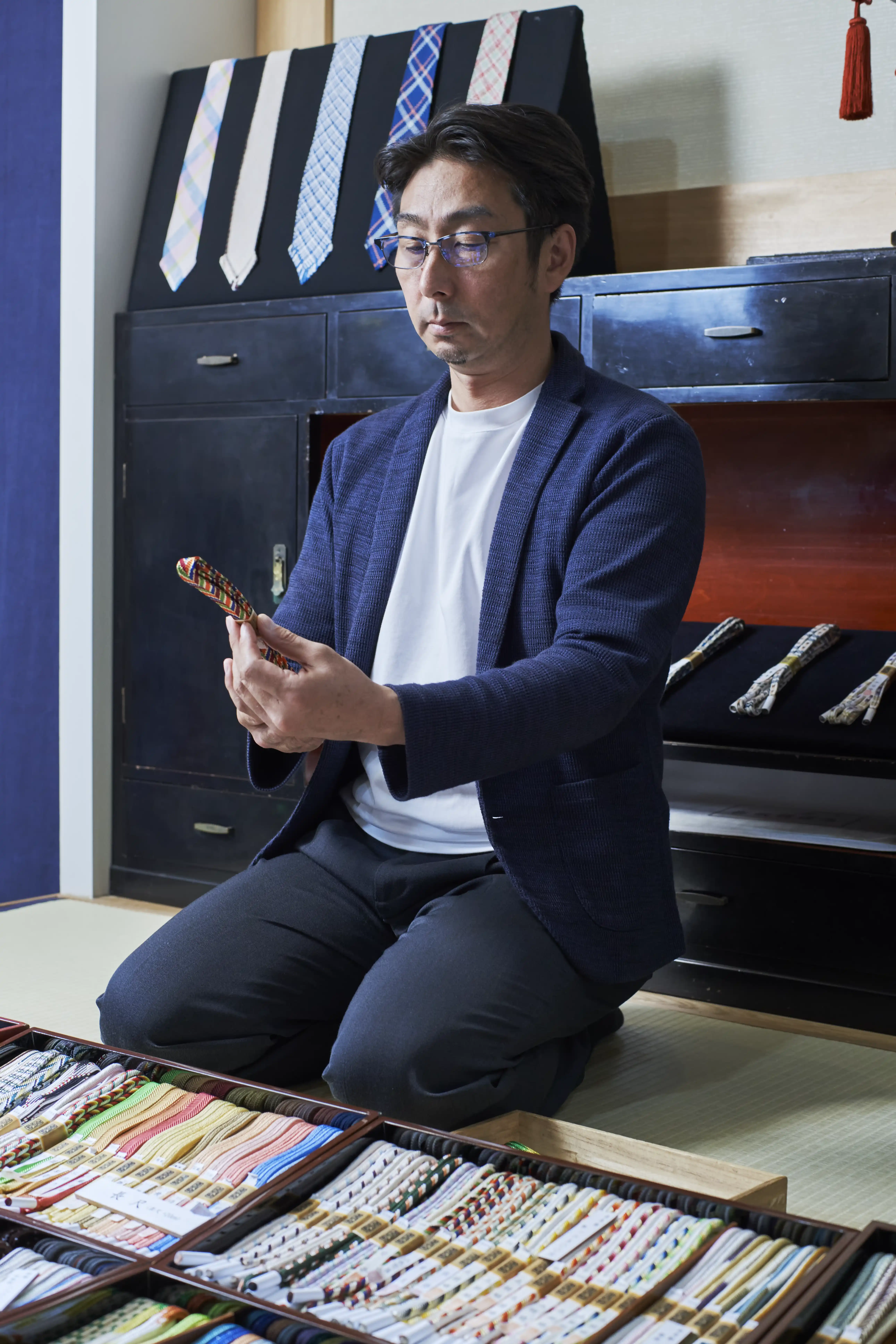
Toguri: We also hear that an academic approach to researching Kumihimo is a characteristic of your company. Could you tell us how you differ from other workshops?
Domyo: For weaving, there are many research institutions and university labs studying it, but in fact there is nowhere studying Kumihimo — and historical Kumihimo at that — on a large scale, and our company actually holds the role of such a research institution. This has been carried out across generations by the staff of the Kumihimo classes and the production division, and based on that research we make many faithful reproductions, exact copies of the originals, and archive them. There are already hundreds of them. Having an archive of knowledge and results found nowhere else in the world — that, I think, is a major difference from other craft houses.
In the Taishō era, at the request of Mori Ōgai, then director of the Imperial Museum, the house went to survey the Kumihimo handed down at the Shosoin in Nara; this, it is said, became the starting point of Domyo's research. For more than a hundred years since, they have accumulated the work of examining and reproducing, one by one, the Kumihimo attached to Buddhist statues and armor across Japan. This was not mere product development but, surely, work that took on the record of a technique that had been on the verge of disappearing.
When he speaks of history, there is no exaggeration in his words. He simply relates, plainly, what happened in what year and what changed. Within that restrained way of speaking, the awareness of one who carries the weight of three hundred years seemed to seep through. Why did this person come to inherit this history and technique? Next, we wanted to ask about the path of his life.
Imperial Museum (Teishitsu Hakubutsukan): the collective former name of what are now the Tokyo, Kyoto, and Nara National Museums; the Tokyo one stands about a five-minute walk from Domyo's building.
From Architecture to Kumihimo
— One Philosophy of Inheritance
The president did not walk the path of Kumihimo from birth. He studied architecture at university and for a time ran a design office. We asked about the course of that turn.
Toguri: Could you tell us what led you into the world of Kumihimo?
Domyo: What led me into this world — part of it, of course, is that it had long been the family business. But when I was young, my father's older brother, my uncle by marriage, was the company's president, and his son was in the position to succeed him, so I myself was in a relatively free position. I wanted to become an architect in the future, studied architecture at university, and after graduating set up my own design office. I had been running it for seven or eight years when the president at the time, my cousin, asked whether I might help out a little with the company's work. That president was about seventeen years older than me, and it seems he felt it was about time to pass the company to the next generation and to devote himself to research, so he asked whether I would take on the management. At the time the company itself had grown quite aged in its workforce, and the building had grown old, so I thought there might be various things I could do, and I took it on — and that is how I have come to the present.
Toguri: Was there a decisive moment that led you to the decision to take over the family business?
Domyo: From about middle school I had been helping with the work here and there — helping with events, and in my university days helping with the dyeing work — so I had a fair amount of involvement. Seeing various things in the midst of that, I recognized the value of the work, and even young as I was, I felt that this was a technique that had to be properly passed on to the next generation. And indeed, when I looked around, there was the situation that I was the only one left to do it next; my father was working and having a hard time, and thinking I might be of help to him, I chose this path.
In the words "the only one left," there was no air of tragedy. Rather, they were spoken as an entirely natural conclusion, drawn after quietly surveying the surrounding circumstances. Perhaps it is closer to say that, rather than choosing the path of the architect once and then letting it go, he moved to live in a world with another kind of structure.
In the story of inheritance he tells, there is no dramatic declaration of resolve, no staging of tragic conflict. There was only the gaze of one who had watched the value of the family business up close for a long time, quietly overlapping with a concrete reality — the figure of a father in difficulty. That very quietness seems to run through this person's whole way of facing his work. What we wanted to ask here was how the perspective of a different field, architecture, worked upon the world of Kumihimo.
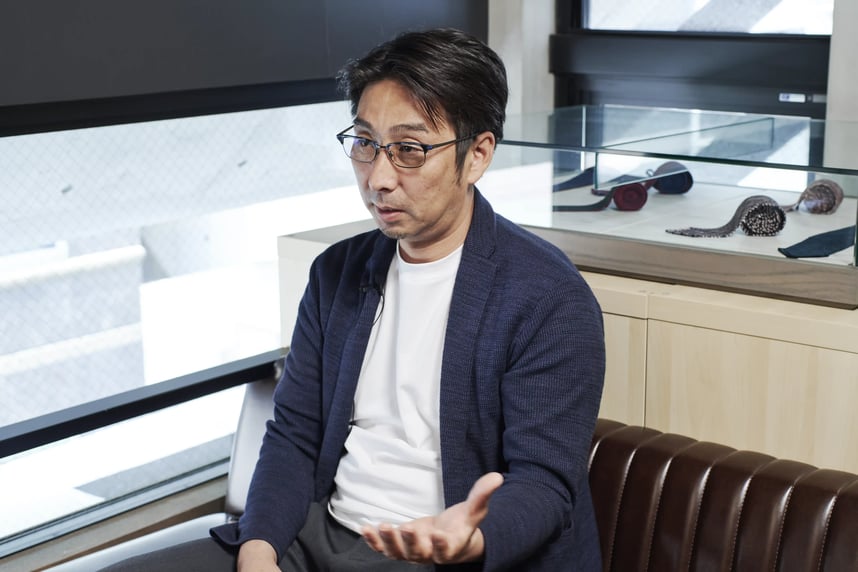
Toguri: From an architectural point of view, what was the impressiveness or the interest of Kumihimo?
Domyo: I was doing architecture — design in particular — and the field of architecture itself has a history spanning several thousand years; it is a culture that has existed since around the dawn of humankind, and a culture accompanied by technique. It is a culture of making beautiful things while satisfying various structural calculations, uses, and functions. Kumihimo, too, is a very small thing, a niche industry, but in fact it has been used for various purposes throughout history and has permeated much of Japanese culture, and it has a very three-dimensional, interesting structure. The movement of the threads is highly three-dimensional, and by placing colors while understanding that three-dimensional movement, Kumihimo's own designs are created — so I was able to understand Kumihimo on the basis of my knowledge and experience in architecture.
Toguri: Coming from the world of architecture into the world of Kumihimo, was there anything that surprised you?
Domyo: Architecture makes large things and Kumihimo makes very small things, but the gap — and I think this is particular to our company — was how thoroughly everything is done by handwork. Dyeing the thread, setting it on frames, bundling it one strand at a time into a state that can be set on the braiding stand, then the braiding process, and on to the final finishing — nearly all of it done with almost no large tools, by the movement of the hands alone. That was a great surprise.
Toguri: How does one acquire the techniques of Kumihimo?
Domyo: Even among artisans there are various directions — an artisan who pursues one or two braiding methods and produces a great deal of them, versus the teachers of the classes who learn various methods, or those who design Kumihimo in-house — but you begin with the simplest stand, with only about four tama on it, first learning how to move the hands, and from there gradually increase the number of tama and learn more complex methods. Once you can manage the Marudai, the round stand, next you take on the Takadai, the high stand — square in form and with a greater number of tama. And because braiding is a highly comprehensive craft, alongside that you learn what uses the historical masterpieces were put to, how to match color with color, how to match kimono with obi-jime, and so on — you need to acquire, in good balance, the many elements surrounding Kumihimo.
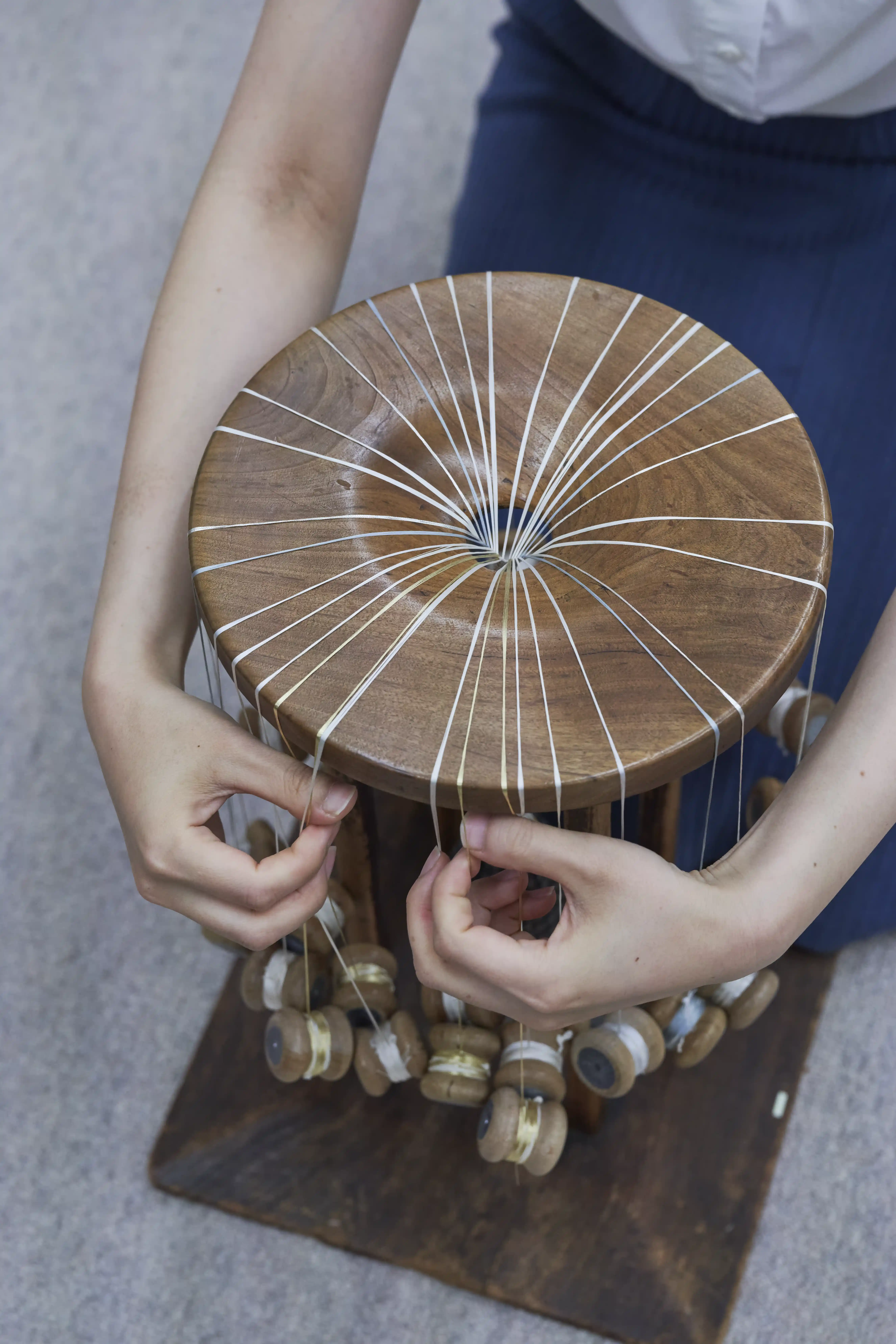
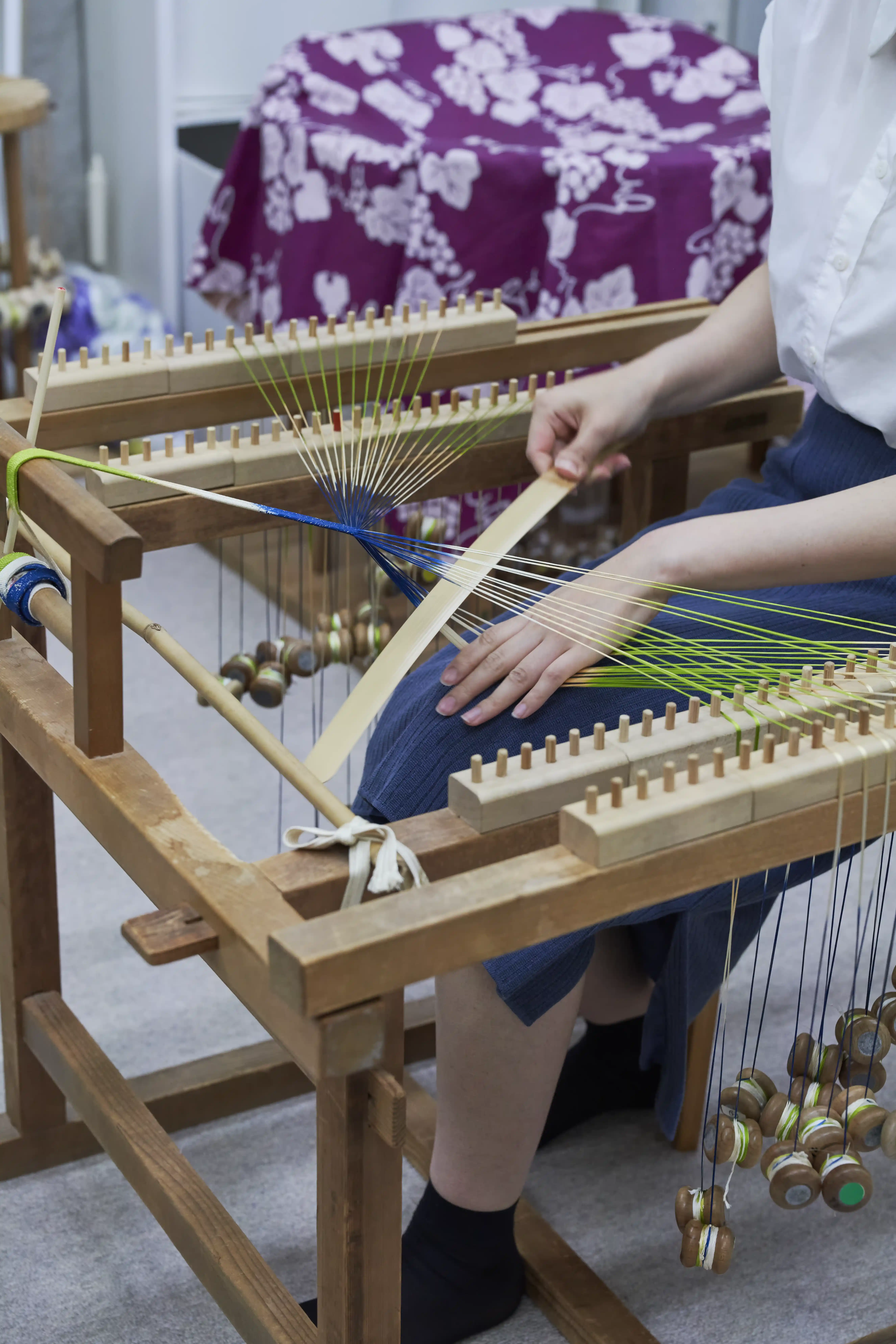
Toguri: Where do you feel the distinctiveness and strengths of your company's artisans lie?
Domyo: It is exactly the ability to understand the highly advanced, complex structures of Kumihimo like those in that archive, and to reproduce them — that, I think, is the greatest thing about our artisans. Beyond that, not only the beauty of appearance and the loveliness of coloring but functionality: they acquire their skills with a very high awareness of the functional side too — how to make a cord that is easy to tie and hard to come undone, rich in elasticity, and pleasant to the touch.
When he speaks of Kumihimo in the language of architecture, his explanations become strikingly clear. Structure, tension, load — words that ought to belong to engineering are carried over intact to explain the movement of a single silk thread. Within this person, the two fields are not opposed; they are perhaps different answers to the same question. How to build a structure that satisfies beauty and function at once.
That perspective connects naturally to an interest in the more concrete process — how the thread itself becomes a cord.
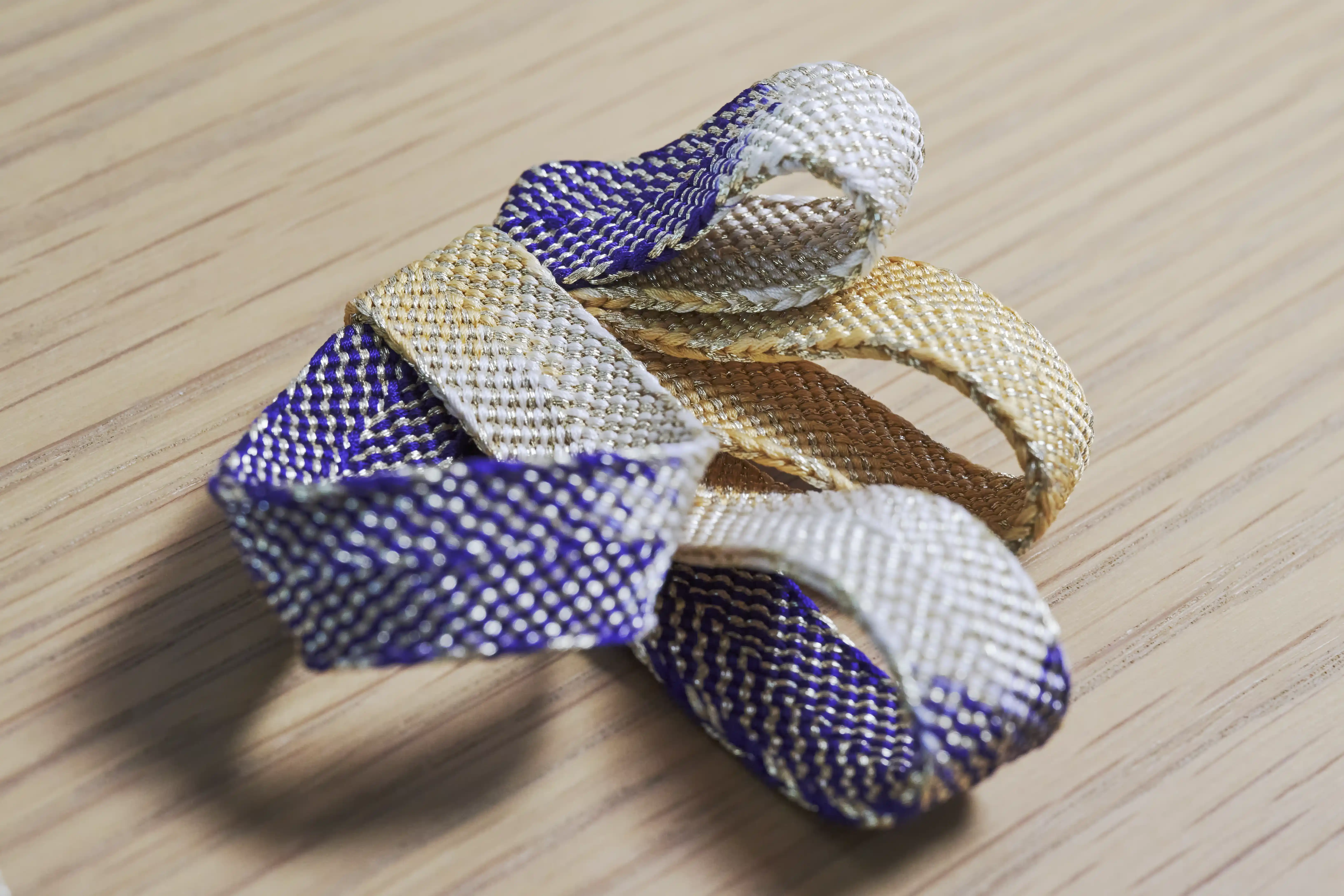
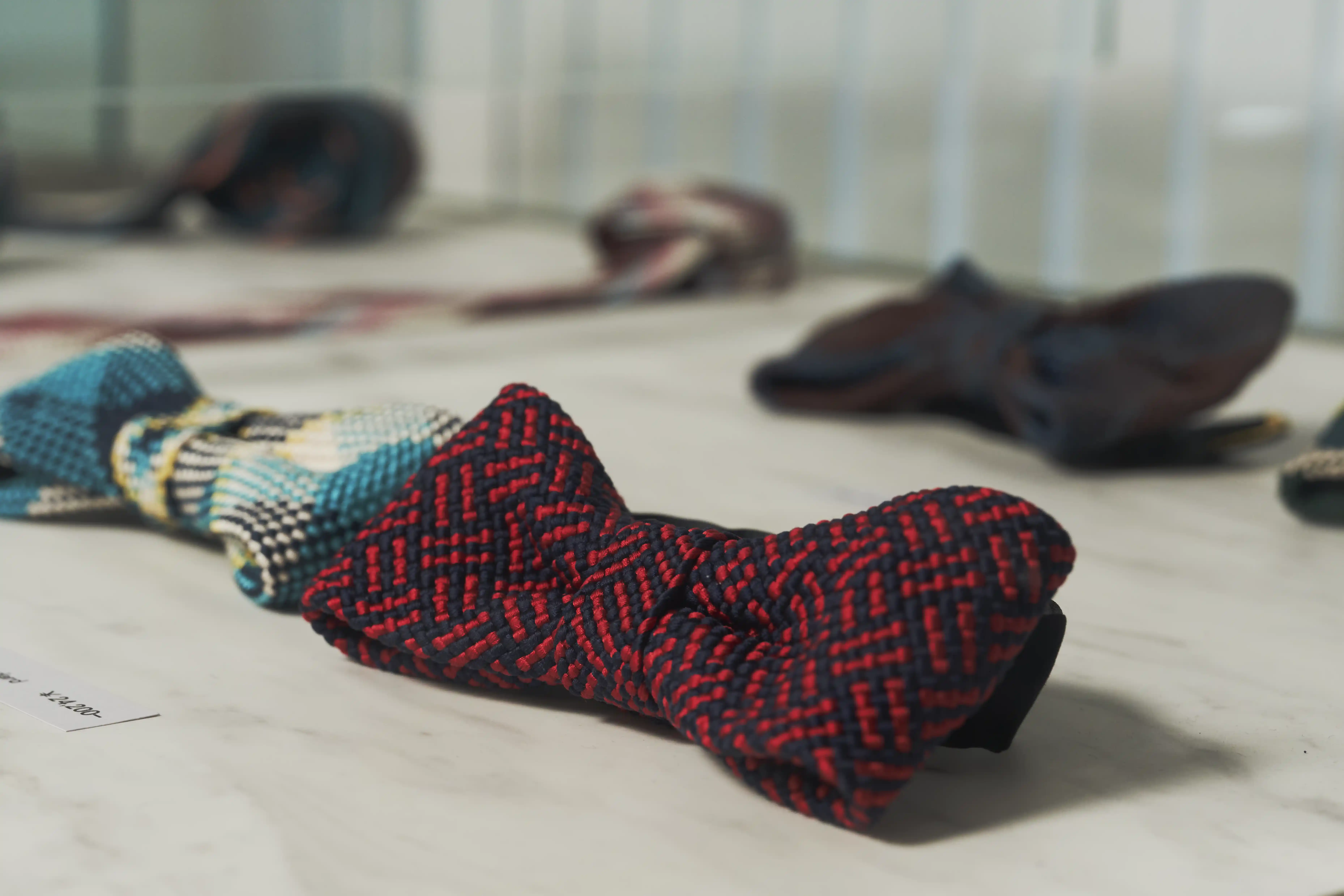
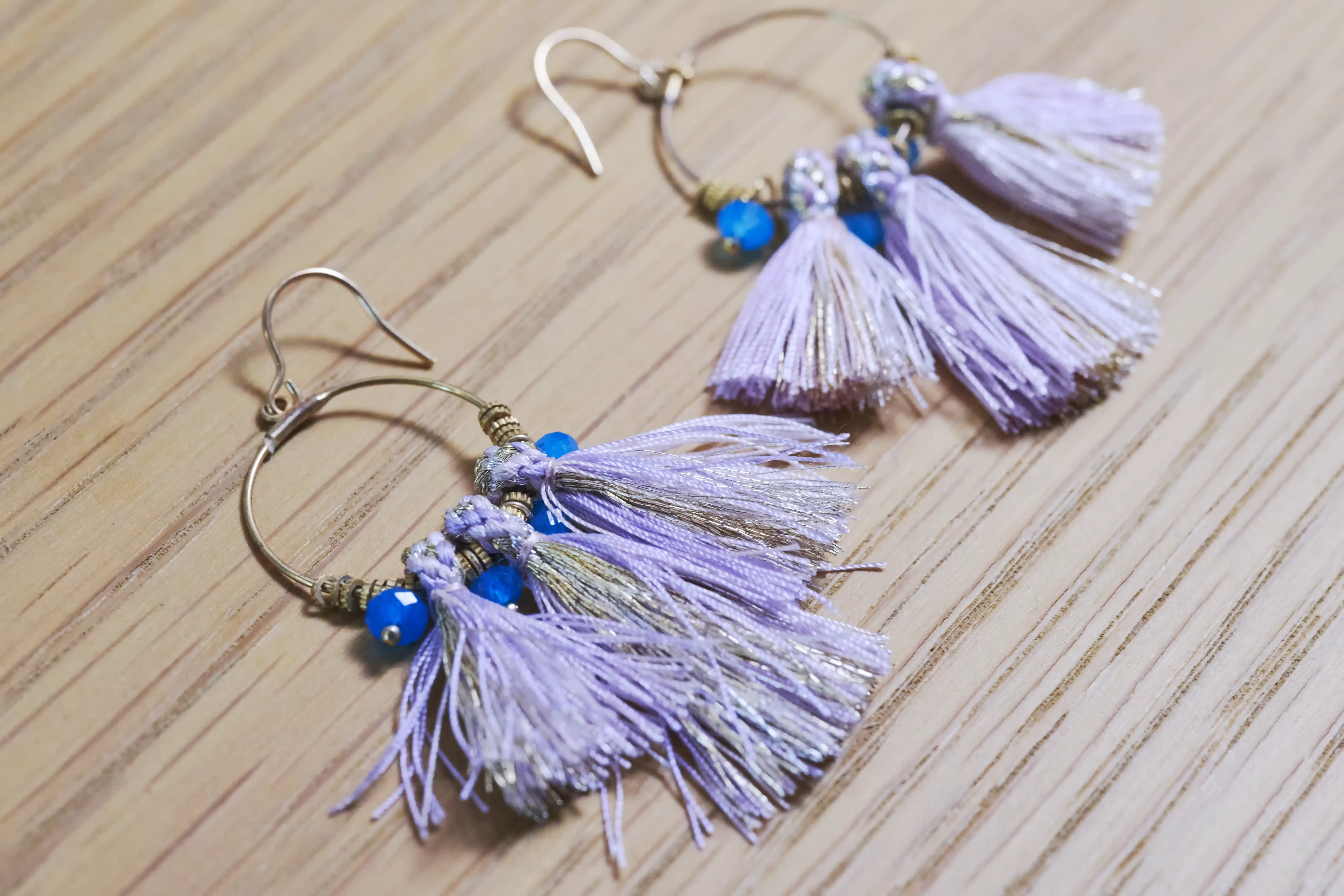
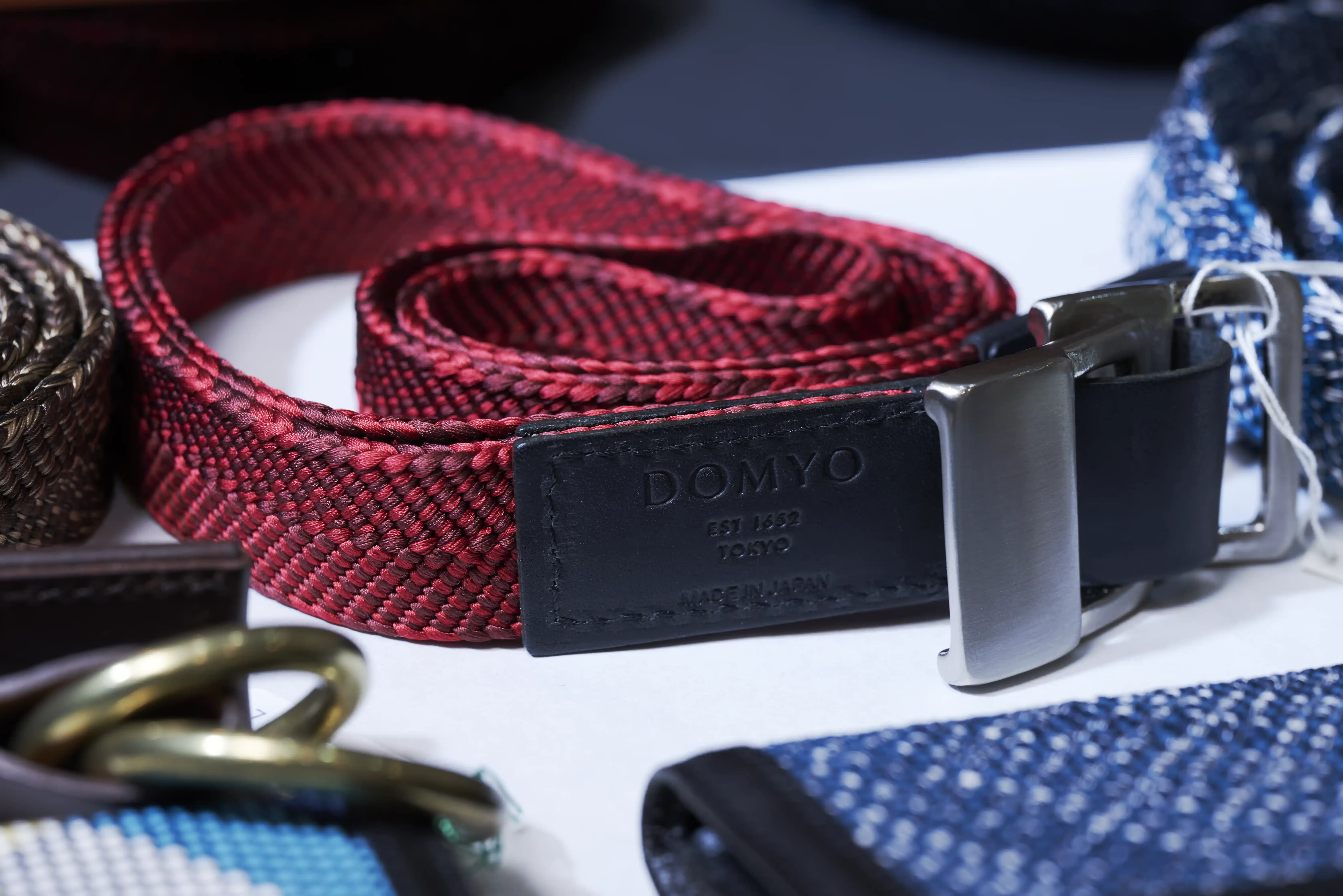
What the Hands Know — Technique as a Kind of Memory
Walking through Domyo's workshop, one notices how many hands are laid upon the thread before it becomes a cord. We asked about each of those processes.
Toguri: Could you tell us how Kumihimo is made, starting from the making of the thread?
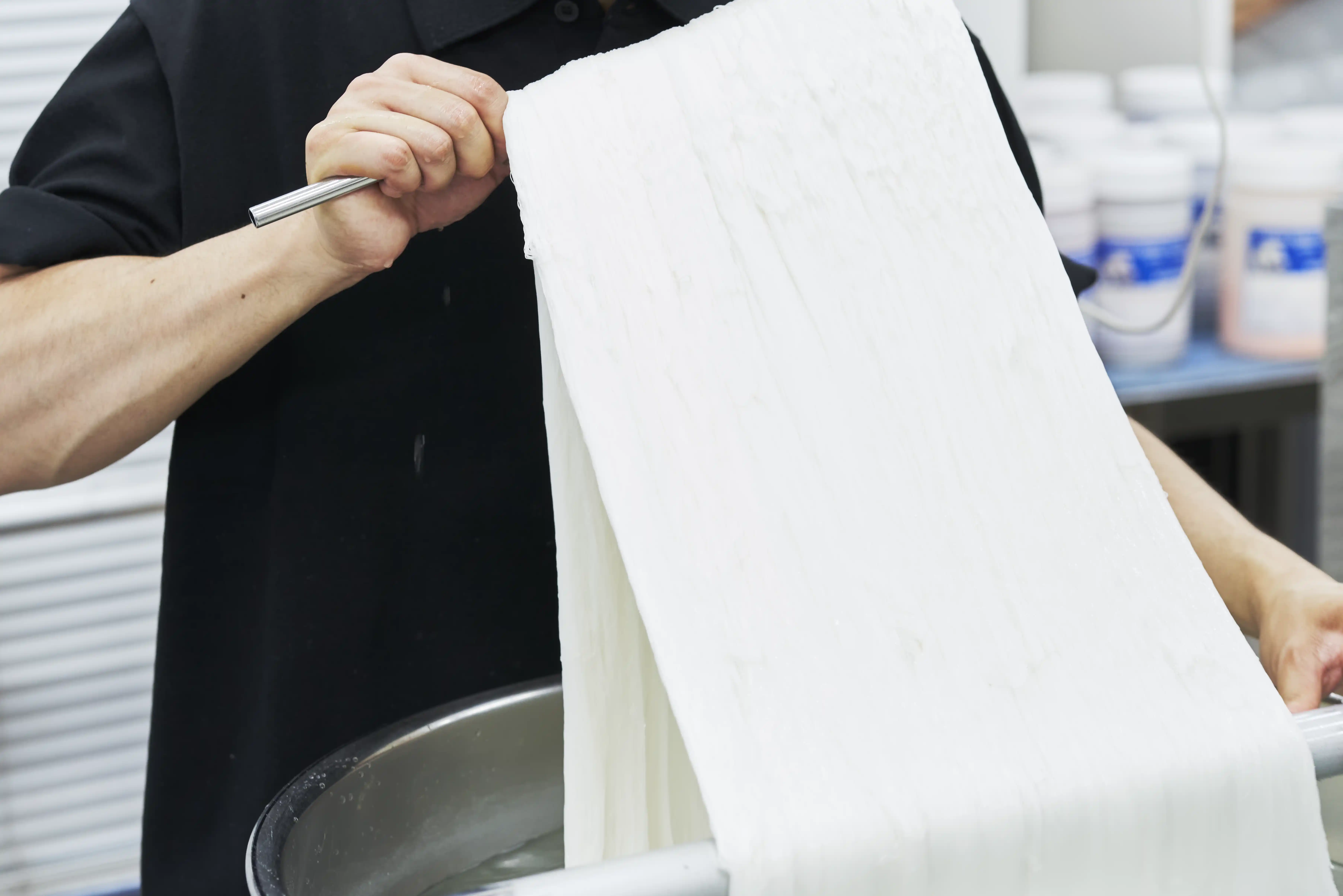
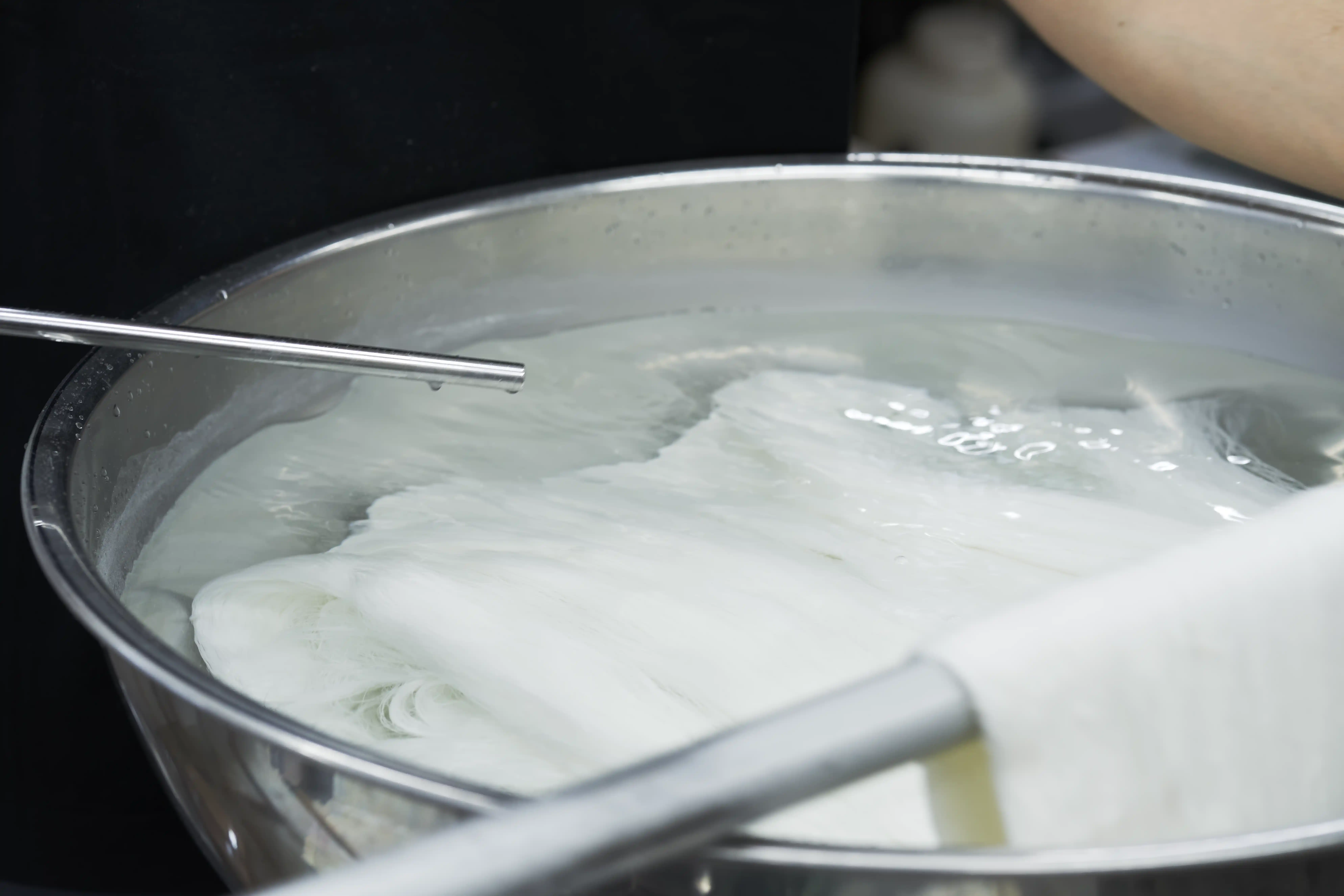
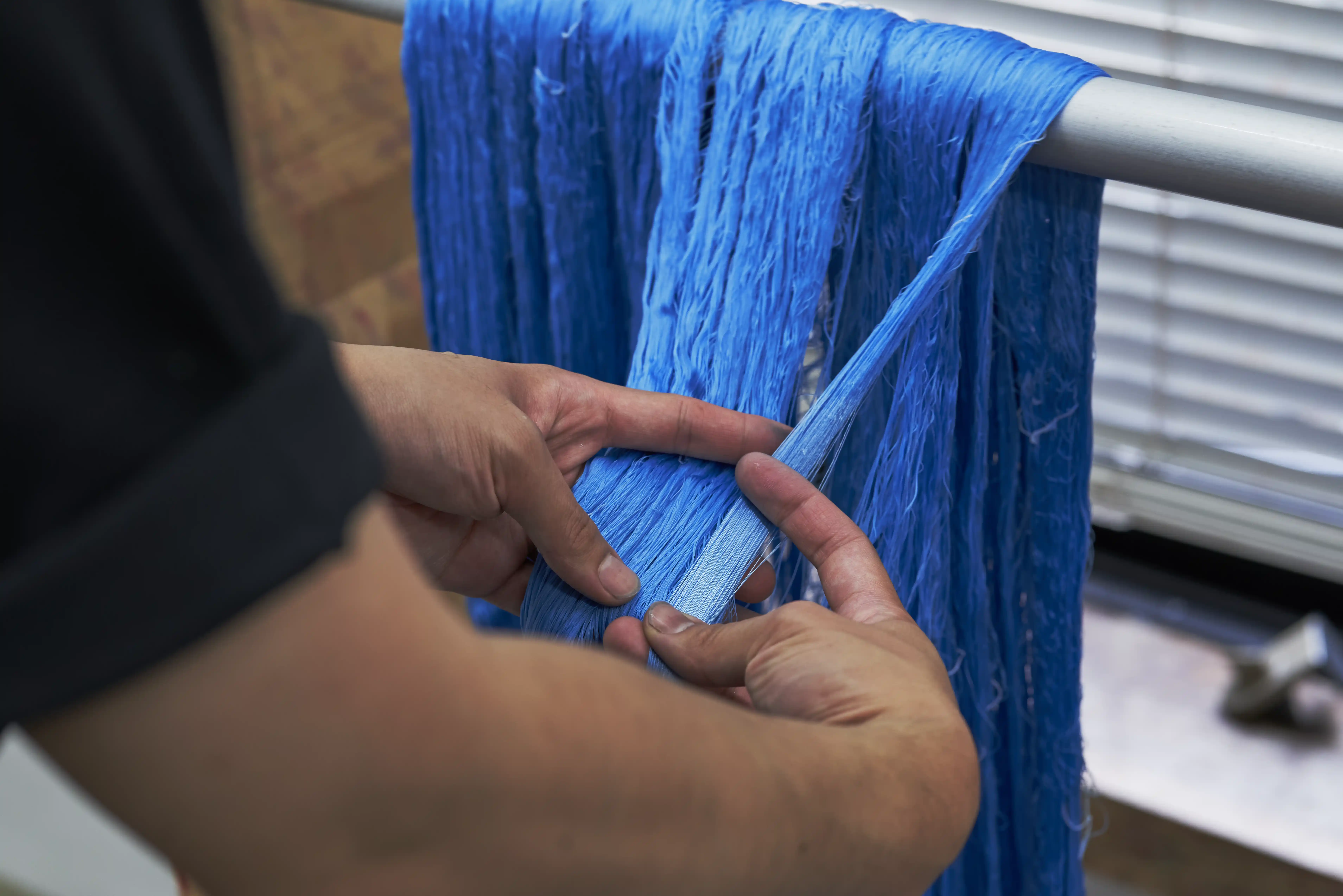
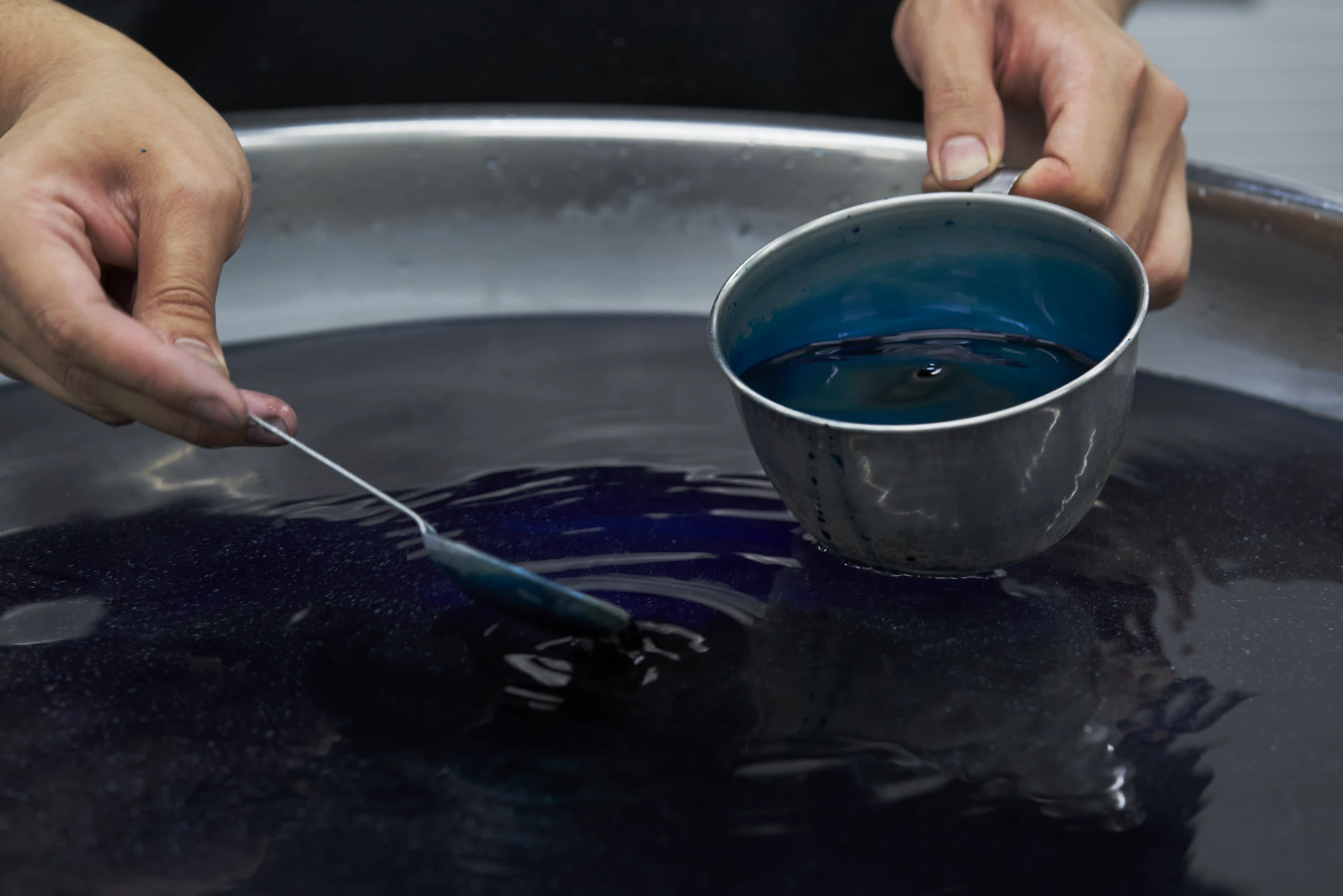
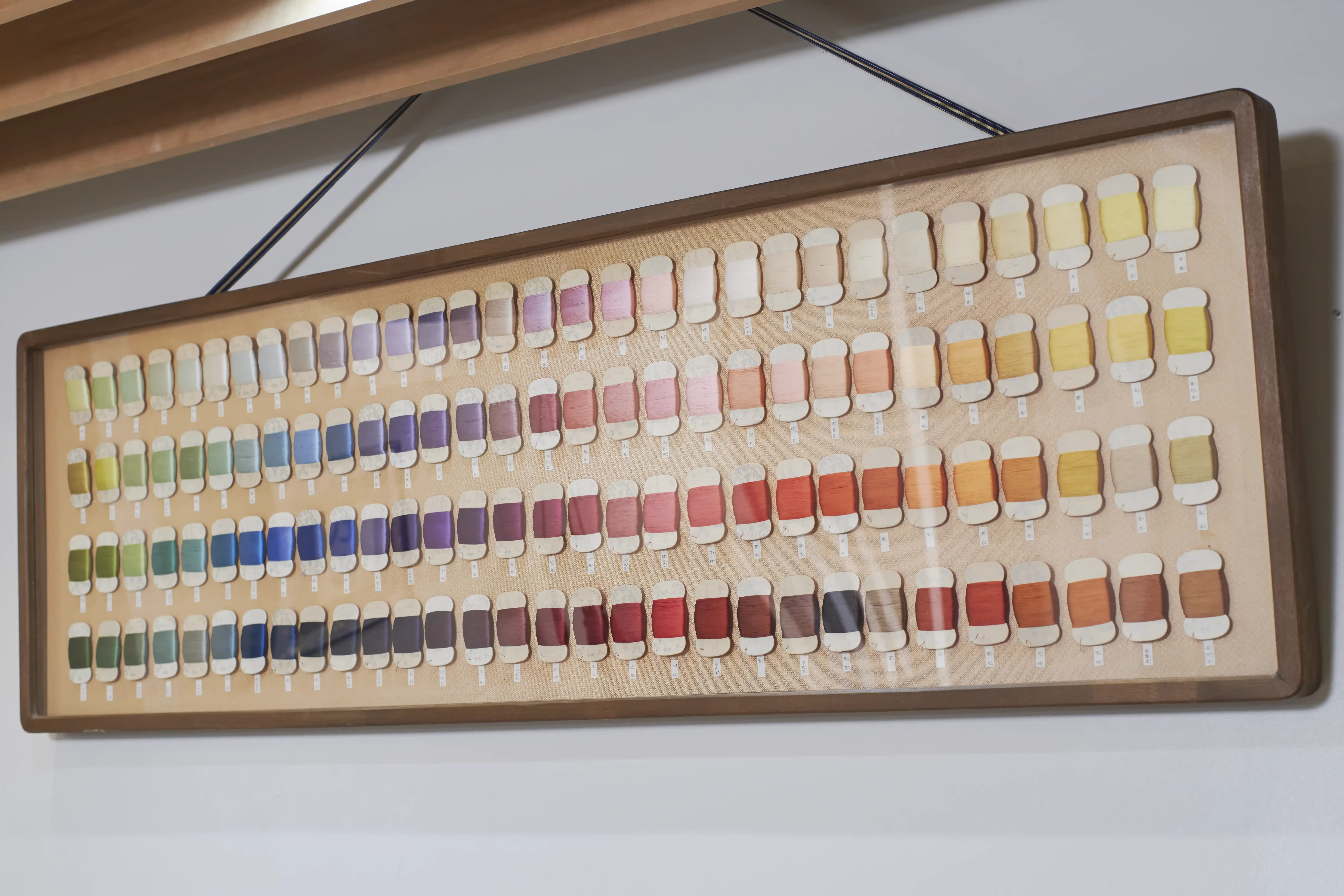
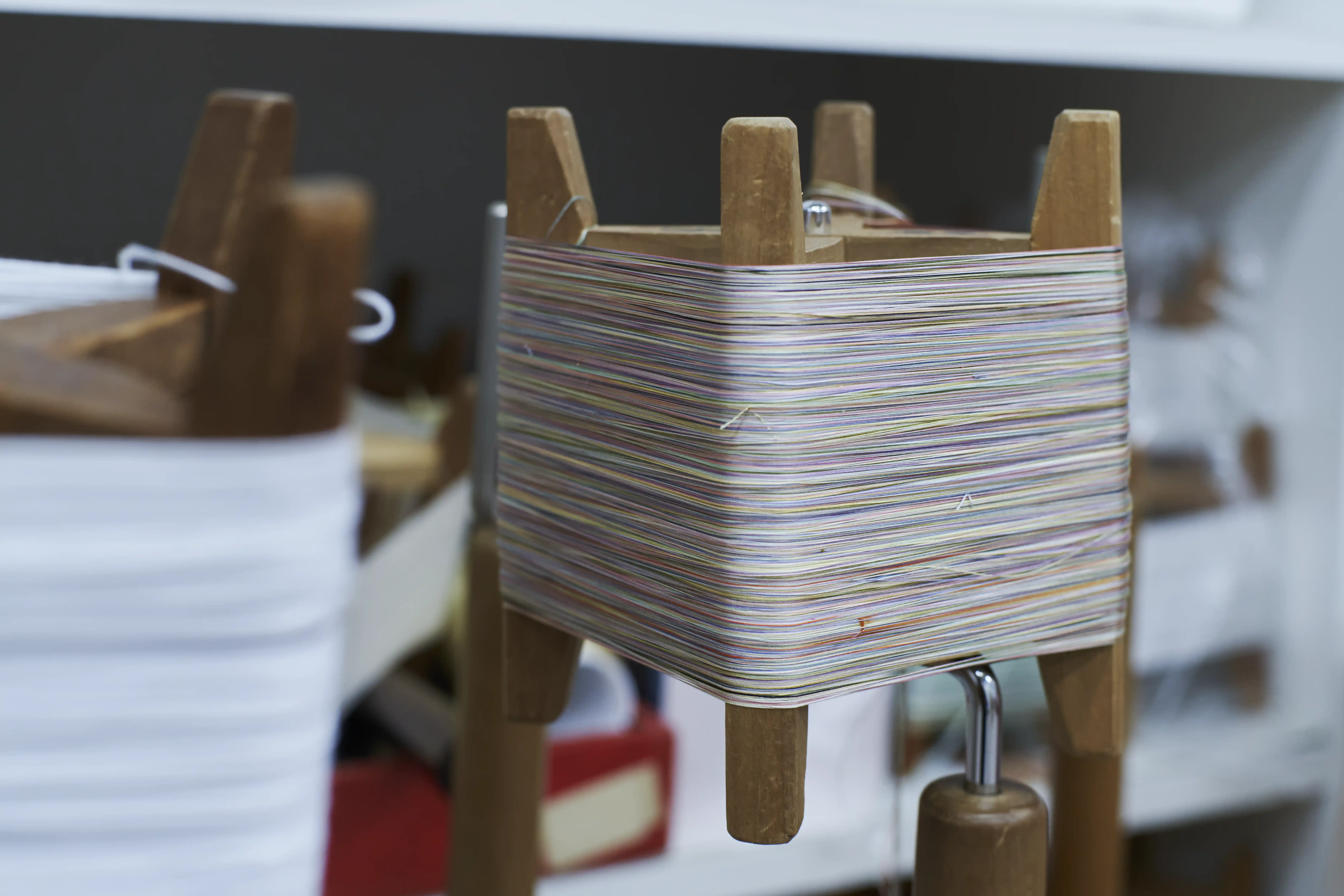
Domyo: Japanese Kumihimo is made mainly all from silk, so from the cocoon, through the work of reeling, it is made into raw silk. That raw silk is put through a process called scouring — scouring is the process of washing away the stiff substance on the thread called sericin, to make a supple, lustrous thread. The scoured thread enters the work of twisting the thread, applying twist, and depending on the manner of twisting, the thickness and degree of luster change, so various threads can be made. The first process is dyeing: the thread is made up into bundled skeins, and it is dyed, compared against a sample, until it matches exactly. The finished thread is set on a wooden reel called a kowaku, and from there comes the work called hekiri — bundling the thread according to the number of strands to be wound onto each individual weight. This is carried to the artisan, set on the stand, and only then comes the work of braiding the Kumihimo. The braiding goes at a pace of roughly one cord a day to one cord in two days, moving the threads through a fixed sequence to braid the cord little by little.
Toguri: When you plan a new piece, how do you usually decide on it?
Domyo: We make a little over a hundred new pieces a year, and in the main series we set a single theme — for instance, turning the pattern of a Japanese National Treasure into Kumihimo, or taking the colors and design of a European textile into Kumihimo, or Persian art — taking works of art, crafts, and paintings from Japan and abroad as motifs, and bringing their coloring and the feel of their patterns down into the cord. We often make such Kumihimo into a series and release it.
Toguri: Could you tell us again about the characteristics of, and your commitment to, hand-braiding and hand-dyeing?
Domyo: The advantage of hand-dyeing is that you can dye many colors in small amounts each. In a large factory, an enormous quantity of thread is dyed with all the dye put in at the start, and while that can bring the color close to a target to some degree, no fine adjustment is possible afterward. It is a single decisive attempt. Because the amount of thread we use for obi-jime is small, by dyeing that small amount into as many colors as possible we can make beautifully colored Kumihimo exactly as intended. That is the merit of hand-dyeing. I think we dye three to four thousand colors a year. As for hand-braiding: a machine keeps pulling the weights continuously and braids at a uniform tension, so no elasticity emerges, but in hand-braiding you can weaken or strengthen the force partway through the braiding, so you can make a braid with elasticity and with fūai — the tactile character and texture that emerges only through adjustment by hand. Further, there are many braiding methods possible only by hand: ways of switching the pattern partway through, or the technique called dan-zome, a Japanese technique of dyeing a single strand of thread in varying colors along its length.
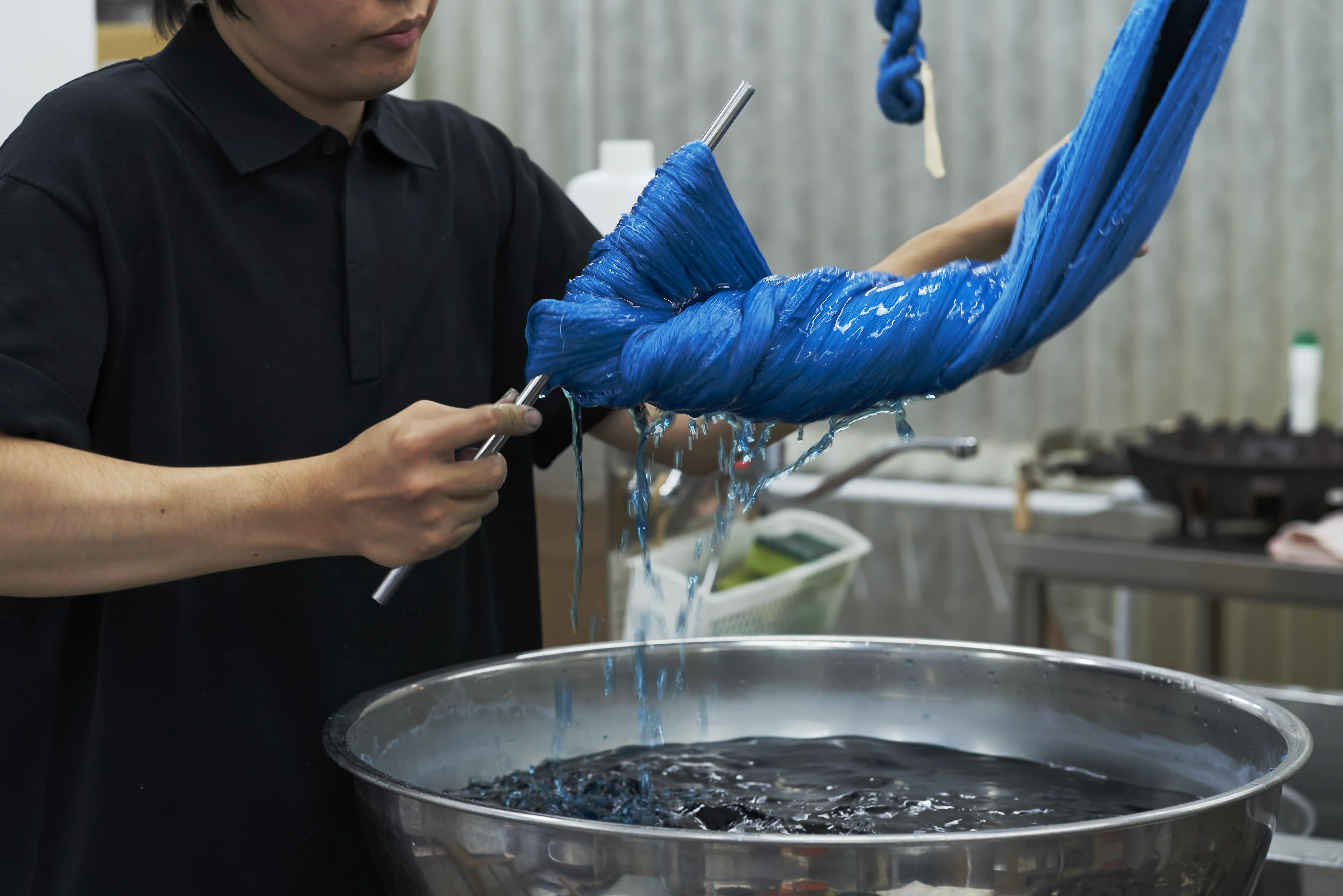
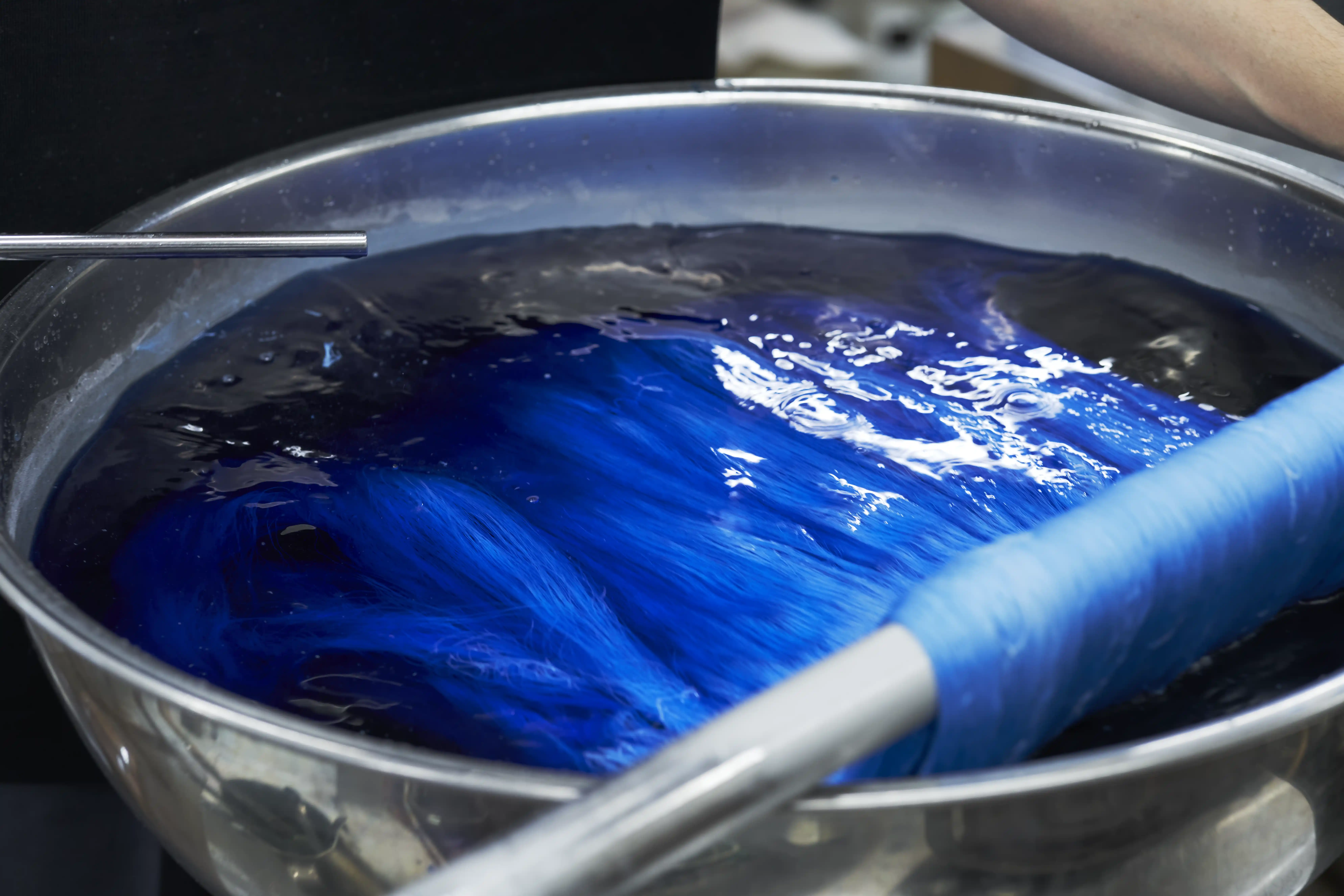
Listening to each process, one comes to see that Domyo's work is supported by not finishing in a single attempt. Both the dyeing and the braiding are structured to always allow fine adjustment. It is the very opposite of efficiency, but that inefficiency is surely what produces a depth of color and a fūai found nowhere else.
The sixth-generation head's decision to refuse mechanization was not mere nostalgia but, one understands once one has heard this far, a choice made in order not to let go of this "adjustability." Technique may dwell not only in precision, but within the room left for hesitation and wavering. From here, we asked more deeply about the tools and materials that support this handwork.
Toguri: In the work of tamatsuke, what specifically is difficult?
Domyo: The work of tamatsuke — the thread-setting process of arranging the silk threads onto the weighted bobbins before braiding — is the process of setting the threads neatly on the stand, and if that is decided neatly, the braiding that follows becomes easier too. Threads are used that have been divided up so as to be easy to separate, by the number of strands to be set on each thread bobbin, and when you separate the threads relying on that, if you put in too much force it can gradually become tangled partway, so this is quite a place where experience speaks. With a Kumihimo whose thread color changes partway through, pulling oddly during tamatsuke will shift the pattern, so you set the tama while paying the closest attention that the pattern not shift.
Toguri: Could you tell us about the characteristics of your company's representative works?
Domyo: Patterns we have kept making for decades — among them patterns that have been made since a hundred years ago, when the Kumihimo obi-jime first appeared — we call these Domyo's signature patterns. Among them there is a series of obi-jime called "Miidera series," which takes in the design of a scroll handed down at Miidera, a temple in Shiga. While taking in traditional, historical cord designs, we replace the colors in various ways to make them easier to use as obi-jime. They are easy to match with many kinds of obi and yet have a presence that does not disappear into them — such are their characteristics. Besides those, among the Marudai pieces there is the dan-zome "Nara-gumi Four-Color Dan" series, which contains both cool and warm colors and is easy to match with various obi.
Toguri: We would also like to ask about tools and materials. What sort of presence do the Marudai and Takadai have for the artisans?
Domyo: There is one stand per Kumihimo artisan. It is highly personal — like one's own partner. It is not some large machine; among the tools of the various crafts, it is truly the kind of thing that becomes one with the hand. If anything, the braiding stand is a place to set the threads; what actually moves is the hand. You set the threads on the stand and move what is to be moved — it is more like a place to set things. The stand is passed on to the next generation, too, but the tama around which the thread is wound wear down, so after thirty or forty years the grooves diminish and they can no longer be used. The stand lasts longer, but even so about a hundred years, I think. It takes on the oil of the hands, turns an amber color, and grows very beautiful.
Toguri: Could you also tell us about how you select thread, and your commitment to materials?
Domyo: The thread we mainly use is made by combining four strands of what is called "21-naka" thread and applying a lower twist, then combining three of those and applying an upper twist; usually a lower twist is applied by combining two, so this takes more effort than usual. In return, a very firm and beautiful Kumihimo results. Domestic silk thread has now become so hard to obtain that it makes up only about 0.05% of the total used, but we use both domestic and foreign thread, and with domestic thread alone our company uses about 2% of Japan's entire production volume. Japanese thread — because the water there has high transparency, the raw silk made from it is said to have high whiteness — so when dyeing white or pale colors, we make them using domestic thread.
That a single company bears 2% of the domestic silk-thread production volume is not merely a matter of procurement quantity. Amid a reality in which the country's silk-reeling industry is already in a devastated state, with only a single surviving company, Domyo — by the very act of continuing to use that thread — has also come to stand on the side that supports the culture of thread.
Tools, and thread — for this company they seem to be at once "objects to use" and "objects to protect." If one pursued efficiency alone, there would be the option of switching to foreign thread; but in not doing so, this person's consistent stance shows. What we wanted to ask next was what those who take up this technique and these tools for the first time experience.
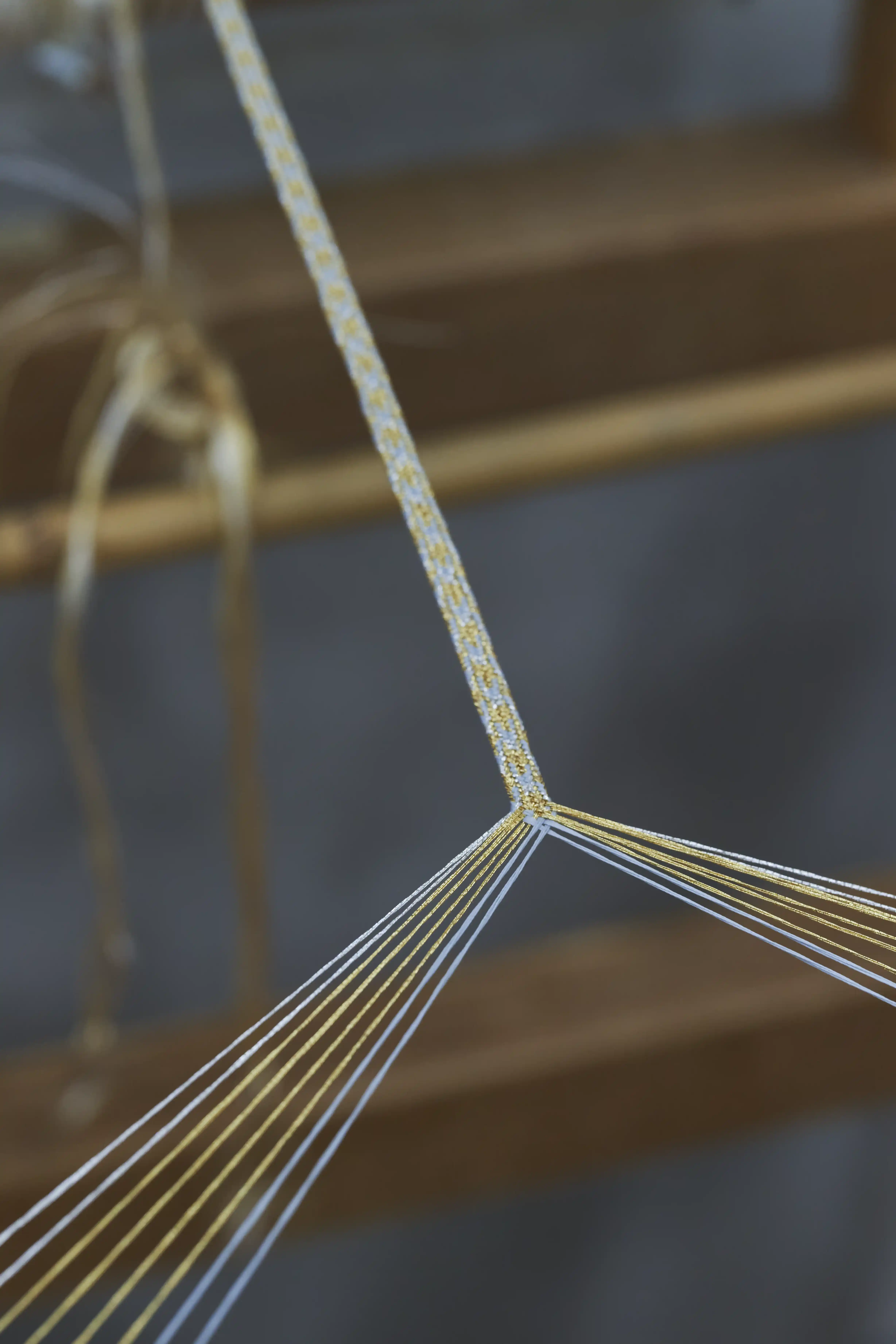
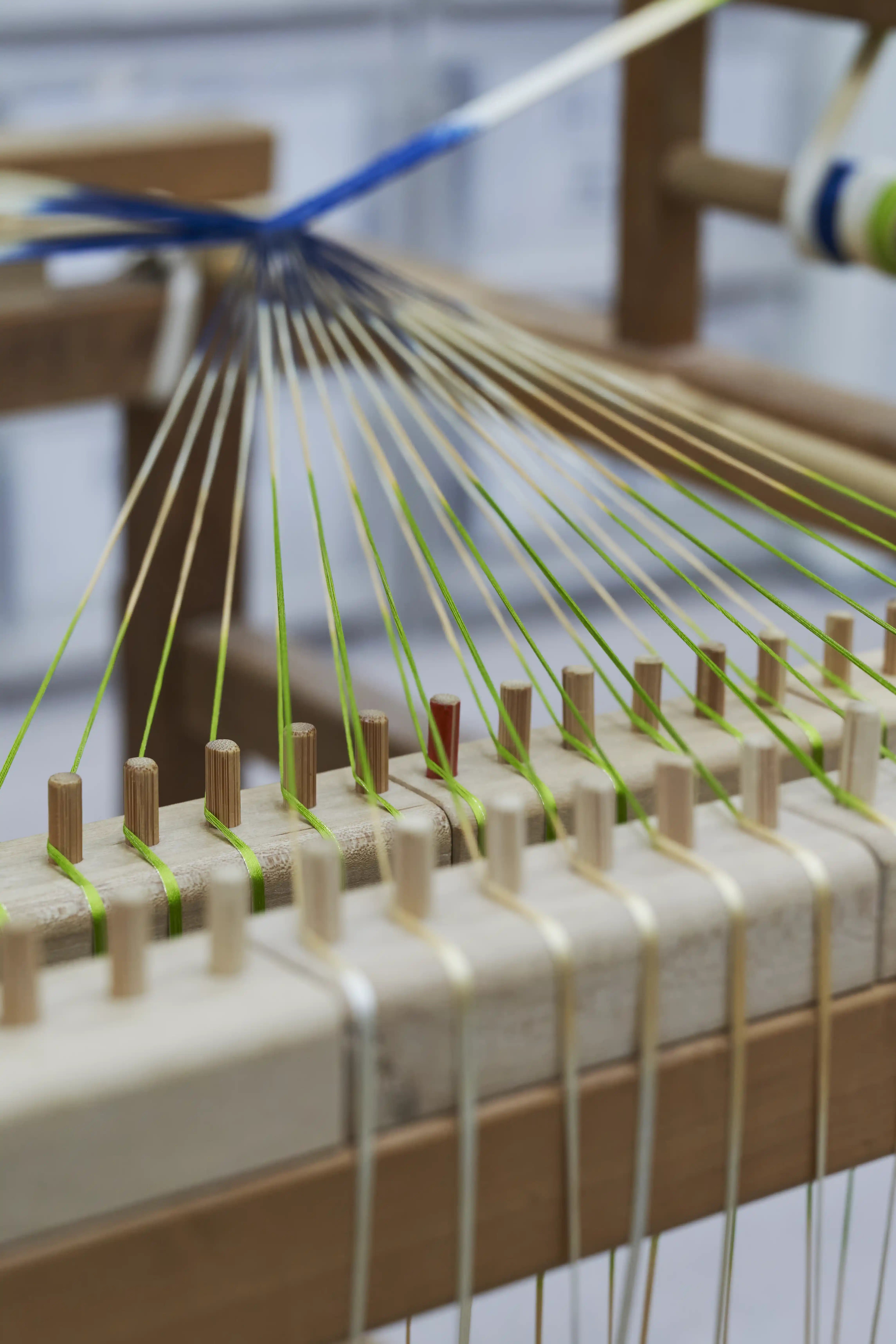
Led by the Sound of the Beads — The Doorway of the Kumihimo Experience
At Domyo, anyone who is not an artisan can actually sit before a braiding stand and braid thread. We asked about this doorway, which one can begin without specialist knowledge.
Toguri: Could you give us an overview of your most representative hands-on experience?
Domyo: The most representative of the Kumihimo experiences we offer has you braid, using the Marudai, a historical method called Nara-gumi, many examples of which remain in the Shosoin. What you make using that Nara-gumi is then worked into various things — a bracelet, a strap, and so on — to take home. In the basic course we use the Marudai, with Nara-gumi and a method called Yatsu-gumi, both very old braiding methods that are easy to braid even for first-timers.
Toguri: What kind of people, feeling what, would you like to have come?
Domyo: Since you braid using the tools the artisans currently use and real silk thread, I would like people who enjoy such things by the actual feel of them, who can sense the beauty of the silk thread's coloring — people who like color and such — to come. And once you have learned a fixed sequence and braid the cord while repeating it many times, you gradually become able to braid in a state of mushin — a state of selfless, unforced focus. So I would very much like those who want time to steadily build something up and lose themselves in it to come.
Toguri: Through the experience, what kind of interiority would you like people to take in?
Domyo: For most people the first fifteen minutes or so are hard — remembering the sequence, and struggling a little with whether it turns right or left — but as you go on, failing many times, the hands gradually remember the method. Then partway through you become able to braid in mushin. Listening to the karan-karan sound of the tama striking the legs of the stand, braiding in mushin, before you know it the Kumihimo has grown downward. You can feel that; and I think many people spend busy days using their heads a great deal, and to braid Kumihimo in mushin amid that is like sitting zazen — seated Zen meditation — at a temple: the body is moving, yet the mind comes into a very settled state.
He used the word "mushin" many times. But it does not, he says, refer to a state of thinking nothing. At first you desperately memorize the sequence, err again and again, and accumulate trial and error. Only beyond that does the state finally arrive — seemingly not thinking, yet thinking. This is the very interiority at the depth of the craft of Kumihimo, and at the same time it sounded as though it overlapped with his own experience of moving from architecture to Kumihimo.
Going back and forth between different fields, one arrives at last at a sensation that only the hands know. What the people who visit the experience find beyond fifteen minutes of struggle may perhaps be of the same kind as what he himself found after inheriting this family business. Last, we asked why he continues this experience.
— the body is moving, yet the mind comes into a very settled state."
— Kiichiro Domyo
Toguri: Given that it takes both labor cost and time, why do you continue offering the Kumihimo experience?
Domyo: The Kumihimo experience — not only Kumihimo, but the wisdom of predecessors held within Japanese crafts, the fact that making by moving the hands takes a great deal of time, that it cannot be made all at once by machine but only little by little, that the feel of the tools and the sense of the materials are so pleasant — I want people to know that background, which cannot be seen by looking only at the finished product. Even buying the same thing, if you buy it knowing such things, you feel that much more attachment to it and understand that it is something good. I think chances to touch such material sensations, such real things, have decreased in modern life, and so I have the wish to bring them back into daily life, to have many people taste them.
Toguri: What do you think Kumihimo is, for Japan? Could you give us a message to close?
Domyo: Kumihimo is, I think, a craft in which many Japanese things are densely packed — the dexterity of Japanese hands, a certain interiority, an awareness of the land's climate and natural features. So it may be a craft quite unique to Japan. I want to make such things known to the world as well: to keep exploring the history, and also to keep making new things. To make things for Japanese dress and for Western dress; through the Kumihimo classes, to broaden the base; for guests who come to Japan from abroad, through the Kumihimo experience, to have them know not only the technique but Japanese culture. And beyond the finished product, to have Kumihimo used as a material supply for various industries. With the technique of Kumihimo at the core, while running various businesses, I want, going forward, to do more of the kind of activity that builds not just a business but a cultural sphere centered on Kumihimo.
Closing
A single cord is bundled together from the technique that crossed the sea in the sixth century, the memory of handwork that has put down roots in this land for three hundred years, and the life of one person who one day suddenly changed his path from architect to manager. Throughout the interview, in his words there was always an awareness of both digging into the past and opening toward the future. These are not opposed; they are perhaps like the two ends of a single thread.
The wavering of tension that a machine would smooth away in an instant, Domyo still entrusts to the human hand. There is a fūai born only by letting go of efficiency, and a beauty that can be reached only by leaving room for hesitation and adjustment. It may be the quiet paradox held within the very act of inheriting something over time.
Within the dry sound of tama touching, only the time of moving the hands in mushin goes on quietly tying together the two ends of the thread — past and future. Within that quiet continuance, I felt, lies the essence of this craft.